Turmeric Root
Turmeric root is the fresh, underground rhizome of Curcuma longa, the plant best known for producing turmeric spice. This form of turmeric has a bright orange-yellow colour, an earthy aroma and a warm, slightly bitter flavour. Fresh turmeric root can be peeled, grated, sliced or blended and used in cooking, drinks and other food preparations.
Although it is commonly called a “root”, turmeric is botanically a rhizome, which is an underground stem. The dried rhizome is processed into the familiar turmeric powder and can also be used to produce turmeric extracts and curcumin supplements.
Turmeric root at a glance
- Botanical name: Curcuma longa
- What it is: A fresh rhizome from the ginger family
- Appearance: Knobbly, brown-skinned exterior with vivid yellow-orange flesh
- Flavour: Earthy, warm, slightly bitter and peppery
- Main natural compounds: Curcumin (Curcuminoids), volatile oils and other plant compounds
- Common uses: Cooking, curries, soups, sauces, smoothies and teas
- Turmeric root vs powder: Root is fresh and moist; powder is dried and ground
- Important distinction: Fresh turmeric is a food ingredient and should not be confused with concentrated curcumin supplements
Fresh Turmeric Root
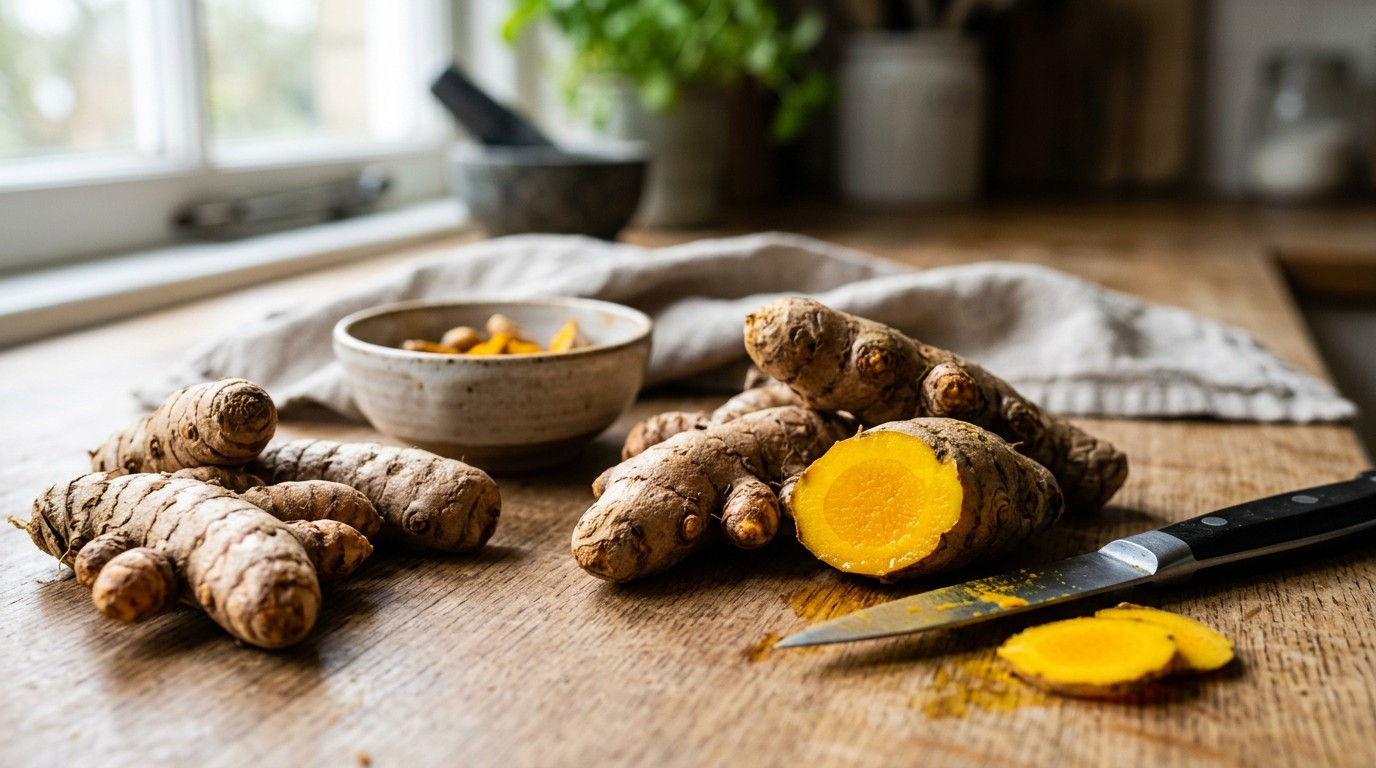
Fresh turmeric root, showing the brown outer skin and bright yellow-orange flesh.
Table of Contents
- What is turmeric root?
- Is turmeric root really a root?
- What does fresh turmeric root look and taste like?
- Turmeric root vs turmeric powder
- How to use turmeric root
- What are the potential advantages?
- What are the disadvantages?
- What does scientific research say?
- How to store turmeric root
- Frequently asked questions
- Summary
- Further Reading and Related Information
- Sources
- Medical disclaimer
What is turmeric root?
Turmeric root usually refers to the fresh rhizome of Curcuma longa, a perennial plant in the Zingiberaceae family, which also includes ginger. This form of turmeric has been cultivated and used in South Asia and other parts of Asia for centuries, and turmeric has a long history as a culinary ingredient, colouring agent and traditional herbal preparation.
The rhizome is the part of the plant that grows underground. It develops into a central section with smaller branches and is harvested when mature. Once cleaned, fresh turmeric can be sold as a whole rhizome. It can then be dried and ground to make turmeric powder or processed into other turmeric preparations.
The characteristic yellow-orange colour comes largely from curcuminoids, a group of naturally occurring polyphenolic compounds that includes curcumin. Turmeric also contains volatile oils and other plant constituents, so fresh turmeric is chemically more complex than simply being a source of isolated curcumin.
Is turmeric root really a root?
Not technically.
The part commonly called turmeric root is a rhizome, which is a modified underground stem. The terminology can be confusing because “turmeric root” is the everyday name used by consumers, retailers and many websites.
For practical purposes, searching for “fresh turmeric root” generally means looking for the fresh Curcuma longa rhizome.
This distinction can be useful when comparing turmeric with other turmeric products because different products may be made from different parts of Curcuma species or may undergo substantially different processing.
What does fresh turmeric root look and taste like?
Fresh turmeric root normally has a thin, brownish skin surrounding vivid yellow or orange flesh. The rhizomes can resemble small pieces of ginger, although turmeric tends to have a more intense colour.
Its flavour is earthy, warm and slightly bitter, with a mild peppery character. Fresh turmeric also has a distinctive aroma from its natural volatile oils.
The colour is particularly noticeable when turmeric is grated or cut, and it can stain fingers, chopping boards, utensils and fabrics yellow-orange.
Turmeric root vs turmeric powder
Fresh turmeric root and turmeric powder originate from the same plant but are different forms of turmeric.
| Feature | Turmeric root | Turmeric powder |
| Form | Fresh rhizome | Dried and ground rhizome |
| Water content | High | Very low |
| Flavour | Fresh, earthy and aromatic | More concentrated and earthy |
| Texture | Firm and juicy | Fine powder |
| Preparation | Peel, grate, slice or blend | Ready to measure and use |
| Storage | Requires refrigeration for longer storage | Generally easier to store |
| Typical use | Fresh dishes, drinks and pastes | Curries, sauces, baking and seasoning |
Turmeric Root vs Turmeric Powder
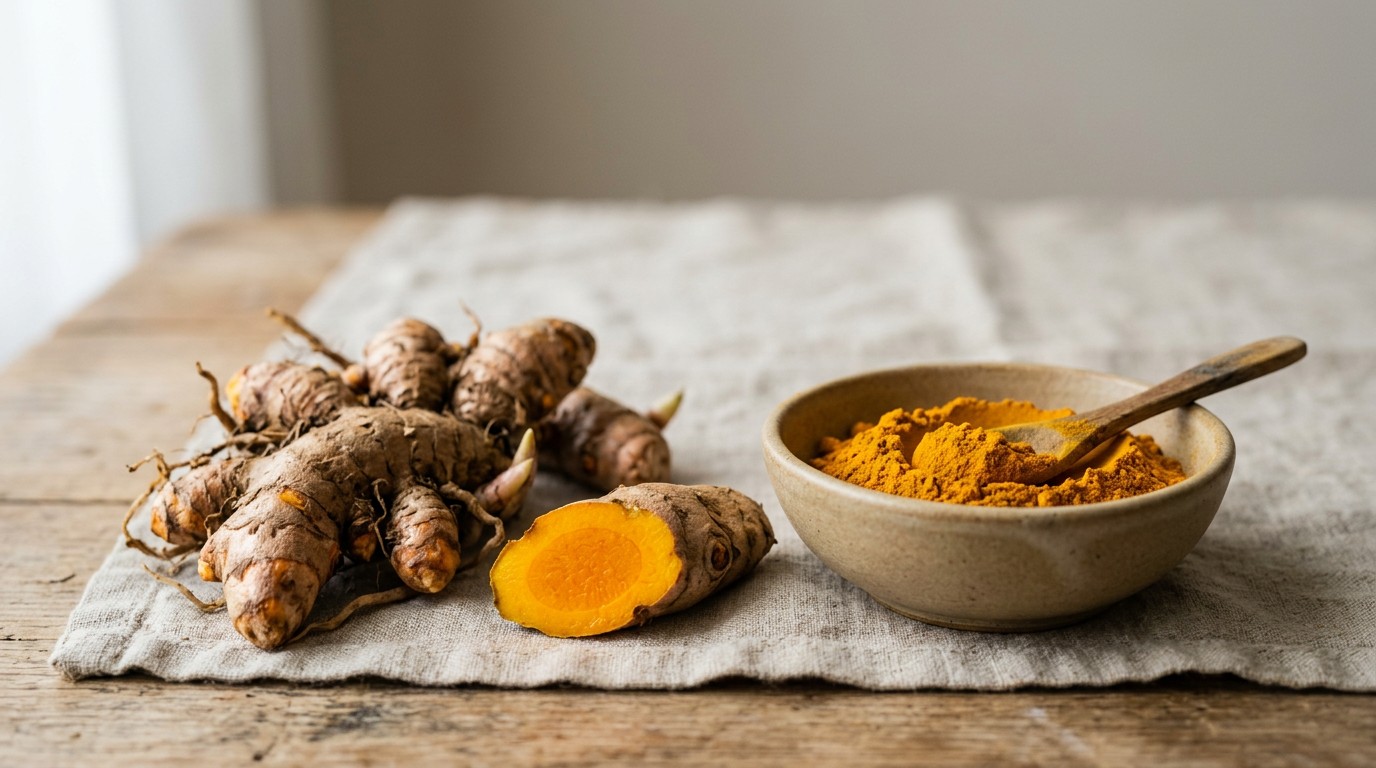
Fresh turmeric root alongside turmeric powder made from dried turmeric rhizomes.
One important point is that fresh turmeric is not automatically a stronger or more effective form of turmeric. The chemical composition can vary according to variety, growing conditions, maturity, storage and processing.
Curcumin itself also has relatively low oral bioavailability, meaning that the amount consumed does not directly indicate how much reaches the bloodstream. This is one reason why concentrated or specially formulated curcumin products cannot be directly compared with ordinary culinary turmeric.
How to use turmeric root
Fresh turmeric root is primarily used as a food ingredient.
Before using it, rinse the rhizome and remove any visible dirt. The skin can be peeled with a small knife or vegetable peeler, although peeling is not always necessary if the root has been thoroughly cleaned.
You can then:
- Grate it into curries, soups, sauces or marinades.
- Slice it into stir-fries or cooked dishes.
- Blend it into smoothies or homemade drinks.
- Finely chop it with ginger, garlic and other aromatics.
- Cook it alongside vegetables, rice, pulses or meat.
- Use it in a turmeric paste for culinary recipes.
Start with a modest amount if you are unfamiliar with fresh turmeric because its flavour and colour can be considerably more noticeable than expected.
It is also worth remembering that turmeric used as a normal food ingredient is different from a high-dose turmeric or curcumin supplement. Research into concentrated preparations cannot automatically be applied to ordinary culinary quantities.
How to Use Fresh Turmeric Root
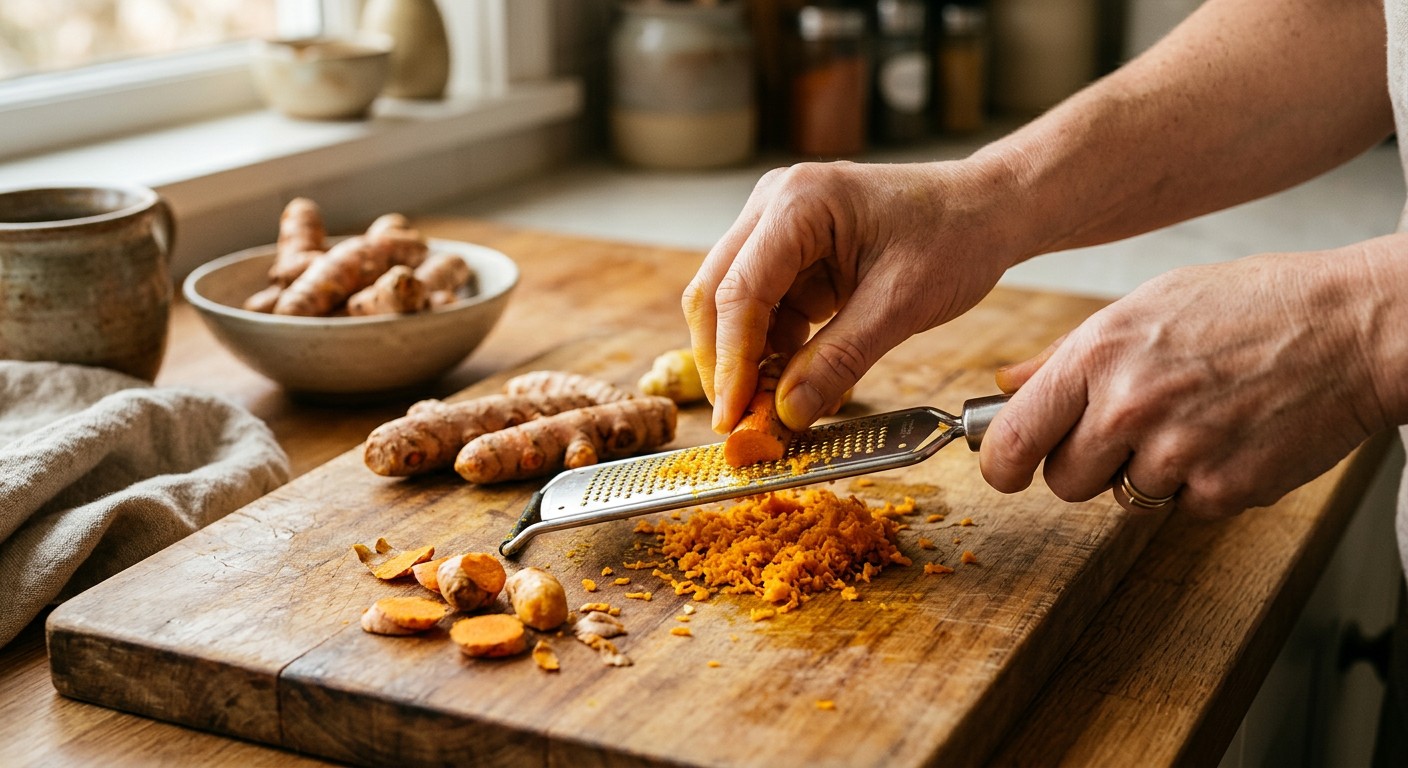
Fresh turmeric root being washed, peeled and grated for cooking.
Potential advantages of turmeric root
1. It is a minimally processed form of turmeric
Fresh turmeric root is close to the original plant material. Unlike a highly concentrated extract, it has not been reduced to a single principal compound.
2. It provides turmeric’s natural mixture of plant compounds
Turmeric contains curcuminoids as well as volatile oils and other constituents. Research has investigated these compounds for antioxidant and anti-inflammatory activities, although laboratory findings should not be interpreted as proof that eating turmeric treats a medical condition.
3. It is versatile in everyday cooking
Fresh turmeric can be grated, sliced, blended or cooked and incorporated into ordinary meals and drinks. This makes it an accessible way to use turmeric as a culinary ingredient without necessarily taking a concentrated supplement.
Disadvantages of turmeric root
1. It is less convenient than powder
Fresh turmeric is perishable, needs preparation and can stain kitchen surfaces. Turmeric powder is generally easier to measure, store and use.
2. Its active compound content is variable
The amount and composition of curcuminoids can vary between turmeric sources and forms. Fresh root therefore does not provide the same standardised amount of curcumin that may be specified on a formulated supplement.
What does scientific research say about turmeric root?
Turmeric and curcumin have been extensively studied, but it is important to separate research on whole turmeric, turmeric extracts and isolated or formulated curcumin.
Laboratory and clinical research has investigated turmeric and curcumin in relation to inflammation, oxidative stress and several areas of health. Some systematic reviews and meta-analyses report potentially beneficial effects for particular outcomes, including aspects of musculoskeletal health. However, the quality and certainty of evidence varies considerably between conditions and studies.
For example, a systematic review and meta-analysis of randomised clinical trials found evidence of effects for some musculoskeletal outcomes, but the authors also noted the need for further research.
A separate analysis of 103 randomised controlled trials involving curcumin found statistically significant effects for some measured outcomes, while rating the evidence for many others as low or very low certainty. The researchers concluded that larger and better-designed long-term trials are still needed.
Another important issue is bioavailability. Curcumin has poor absorption and is rapidly metabolised, which has led researchers to investigate formulations designed to increase bioavailability, such as black pepper. Consequently, results from a study using a specialised curcumin formulation should not automatically be attributed to fresh turmeric root.
For a neutral interpretation, turmeric root is best viewed primarily as a traditional food and culinary ingredient with interesting bioactive compounds, rather than as a proven treatment for disease.
Curcuma Longa Turmeric Rhizome
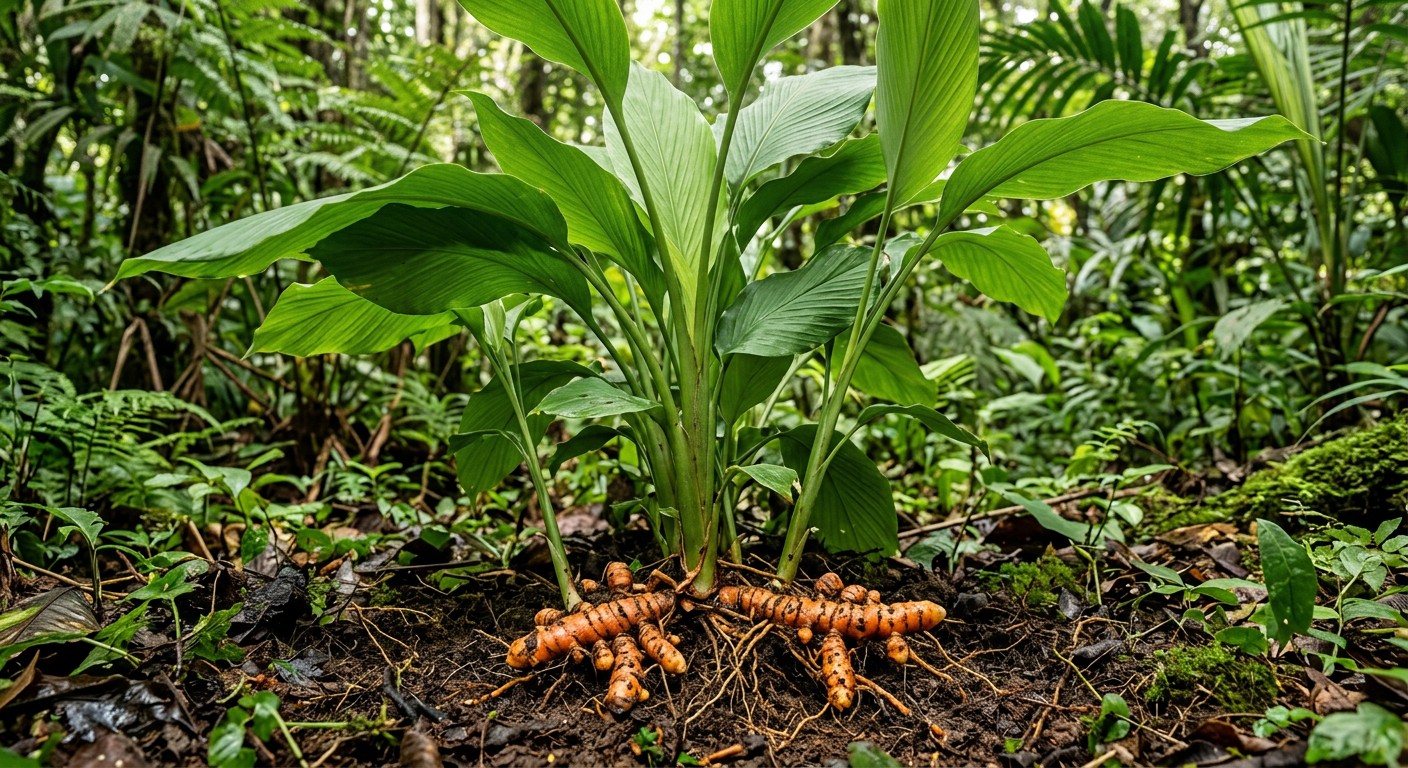
The turmeric rhizome of Curcuma longa, the part commonly known as turmeric root.
How to store turmeric root
Fresh turmeric root is perishable. Keep it clean and dry and store it in the refrigerator according to the storage guidance provided with the product.
Look for firm rhizomes without obvious mould, excessive softness or unpleasant odours. If you have more turmeric than you can use promptly, freezing is another practical option; frozen turmeric can be grated or chopped while still firm.
Because turmeric stains easily, handle it carefully and wash preparation surfaces promptly.
Frequently asked questions
What is turmeric root?
Turmeric root is the common name for the fresh rhizome of Curcuma longa. It is the underground part of the turmeric plant used as a culinary ingredient and as the raw material for products such as turmeric powder.
Is turmeric root the same as turmeric powder?
They come from the same plant but are different forms. Turmeric powder is made by drying and grinding turmeric rhizomes, whereas turmeric root normally refers to the fresh rhizome.
Can you eat fresh turmeric root?
Yes. Fresh turmeric can be used as a food ingredient. It can be peeled, grated, sliced or blended and added to cooked dishes, drinks and other recipes.
Does fresh turmeric root contain curcumin?
Yes. Turmeric rhizomes naturally contain curcuminoids, including curcumin. However, the amount can vary depending on factors such as the plant material, growing conditions and processing.
Is turmeric root better than turmeric powder?
Neither form is universally “better”. Fresh turmeric offers a fresh flavour and texture, while powder is more convenient and has a longer shelf life. The best choice depends on how you intend to use turmeric.
Is turmeric root safe?
Turmeric used as a food is generally considered safe for most people. Higher amounts or concentrated preparations can have side effects, including digestive symptoms, and turmeric or curcumin products may not be appropriate for everyone. Anyone considering curcumin or turmeric supplements should discuss them with a doctor or other qualified healthcare professional, particularly if they take medicines or have an existing medical condition.
Final summary
Turmeric root is the fresh rhizome of Curcuma longa and is the starting material for familiar products such as turmeric powder. Although commonly called a root, it is botanically a rhizome.
Fresh turmeric has a distinctive yellow-orange colour and earthy flavour and can be used in a wide range of everyday recipes. Compared with turmeric powder, it is less convenient and more perishable, but it provides turmeric in a minimally processed, whole-food form.
Scientific research into turmeric and its best-known compound, curcumin, is extensive but should be interpreted carefully. Evidence varies by health outcome, and research involving concentrated curcumin preparations does not necessarily demonstrate the same effects from eating fresh turmeric root.
For most readers, the simplest way to think about turmeric root is as a versatile culinary ingredient with an interesting natural chemical profile, rather than as a substitute for medical treatment.
Ways to Use Turmeric Root in Cooking
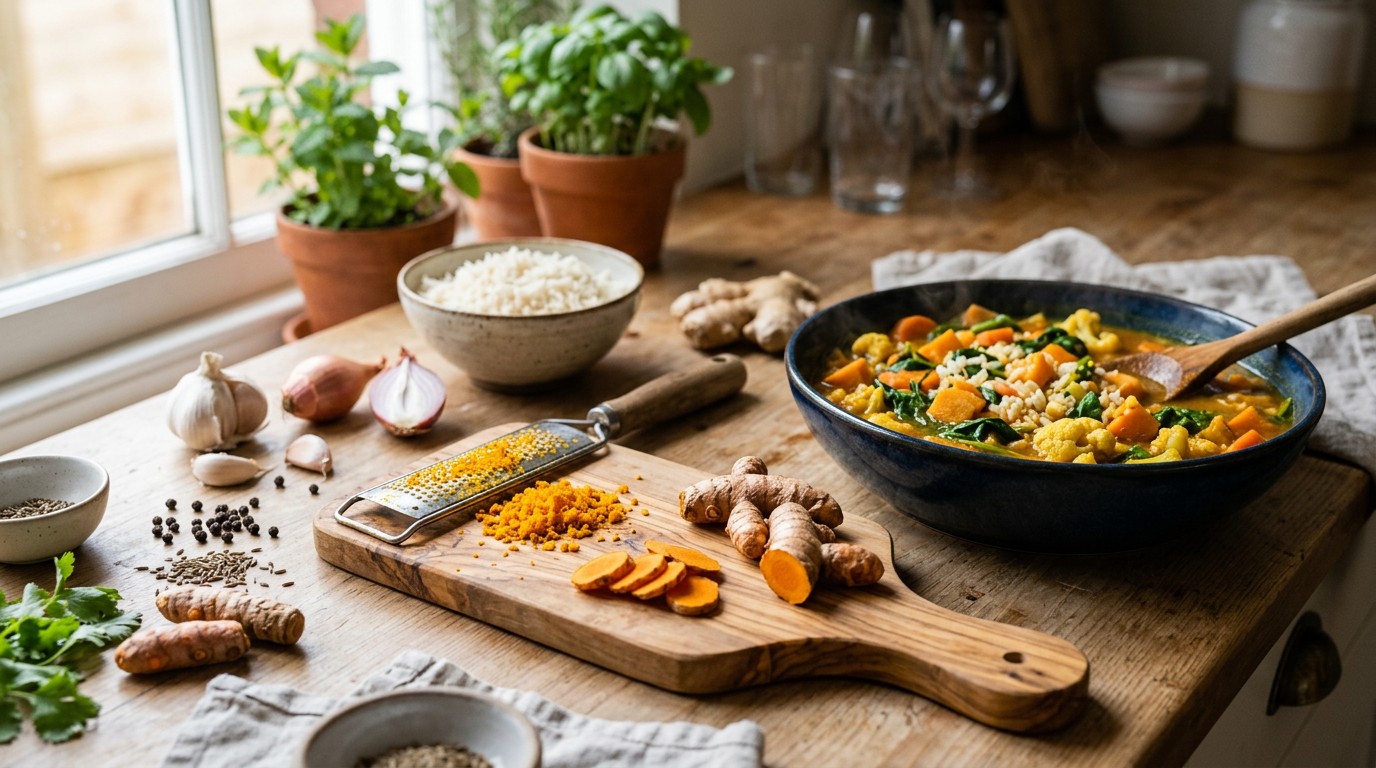
Fresh turmeric root used as an ingredient in a colourful homemade meal.
Further Reading, Information and Related Information
1. Should You Take Turmeric Every Day? Here’s What Doctors Say
2. Turmeric: Usefulness and Safety
Brief description: A comprehensive evidence-based guide covering turmeric, also known as turmeric root, its botanical name Curcuma longa, traditional uses, curcumin, current scientific evidence, safety and potential side effects. The page also explains that the part commonly called the root is technically a rhizome, or underground stem.
Published by: National Center for Complementary and Integrative Health (NCCIH), National Institutes of Health (NIH).
Direct URL: Turmeric: Usefulness and Safety — NCCIH
3. Turmeric Health Benefits and Side Effects
Brief description: A medically reviewed guide explaining what turmeric is, where it comes from, its flavour and culinary uses, fresh turmeric root, turmeric powder and curcumin. It also discusses potential health effects and safety considerations.
Published by: Cleveland Clinic.
Read article: Turmeric Health Benefits and Side Effects — Cleveland Clinic
4. Nutritional Approaches for Musculoskeletal Pain and Inflammation
Brief description: An evidence-focused guide that includes turmeric (Curcuma longa) and discusses the scientific evidence surrounding curcumin’s potential anti-inflammatory properties. It provides a balanced assessment rather than presenting turmeric as a proven treatment.
Published by: National Center for Complementary and Integrative Health (NCCIH), National Institutes of Health (NIH).
Read article: Nutritional Approaches for Musculoskeletal Pain and Inflammation — NCCIH
5. Nutritional Approaches for Musculoskeletal Pain: What the Science Says
Brief description: A detailed scientific overview of nutritional and complementary approaches for musculoskeletal pain, including a section on turmeric and curcumin. It discusses the available evidence and notes that there is currently insufficient evidence to support turmeric supplementation for inflammatory disorders generally.
Published by: National Center for Complementary and Integrative Health (NCCIH), National Institutes of Health (NIH).
Read article: Nutritional Approaches for Musculoskeletal Pain: What the Science Says — NCCIH
Sources
- National Center for Complementary and Integrative Health (NCCIH), Nutritional Approaches for Musculoskeletal Pain: What the Science Says — evidence and safety information concerning turmeric and related dietary ingredients.
- Bučević Popović et al., Bioavailability of Oral Curcumin in Systematic Reviews: A Methodological Study, Pharmaceuticals, 2024 — research concerning the importance of bioavailability when interpreting curcumin evidence.
- Curcuma Longa (turmeric): from traditional applications to modern plant medicine research hotspots — review of the botany, traditional applications, phytochemistry and clinical research surrounding Curcuma longa.
- Turmeric (Curcuma longa) and its major constituent (curcumin) as nontoxic and safe substances: Review — review of safety and toxicity evidence.
- Safety and Efficacy of Turmeric (Curcuma longa) Extract and Curcumin Supplements in Musculoskeletal Health: A Systematic Review and Meta-Analysis — systematic review and meta-analysis of randomised clinical trials.
- A Comprehensive Review on the Therapeutic Potential of Curcuma longa Linn. in Relation to its Major Active Constituent Curcumin — review covering turmeric’s constituents, traditional uses and research evidence.
- Sources, morphology, phytochemistry, pharmacology of Curcumae Longae Rhizoma, Curcumae Radix, and Curcumae Rhizoma: a review of the literature — useful botanical and nomenclature context concerning Curcuma rhizomes and roots.
- Curcumin on Human Health: A Comprehensive Systematic Review and Meta-Analysis of 103 Randomized Controlled Trials — large systematic review and meta-analysis assessing clinical evidence for curcumin.
- Bioavailable curcumin formulations: A review of pharmacokinetic studies in healthy volunteers — review explaining differences in bioavailability between conventional and formulated curcumin.
Editorial note: The evidence above has been used to keep the page informational. Findings about isolated curcumin, concentrated turmeric extracts or specialised formulations should not be presented as direct evidence that fresh turmeric root treats or prevents disease.
Medical disclaimer
This page is provided for general information and educational purposes only. It is not medical advice, does not diagnose or treat any illness and should not be used as a substitute for advice from a qualified medical professional.
Turmeric, curcumin and other turmeric preparations may not be suitable for everyone and may interact with medicines or be inappropriate in certain circumstances. Always consult your doctor or another qualified healthcare professional before taking turmeric or curcumin as a supplement, particularly if you have a medical condition, take prescription medicines, are pregnant or breastfeeding, or are considering using turmeric for a specific health problem.
Author
Written by J. Henderson
Health & Wellness Research Writer
J. Henderson writes evidence-based articles on nutrition, botanical supplements and everyday wellbeing. His work focuses on translating scientific research into clear, practical guidance that helps readers make informed decisions about natural health products.