Turmeric vs Ashwagandha: Which Supplement Is Best?
Introduction
Turmeric and ashwagandha are popular herbal supplements, but they are traditionally used for different reasons. If you are comparing turmeric vs ashwagandha before buying a supplement, the better choice depends on what you want to use it for.
- Turmeric is best known for its curcumin content and is commonly chosen for general wellbeing and support around inflammation.
- Ashwagandha is an adaptogenic herb traditionally used for stress, relaxation and general resilience.
- Turmeric and ashwagandha are not direct substitutes because they have different active compounds and traditional uses.
- When choosing between them, consider your main goal, the product’s ingredients and dosage, and any medicines or health conditions that may affect suitability.
Quick answer: Choose turmeric if your main interest is curcumin and general inflammation-related support. Choose ashwagandha if your main interest is stress, relaxation and sleep-related wellbeing.
Turmeric vs Ashwagandha Comparison

Turmeric and ashwagandha are traditional herbal ingredients with different active compounds and areas of research.
Turmeric vs Ashwagandha: Quick Comparison
| Feature | Turmeric | Ashwagandha |
| Botanical name | Curcuma longa | Withania somnifera |
| Best known compounds | Curcuminoids, including curcumin | Withanolides |
| Traditional use | General health and wellbeing | Stress, relaxation and vitality |
| Common reason for taking it | Joint and inflammation-related wellbeing | Stress management and sleep support |
| Typical forms | Capsules, tablets, powders and extracts | Capsules, tablets, powders and extracts |
| Best suited to | People interested in curcumin-based supplements | People interested in adaptogenic herbs |
| Potential benefits | May support joint comfort and antioxidant activity | May support stress management and sleep |
| Stress support | Not a primary research area | Commonly researched for stress |
| Sleep support | Not primarily associated with sleep | Some preparations have been studied for sleep |
| Joint support | Commonly researched for joint symptoms | Not a primary research area |
| Possible side effects | Digestive discomfort; some concentrated products have been linked to liver injury | Digestive discomfort or drowsiness; rare liver injury reported |
| Are they interchangeable? | No | No |
| Overall focus | Joint and inflammation-related wellbeing | Stress, relaxation and sleep |
Turmeric (Curcumin) vs Boswellia (Indian Frankincense)
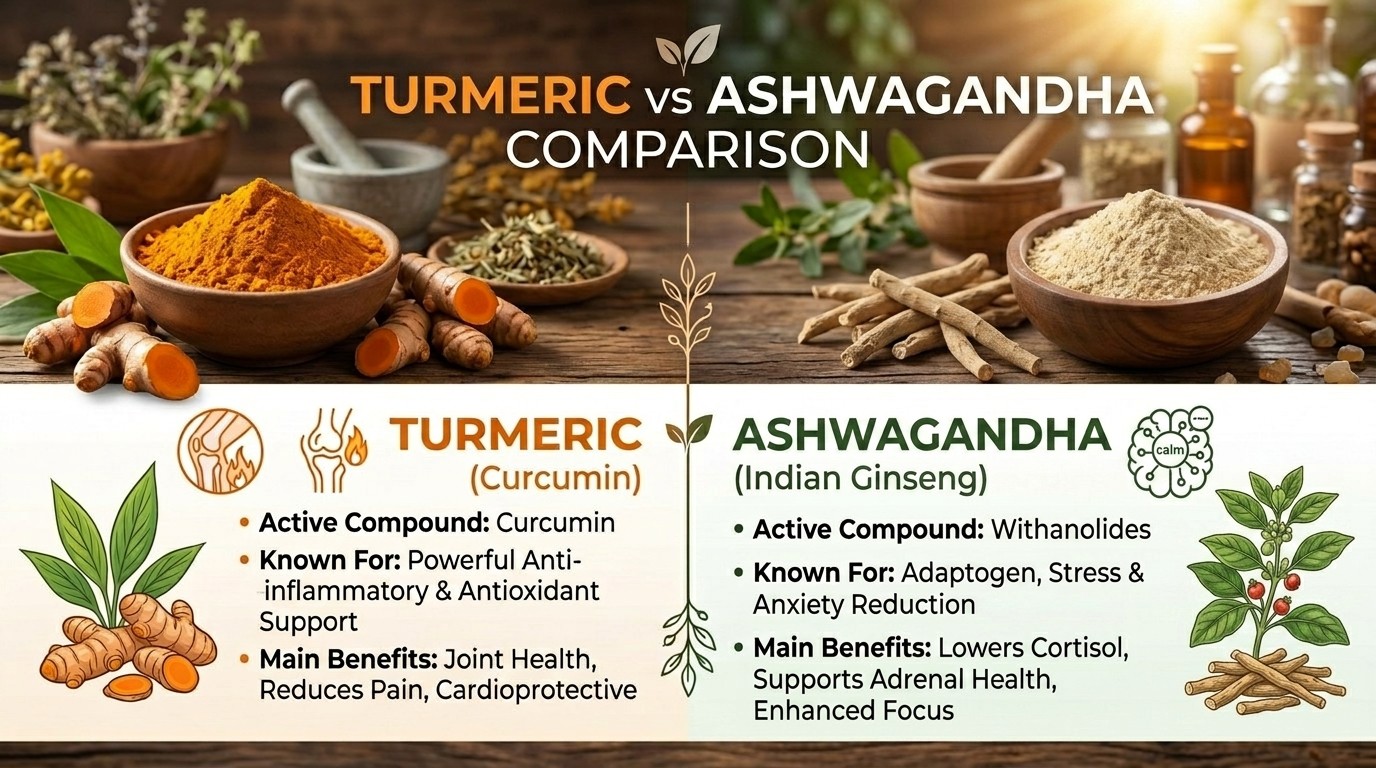
Turmeric’s active compound is Curcumin and Ashwagandha’s active compound are Withanolides.
Related Guides
Explore related turmeric guides:
- Turmeric Benefits — the wider picture of potential turmeric benefits.
- Turmeric vs Ginger — comparing two familiar plant ingredients.
- Turmeric Comparisons — exploring how turmeric compares with other ingredients.
- How to Choose Turmeric Supplements — what to consider when comparing products.
Table of Contents
What Is Turmeric?
Turmeric is a plant in the ginger family and has been used traditionally in South Asian cuisine and Ayurvedic practices. Its bright yellow-orange colour comes largely from compounds called curcuminoids, with curcumin being one of the best-known.
Turmeric supplements are often marketed for antioxidant support and inflammation-related benefits. However, turmeric powder and concentrated curcumin extracts are not identical products. The amount of curcumin can vary considerably, which is why checking the supplement label is important.
Some curcumin products also contain ingredients such as piperine or are formulated to improve absorption. These formulations can differ significantly from ordinary turmeric powder.
What Is Ashwagandha?
Ashwagandha, or Withania somnifera, is a traditional Ayurvedic herb sometimes described as an adaptogen. Its roots contain naturally occurring compounds called withanolides.
Modern research has investigated ashwagandha particularly in relation to stress, anxiety, sleep and general wellbeing. Evidence varies depending on the extract, dose and health outcome being studied, so it is important not to assume that every ashwagandha product will produce the same results.
Ashwagandha Root and Powder
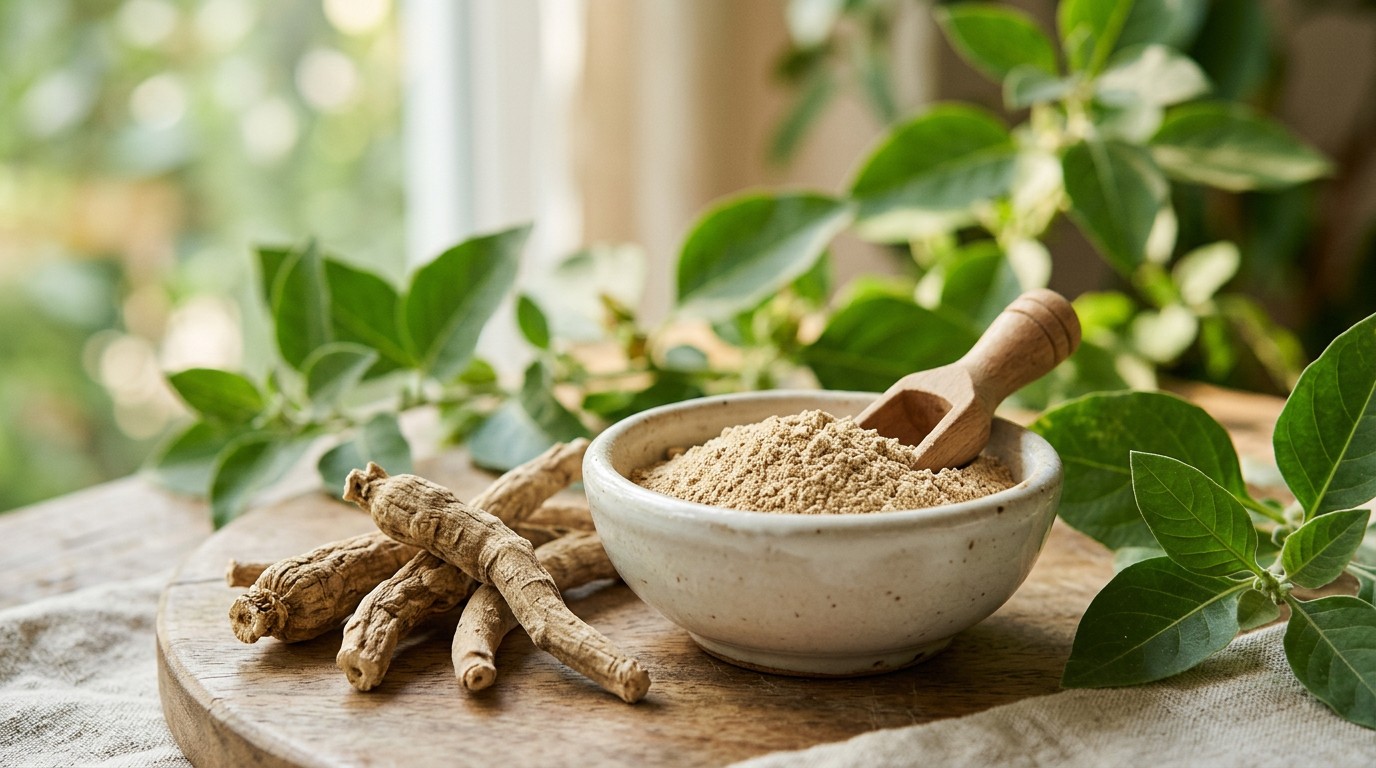
Ashwagandha is an Ayurvedic herb commonly researched for stress management, relaxation and sleep.
Turmeric vs Ashwagandha: Key Differences
The biggest difference is their traditional purpose and research focus.
Turmeric is generally associated with curcumin, antioxidant activity and inflammation-related health research. It may therefore appeal more to someone looking for a supplement focused on general physical wellbeing.
Ashwagandha is more commonly associated with stress management, relaxation and sleep. It may appeal to someone looking for an herbal supplement to complement a healthy approach to managing everyday stress.
Neither supplement should automatically be considered “better”. The most appropriate option depends on your individual reason for taking a supplement.
Why Choose Turmeric or Ashwagandha?
Why choose turmeric?
You might consider turmeric or a curcumin supplement if you are particularly interested in:
- Curcumin and its antioxidant properties
- General health and wellbeing
- Inflammation-related research
- Supplements aimed at physical wellbeing and joint health
If you choose turmeric, compare the curcumin content, extract type and formulation, rather than simply choosing a product because it contains turmeric.
Why choose ashwagandha?
You might consider ashwagandha if your main interests are:
- Managing everyday stress
- Relaxation and calm
- Sleep and general wellbeing
- Trying a traditional adaptogenic herb
Look at the specific ashwagandha extract and standardisation when comparing products, as different supplements can contain substantially different formulations.
Which Is the Best Supplement to Buy?
There is no universal winner in the turmeric vs ashwagandha comparison.
For inflammation and curcumin-related wellbeing: turmeric or a curcumin supplement may be the more relevant choice.
For stress, relaxation and sleep-related wellbeing: ashwagandha may be the more relevant choice.
Quality also matters. Look for clear ingredient information, appropriate serving sizes, reputable manufacturers and transparent labelling. Avoid assuming that a higher dose automatically means a better product.
If you take prescription medicines, are pregnant or breastfeeding, or have an existing medical condition, speak to a healthcare professional before starting either supplement.
Turmeric and Ashwagandha Supplement Forms
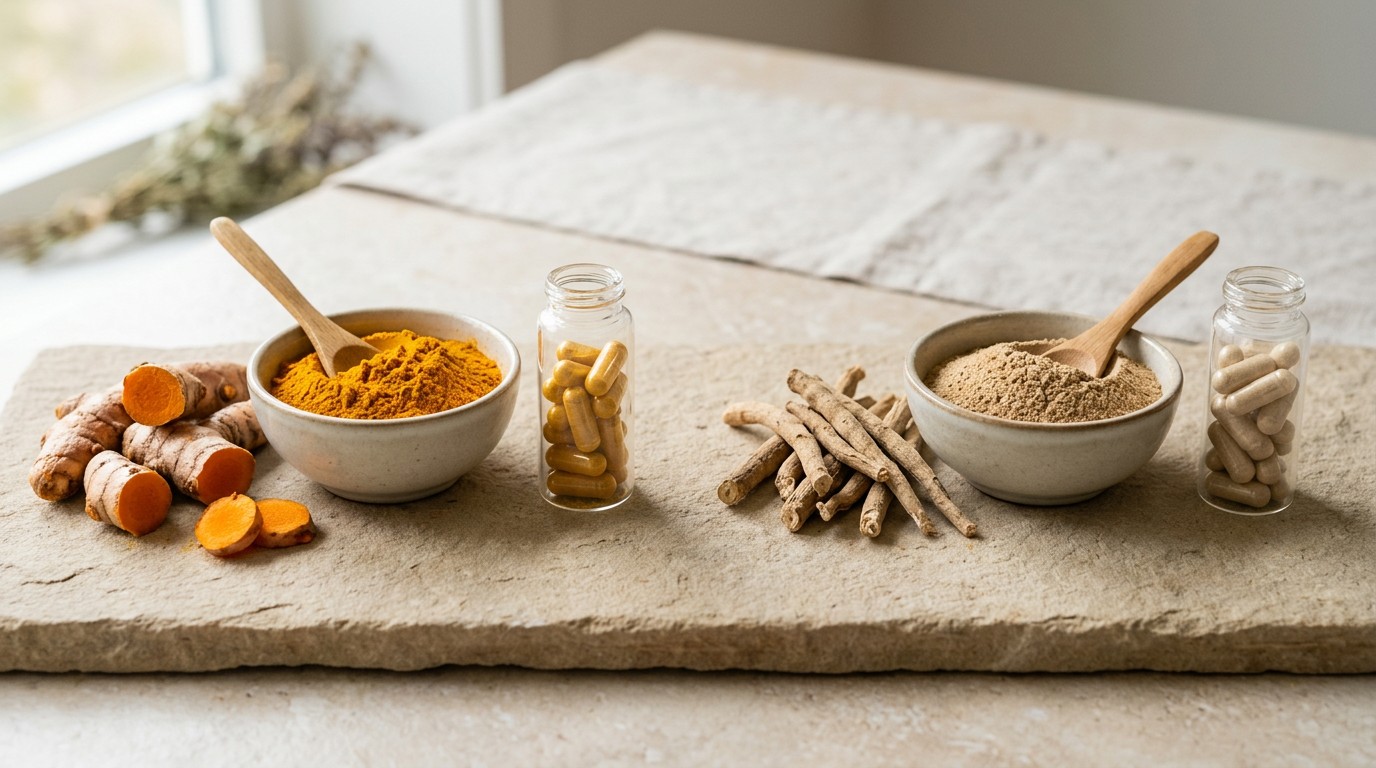
Both turmeric and ashwagandha are available as powders, capsules, tablets and herbal extracts.
Frequently asked questions
Is turmeric or ashwagandha better?
Neither is universally better. Turmeric is generally chosen for curcumin and inflammation-related wellbeing, while ashwagandha is more commonly chosen for stress, relaxation and sleep-related wellbeing.
Can you take turmeric and ashwagandha together?
Some people may take both, but combining supplements is not automatically appropriate for everyone. Consider the ingredients, doses, possible interactions and your individual circumstances before combining them.
Does turmeric help with stress?
Turmeric is not primarily known as a stress supplement. Ashwagandha has a stronger traditional association and research interest around stress and relaxation.
Does ashwagandha help with inflammation?
Research has investigated several potential effects of ashwagandha, including inflammation-related pathways, but it is generally better known as an adaptogenic herb associated with stress and wellbeing rather than being viewed as a direct alternative to curcumin.
Which is better for daily use, turmeric or ashwagandha?
It depends on your reason for taking it. If you are interested in curcumin and general physical wellbeing, turmeric may be more appropriate. If stress and relaxation are your priorities, ashwagandha may be the better fit.
Comparative overview – Turmeric & Ashwagandha Research
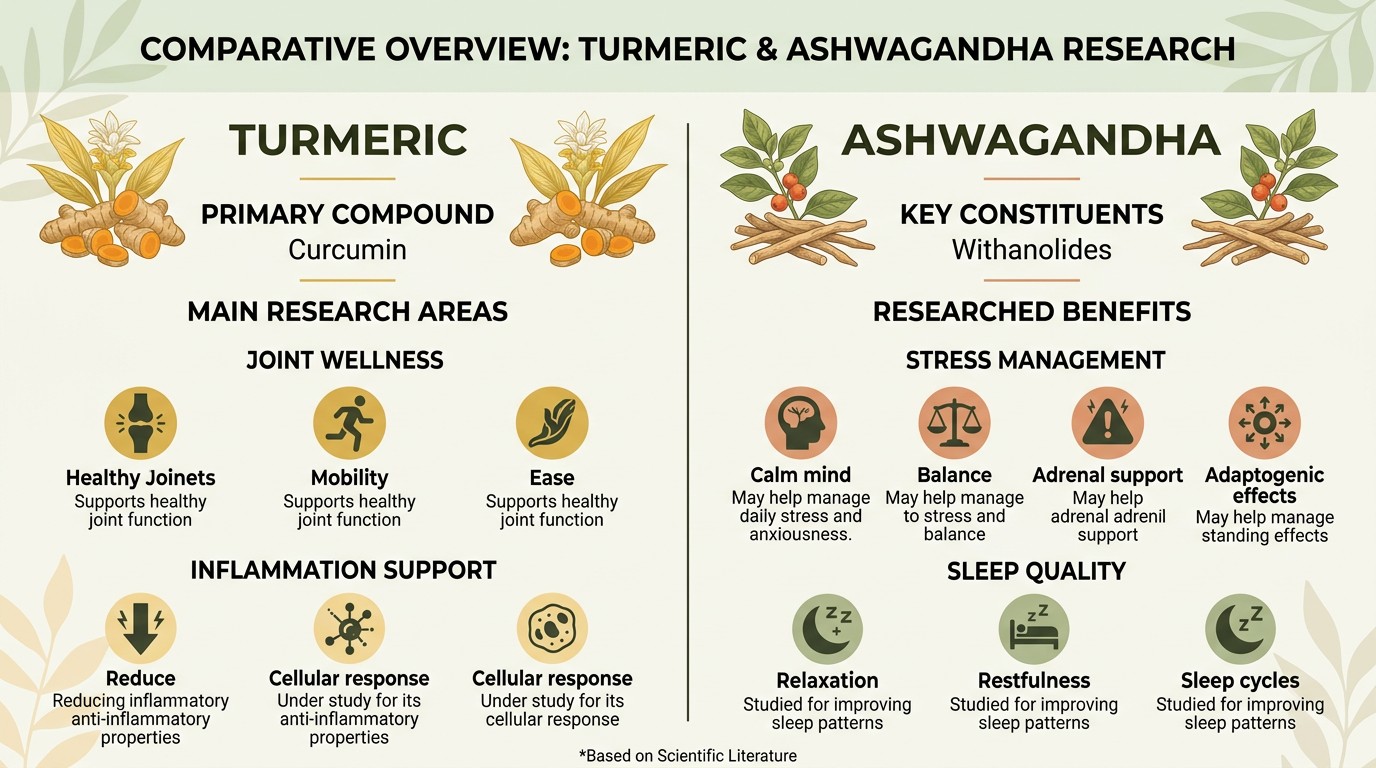
Turmeric is commonly researched for joint health, while ashwagandha has been studied for stress and sleep support.
Final Summary
Turmeric vs ashwagandha comes down to what you want from a supplement. Turmeric is primarily associated with curcumin and inflammation-related and antioxidant research, while ashwagandha is traditionally associated with stress, relaxation and general resilience.
Rather than looking for one overall winner, choose the supplement that best matches your specific goal, then compare the quality, formulation, dosage and evidence behind the individual product.
Further information
1. The Unique Benefits of ASHWAGANDHA (How and When to Take it) – Dr. Berg Explains
2. The TRUTH About Ashwagandha: Dr. Sung Breaks Down Everything You Need to Know
3. We Asked Experts About 7 Most Popular Supplements—And They Didn’t Agree
Description: A Verywell Health expert roundup that discusses both turmeric and ashwagandha, including their potential benefits, limitations of the evidence, and safety concerns. It is one of the closest high-authority articles to a direct turmeric-vs-ashwagandha comparison.
Published by: Verywell Health
Read the article Verywell Health
4. Efficacy of Botanical Extracts for Knee Osteoarthritis: A Network Meta-Analysis of Randomized Controlled Trials
Description: A scientific network meta-analysis that evaluates multiple botanical treatments and includes both ashwagandha and Curcuma (turmeric) extracts, allowing their effects on osteoarthritis outcomes to be compared within the same analysis.
Published by: Frontiers in Pharmacology / Frontiers
Read the article Frontiers
5. Evaluation of Turmeric, Ashwagandha, and Aloe Vera in the Management of Oral Lichen Planus Lesion
Description: A comparative clinical study that evaluates turmeric and ashwagandha as separate topical treatments for oral lichen planus, making this particularly relevant if you’re looking for an actual head-to-head comparison.
Published by: Journal of Indian Society of Periodontology, indexed in PubMed Central
Read the article PubMed Central (PMC)
6. A Comprehensive Review on the Hepatotoxicity of Herbs Used in the Indian (Ayush) Systems of Alternative Medicine
Description: A research review that examines liver-safety concerns associated with both turmeric/curcumin and ashwagandha. Useful for comparing the two from a safety and adverse-effect perspective rather than simply comparing claimed benefits.
Published by: PubMed Central / peer-reviewed medical literature
Read the article PubMed Central (PMC)
Disclaimer
This article is for general informational purposes only and is not medical advice. Food supplements should not be used as a substitute for a balanced diet or appropriate medical care. Always check whether a supplement is suitable for you, particularly if you take medication, have a medical condition, are pregnant or breastfeeding. Speak to a qualified healthcare professional if you are unsure.
Author
Written by J. Henderson
Health & Wellness Research Writer
J. Henderson writes evidence-based articles on nutrition, botanical supplements and everyday wellbeing. His work focuses on translating scientific research into clear, practical guidance that helps readers make informed decisions about natural health products.