Turmeric Supplements
Quick Answer
Turmeric supplements provide turmeric, turmeric extracts or curcumin in concentrated or convenient forms such as capsules, tablets, powders and gummies. Products can differ considerably in their ingredients and formulation. Research into potential health benefits is encouraging in some areas, particularly osteoarthritis, but the overall evidence remains uncertain.
Key Points
- Turmeric supplements come in several forms.
- Turmeric and curcumin are not the same.
- Products can contain very different formulations.
- Potential benefits depend on the evidence studied.
- Some formulations improve curcumin absorption.
- Higher milligrams do not necessarily mean better.
- Supplements can cause side effects and interactions.
Related Guides
Explore more about turmeric and your options:
- Turmeric Capsules — understanding turmeric capsule formulations.
- Turmeric Tablets — how tablets compare with other formats.
- Turmeric Powder — exploring turmeric powders sold as supplements.
- How to Choose Turmeric Supplements — what to consider when comparing products.
- Taking Turmeric Supplements with Food — practical questions about taking supplements with food.
Turmeric Supplements
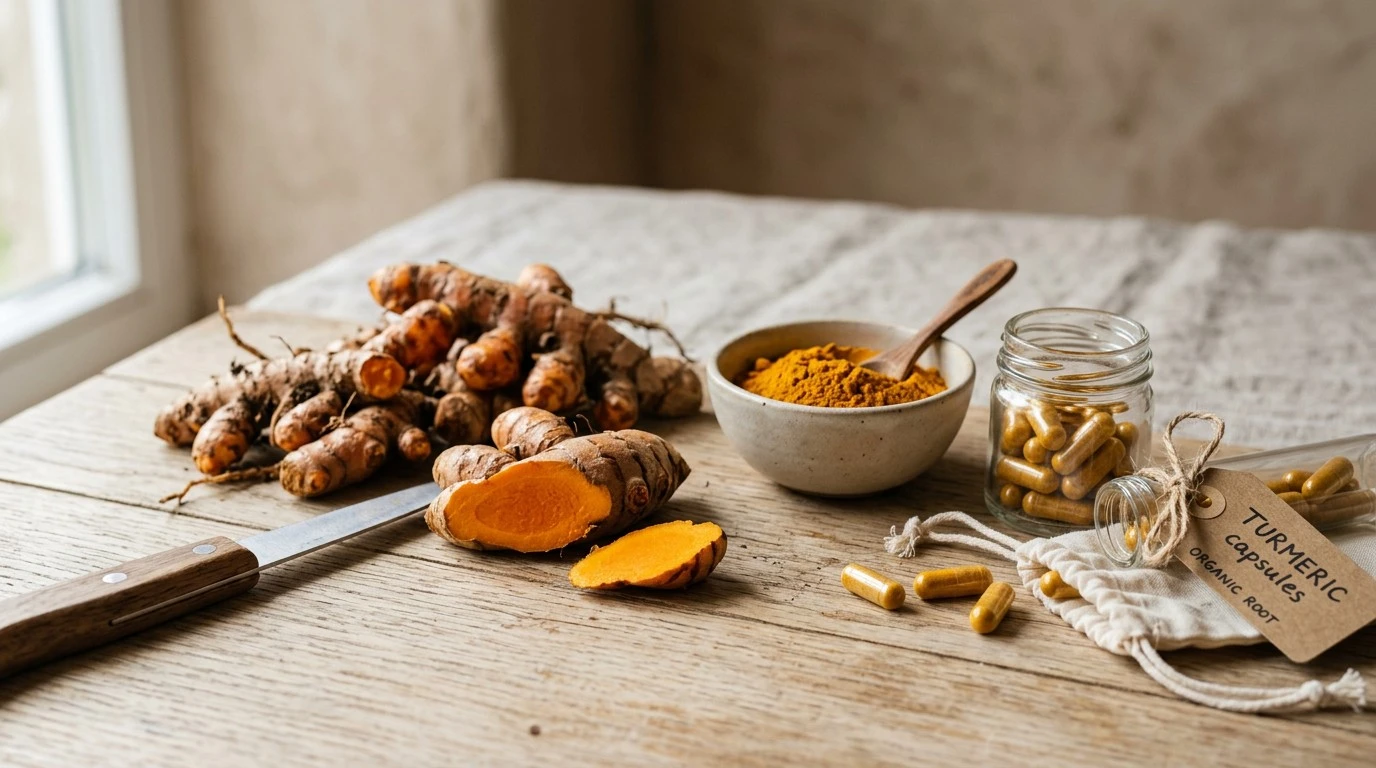
Turmeric supplements are available in different forms and can contain whole turmeric, extracts or concentrated curcumin.
About Turmeric Supplements
Who Might Consider Turmeric Supplements?
People may consider turmeric supplements because they want a convenient or concentrated way to consume turmeric or curcumin. Interest commonly relates to potential health effects such as joint health, although benefits should be considered against the evidence for the particular product and purpose.
What Are Turmeric Supplements?
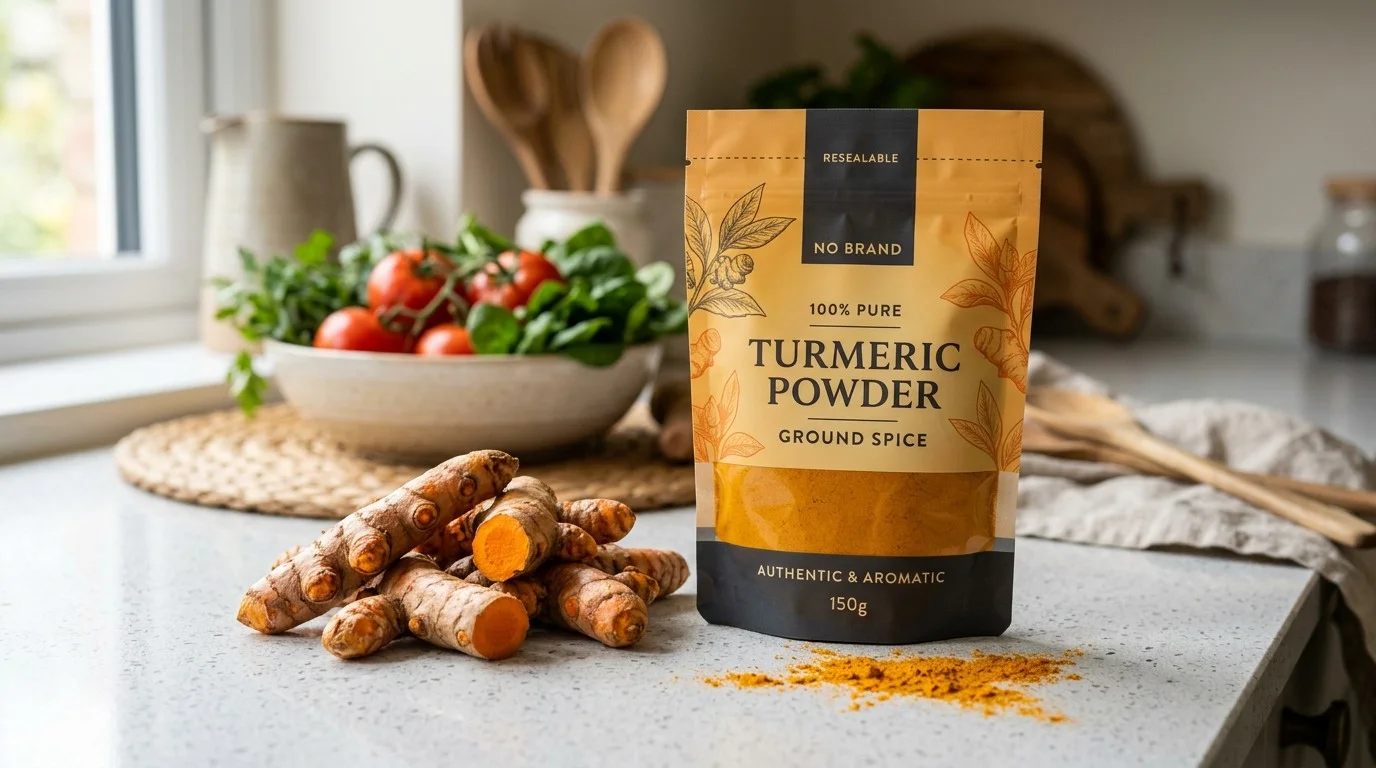
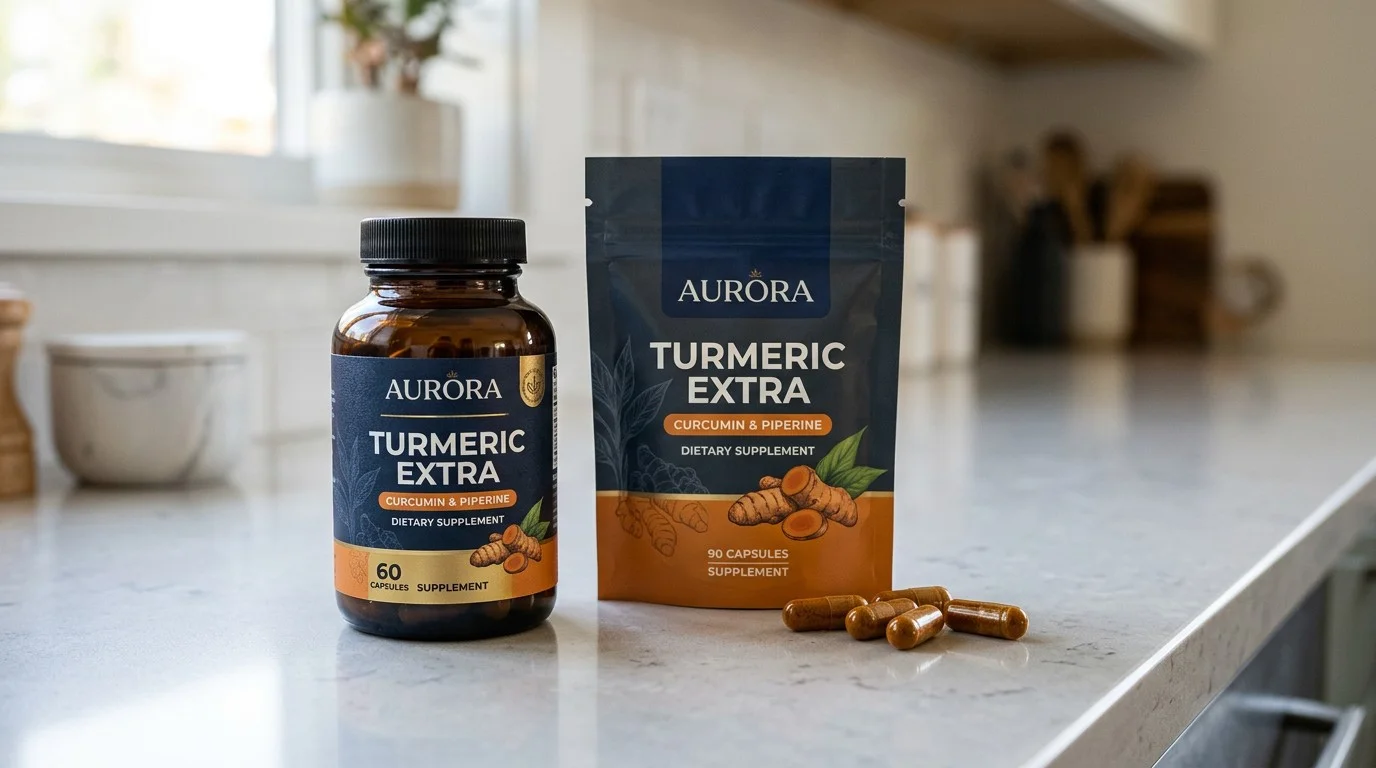
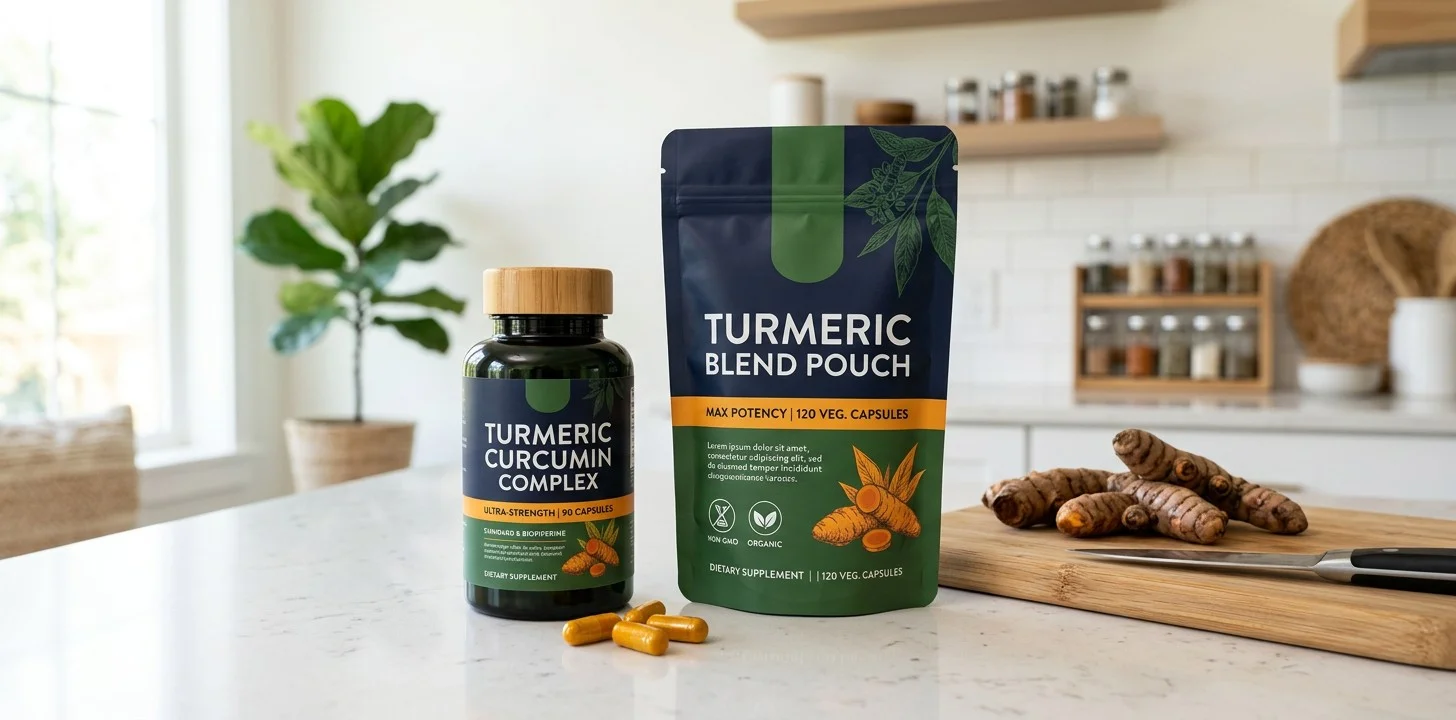
Turmeric supplements are products containing turmeric powder, turmeric extracts, curcuminoids or curcumin. They are available as capsules, tablets, powders, gummies and other formulations, and different products should not be assumed to be equivalent.
Where Can You Buy Turmeric Supplements?
Turmeric supplements are widely available from online retailers, pharmacies, supermarkets and health shops. Look for reputable products with clear information about their ingredients, amounts, directions, warnings and manufacturer.
When Should You Take Turmeric Supplements?
There is no single best time that applies to every turmeric supplement. Follow the directions for the particular product, and seek professional advice if you take medicines, have a medical condition or are unsure whether supplementation is appropriate.
Why Do People Take Turmeric Supplements?
People take turmeric supplements for several reasons, including interest in their potential effects on joint health and inflammation. However, why people use a supplement is not the same as proving that it provides a particular health benefit. Scientific evidence varies according to the outcome and formulation studied.
How Do You Choose a Turmeric Supplement?
Start by checking what the product actually contains. Consider the type of turmeric or curcumin, amount per serving, curcuminoid content where stated, additional ingredients, formulation and safety information. Don’t assume the product with the largest milligram number is automatically the best choice.
Person looking to Choose a Turmeric Supplement

Person comparing turmeric supplements before choosing a product
Table of Contents
- What are turmeric supplements?
- Turmeric vs curcumin
- Types of turmeric supplements
- Turmeric supplement comparison
- What are turmeric supplements used for?
- What does the scientific evidence show?
- Curcumin absorption and bioavailability
- How to choose a turmeric supplement
- How much should you take?
- Side effects and safety
- Who should seek medical advice?
- Frequently asked questions
- Summary
- Sources and further information
What are turmeric supplements?
Turmeric supplements are products containing turmeric or substances derived from turmeric.
Turmeric comes from Curcuma longa, a plant belonging to the ginger family. Its underground rhizome is widely used as a culinary spice and also has a long history of use in traditional systems of medicine.
Modern supplements can contain:
- Ground turmeric rhizome
- Turmeric extract
- Standardised turmeric extract
- Curcuminoids
- Curcumin
- Curcumin combined with piperine
- Specialised curcumin formulations
The important point is that these are not necessarily equivalent products.
A capsule containing ordinary turmeric powder can be quite different from one containing concentrated curcuminoids. A specialised curcumin formulation designed to increase absorption may be different again.
This also matters when interpreting research. Results from a study using one particular turmeric or curcumin preparation should not automatically be applied to every turmeric supplement.
Turmeric vs curcumin: what is the difference?
Turmeric is the plant material; curcumin is one of the natural compounds found within it.
Turmeric rhizomes contain numerous substances, including volatile oils and a group of compounds called curcuminoids.
Curcumin is the best-known curcuminoid and contributes to turmeric’s characteristic yellow-orange colour.
Many clinical studies have investigated concentrated curcumin or curcuminoid preparations rather than ordinary turmeric powder.
This distinction is important.
A study finding a particular result from a concentrated curcumin formulation does not necessarily demonstrate that eating turmeric with food, taking turmeric powder or using another supplement will have the same effect.
What types of turmeric supplements are available?
Types of Turmeric Supplements
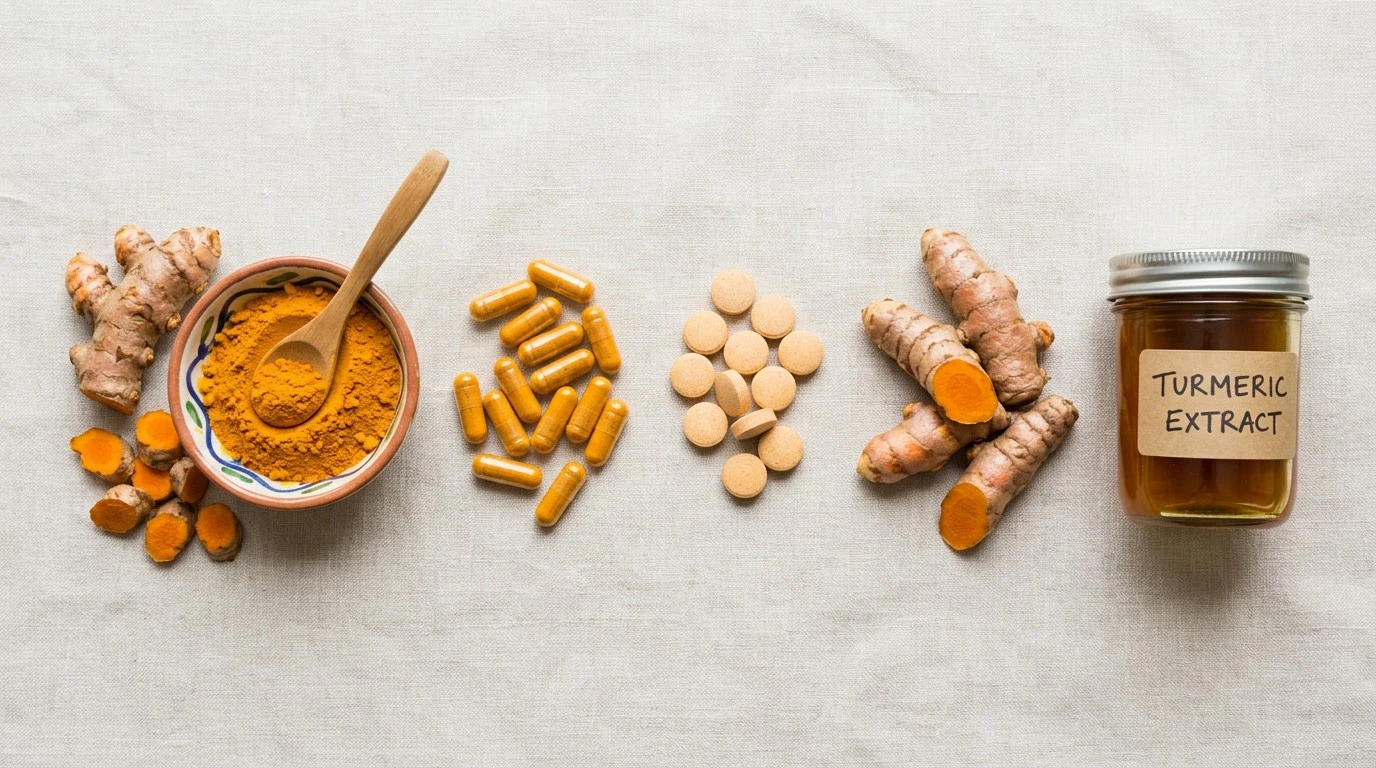
Turmeric supplements include powders, capsules, tablets, extracts and concentrated curcumin formulations.
There is no single form of turmeric supplement that is automatically best for everyone.
Turmeric tablets, capsules and powders describe how a product is supplied. Terms such as turmeric extract, curcuminoids and curcumin tell you more about what it contains.
Each type has potential advantages and disadvantages.
Turmeric capsules
Turmeric capsules contain turmeric powder, extracts or curcuminoids inside a dissolvable capsule.
Potential advantages
- Convenient measured serving
- Little or no turmeric taste
- Easy to carry and store
- Can contain powder or concentrated extracts
Potential disadvantages
- Contents vary considerably between products
- Larger capsules can be difficult to swallow
- Additional capsule ingredients may be present
- Capsule form tells you little about absorption
What to check: Look at what is actually inside the capsule rather than assuming all turmeric capsules are similar.
Turmeric tablets
Turmeric tablets contain compressed turmeric powder, extracts or curcuminoids.
Potential advantages
- Convenient measured serving
- Generally easy to store
- Can contain concentrated extracts
- Widely available
Potential disadvantages
- May contain binders, coatings and other ingredients
- Some tablets can be difficult to swallow
- Formulations vary considerably
- Large milligram numbers can be misleading
What to check: When comparing turmeric tablets, look at the active ingredients and formulation rather than choosing a supplement simply because it comes in tablet form.
Turmeric powder
Turmeric powder is normally made from dried and ground turmeric rhizome.
Potential advantages
- Contains a broad mixture of turmeric constituents
- Can be added to foods and drinks
- Simple and familiar form
- Amount used can be easily adjusted
Potential disadvantages
- Less concentrated in curcuminoids than many extracts
- Distinctive taste may not suit everyone
- Strong colour can stain
- Less convenient for precise supplementation
What to check: Turmeric powder and concentrated curcumin extracts are different products and should not be compared simply by their weight.
Turmeric extracts
Turmeric extracts contain selected components concentrated from turmeric rhizome.
Potential advantages
- More concentrated than ordinary turmeric powder
- Some specify their curcuminoid content
- Standardisation can make composition clearer
- Convenient for measured supplementation
Potential disadvantages
- Different extracts may not be equivalent
- Concentrations vary between products
- Less representative of whole turmeric
- Milligram amounts can be difficult to compare
What to check: Look for clear information about the extract, its concentration and whether its curcuminoid content is stated.
Curcumin supplements
Curcumin supplements provide concentrated curcumin or mixtures of curcuminoids.
Potential advantages
- Concentrated source of curcuminoids
- Curcuminoid amount may be clearly stated
- Frequently used in clinical research
- Available in different formulations
Potential disadvantages
- Conventional curcumin has relatively low bioavailability
- Research findings can depend on formulation
- Does not represent whole turmeric in its natural proportions
- Greater concentration does not guarantee greater benefit
What to check: Identify which curcumin formulation is supplied and whether evidence for that type is relevant to the reason you are considering it.
Curcumin with black pepper or piperine
These supplements combine curcumin with piperine, a natural constituent of black pepper.
Potential advantages
- Piperine can increase curcumin bioavailability
- Widely available combination
- Can increase exposure compared with conventional curcumin
Potential disadvantages
- Greater absorption does not prove greater benefit
- Increased exposure is not automatically preferable
- Additional ingredients introduce other considerations
- May not be appropriate for everyone
What to check: Do not assume that “with black pepper” automatically means a better supplement.
Enhanced-bioavailability curcumin
These products use specialised formulations intended to increase curcumin absorption or exposure.
They can include lipid formulations, phospholipid complexes, micelles, emulsions and other delivery technologies.
Potential advantages
- Can increase curcumin exposure
- Designed to address poor natural bioavailability
- Some formulations have been clinically studied
- Different delivery methods are available
Potential disadvantages
- Formulations can be difficult to compare
- Higher absorption does not guarantee better outcomes
- Milligram amounts may be misleading
- Safety needs considering alongside absorption
What to check: “More bioavailable” should not automatically be interpreted as “more effective” or “better”.
Comparing Turmeric Supplement Types
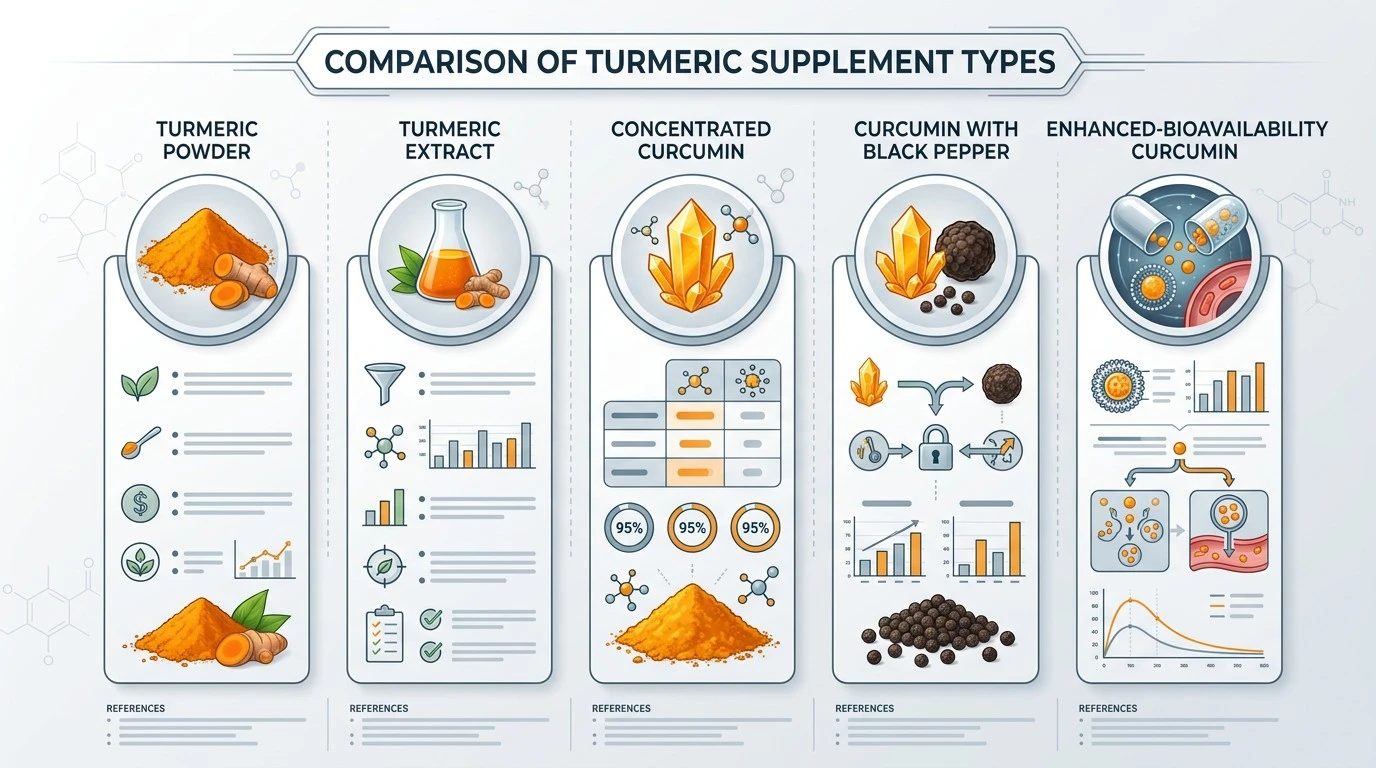
Different turmeric supplement types have practical advantages and disadvantages, and products cannot be compared using milligrams alone.
Turmeric supplement comparison
| Type | What is it? | Potential advantage | Potential disadvantage |
| Turmeric powder | Ground rhizome | Broad turmeric composition | Less concentrated |
| Capsules | Powder or extract in capsule | Convenient | Contents vary |
| Tablets | Compressed powder or extract | Measured serving | Formulations vary |
| Turmeric extract | Concentrated components | Higher concentration | Extracts differ |
| Curcumin | Concentrated curcuminoids | Clearly defined | Low natural bioavailability |
| Curcumin + piperine | Curcumin with black pepper compound | Greater absorption | Benefit not necessarily greater |
| Enhanced curcumin | Specialised formulation | Increased exposure | Harder to compare |
The biggest number on the label does not necessarily identify the best product.
For example, 1,000 mg of turmeric powder and 500 mg of concentrated curcumin cannot meaningfully be compared using the numbers alone.
What are turmeric supplements used for?
People take turmeric and curcumin supplements for a variety of reasons, particularly joint health and general wellbeing.
Research has investigated their possible effects in areas including:
- Osteoarthritis
- Joint pain and physical function
- Metabolic health
- Blood lipids
- Non-alcoholic fatty liver disease
- Digestive conditions
- Exercise-related muscle soreness
- Oral mucositis
However, there is an important difference between what a supplement is sold for and what good clinical evidence shows it can do.
Laboratory studies have also investigated curcumin’s effects on inflammatory and antioxidant pathways.
These findings can help researchers identify possible mechanisms and decide what to investigate in humans. They do not, by themselves, demonstrate that taking a turmeric supplement will prevent or treat a disease.
The evidence therefore needs to be considered separately for each proposed use.
What does the scientific evidence show?
Research into turmeric and curcumin is substantial, but the evidence is not equally strong for every claimed benefit.
This is why broad statements such as “turmeric works” or “turmeric doesn’t work” are not particularly helpful.
A better question is:
What does the evidence show for this particular use?
Osteoarthritis and joint health
Osteoarthritis has some of the more encouraging clinical evidence for curcumin supplementation.
A 2024 meta-analysis of 11 previous meta-analyses reported favourable pooled effects across several measures of osteoarthritis pain, stiffness and physical function.
However, the research has important limitations.
Studies have used different:
- Products
- Extracts
- Curcumin concentrations
- Doses
- Treatment periods
- Absorption-enhancing formulations
Study size and methodological quality also vary.
This means encouraging results for a particular curcumin preparation cannot simply be applied to every turmeric supplement.
A reasonable interpretation is that curcumin shows promise for osteoarthritis symptoms, but important uncertainties remain.
Turmeric, Curcumin and Osteoarthritis Research
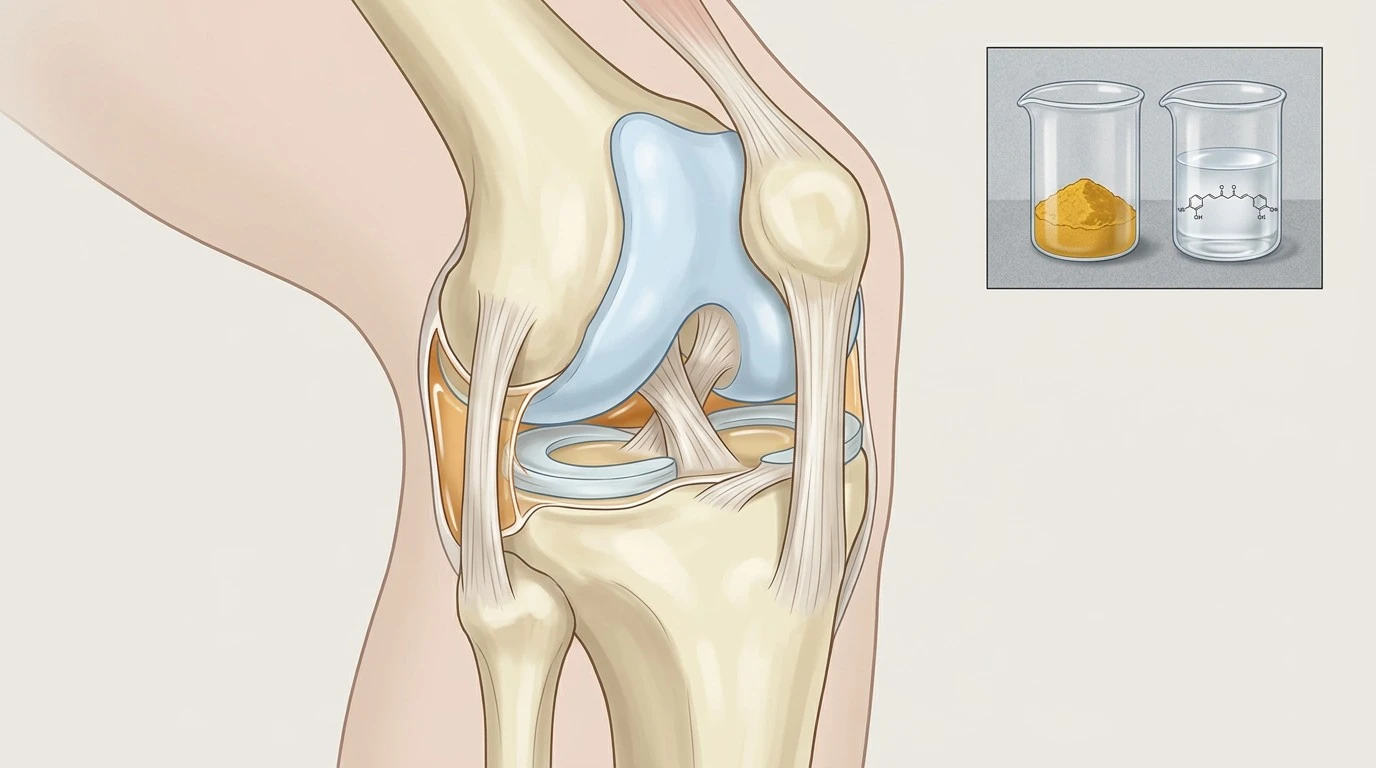
Knee osteoarthritis is one of the more extensively studied potential uses of curcumin supplements, although uncertainties remain.
What about other potential benefits?
Turmeric and curcumin have been studied for numerous other health outcomes.
Some research has produced potentially favourable results, while evidence for many proposed uses remains preliminary, inconsistent or insufficient.
The strength of evidence should therefore be assessed separately for each condition.
It is also important to distinguish between a biological mechanism and a demonstrated health benefit.
For example, evidence that curcumin affects an inflammatory pathway does not by itself establish that a turmeric supplement effectively treats an inflammatory disease.
Curcumin absorption and bioavailability
One reason turmeric supplements can become confusing is bioavailability.
In simple terms, bioavailability concerns how much of a substance becomes available to the body after it is consumed.
Conventional curcumin has relatively low oral bioavailability because of factors including poor water solubility, limited absorption and metabolism.
Curcumin Absorption and Bioavailability
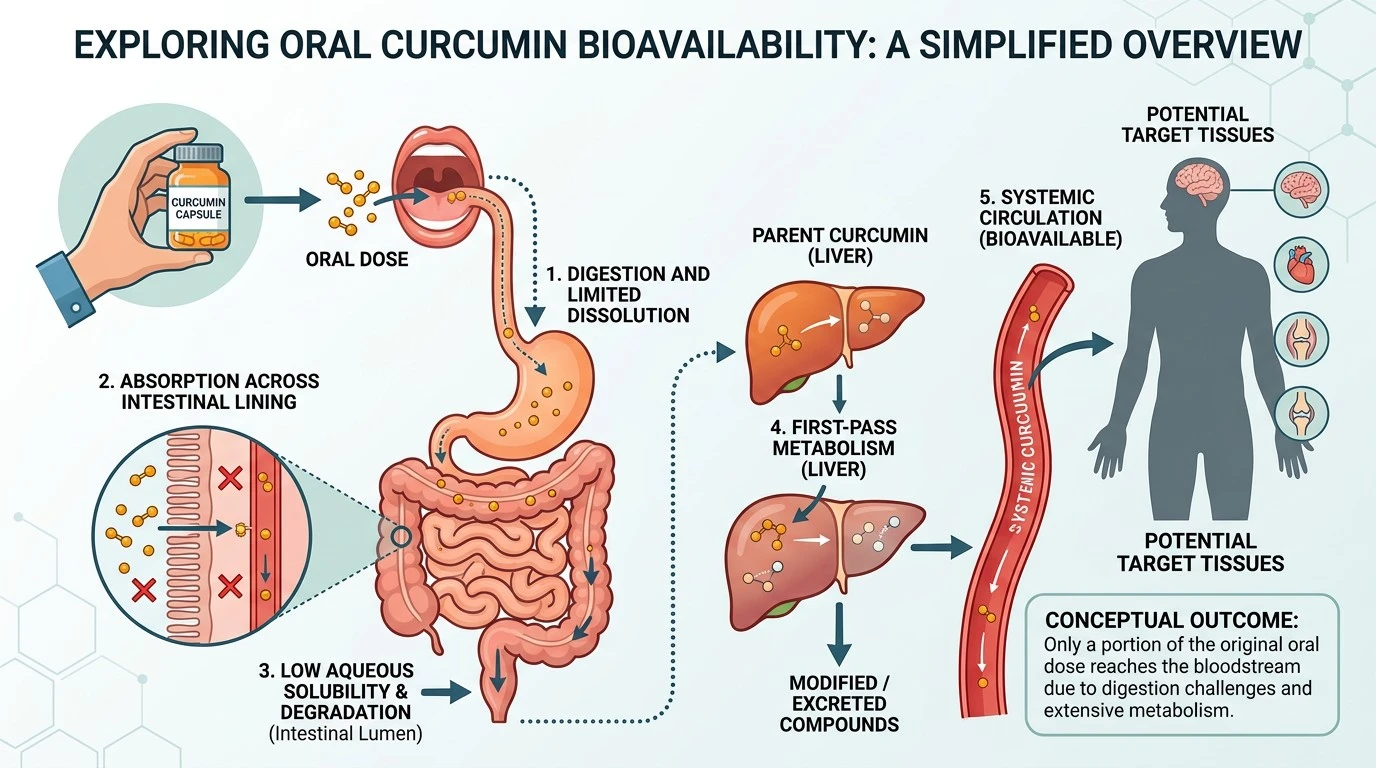
Conventional curcumin has relatively low oral bioavailability, which has led to formulations designed to increase exposure.
Researchers and manufacturers have therefore developed ways of increasing curcumin exposure.
These include:
- Piperine
- Lipid formulations
- Phospholipid complexes
- Micelles
- Emulsions
- Nanoparticle formulations
- Other delivery technologies
Does black pepper help curcumin absorption?
Yes, piperine, a compound found in black pepper, can increase curcumin bioavailability.
Research into whether black pepper increases turmeric absorption has largely focused on piperine and curcumin. A small human pharmacokinetic study published in 1998 found substantially greater curcumin bioavailability when 20 mg of piperine was given with 2 g of curcumin.
This finding helps explain why black pepper extract is included in many modern curcumin supplements.
But it is important to understand what the finding means.
It demonstrates that piperine can increase exposure to curcumin.
It does not automatically demonstrate that a curcumin supplement containing piperine will provide greater health benefits.
Why does formulation matter?
A 2024 methodological study examined 171 systematic reviews of oral curcumin.
Researchers found that differences in the bioavailability of curcumin formulations were rarely adequately considered when evidence from clinical studies was combined.
This is important because two studies described simply as trials of “curcumin” may actually have used formulations producing very different levels of exposure.
For someone choosing a supplement, the lesson is straightforward:
Not all curcumin supplements are interchangeable.
How to choose a turmeric supplement
Understanding how to choose a turmeric supplement does not mean simply looking for the product that claims to be the “strongest”.
Start by understanding what you are actually buying.
How to Choose a Turmeric Supplement

Check what a turmeric supplement contains, its formulation, ingredients, serving information and relevant safety information before choosing.
1. Is it turmeric or curcumin?
Check the main ingredient first.
Whole turmeric powder, turmeric extract and concentrated curcumin are different preparations.
This simple distinction makes everything else easier to understand.
2. What do the milligrams refer to?
Check whether the amount on the label refers to:
- Turmeric powder
- Turmeric extract
- Curcuminoids
- Curcumin
- One capsule or tablet
- A complete daily serving
Do not assume that a larger milligram number means a stronger or better product.
3. Is the curcumin or curcuminoid content stated?
Some extracts state how much curcumin or total curcuminoids they contain.
This makes their composition easier to understand and compare.
However, a high percentage of curcuminoids does not by itself demonstrate that a supplement will provide a health benefit.
4. Is it designed for increased absorption?
Look for piperine or a named enhanced-bioavailability formulation.
This tells you something important about how the product has been designed.
But remember:
Better absorption does not automatically mean a better supplement.
5. Why are you considering taking it?
This may be the most useful question.
If you are considering turmeric for a particular purpose, look at the human clinical evidence for that specific purpose.
Do not use evidence relating to one condition to justify claims about another.
6. Weigh up the advantages and disadvantages
Consider practical factors such as:
- Convenience
- Taste
- Ease of swallowing
- Concentration
- Additional ingredients
- Formulation
- Bioavailability
- Safety
The most appropriate form can depend partly on individual preferences and circumstances.
7. Read the complete ingredient list
Some turmeric supplements contain much more than turmeric.
Additional ingredients may include:
- Black pepper extract
- Other botanical extracts
- Vitamins
- Minerals
- Oils
- Fillers and excipients
Combination products make it particularly important to understand exactly what you are taking.
8. Look for clear product information
Useful information includes:
- Manufacturer details
- Full ingredient list
- Amount per serving
- Directions for use
- Safety warnings
- Storage information
- Relevant quality information
Be cautious about dramatic claims promising to cure, prevent or rapidly reverse diseases.
Marketing claims are not a substitute for scientific evidence.
9. Consider whether it is safe for you
Individual circumstances matter.
Medicines, existing health conditions, pregnancy, breastfeeding and previous reactions to supplements can affect whether a product is appropriate.
Ask a doctor or pharmacist if you are unsure.
Is higher bioavailability better?
Not necessarily.
Higher bioavailability generally means more curcumin becomes available to the body.
That answers one question:
How much is absorbed or becomes available?
It does not automatically answer another:
Will it produce a better health outcome?
That requires appropriate clinical evidence.
Safety should also be considered. Some turmeric products, including formulations designed to increase bioavailability, have been associated with cases of liver injury.
This does not mean enhanced formulations inevitably cause liver problems.
It means maximum absorption should not automatically be treated as maximum benefit.
How much turmeric supplement should you take?
There is no single dose suitable for every turmeric supplement or every person.
Studies have used widely varying amounts and formulations.
The same number of milligrams can also represent very different products depending on whether it refers to whole turmeric powder, an extract, concentrated curcuminoids or an enhanced curcumin formulation.
Appropriate use can depend on:
- The product
- Its concentration
- Its formulation
- Why it is being taken
- Other medicines or supplements
- Existing health conditions
- Individual tolerance
For these reasons, copying a dose from a research study, another website or another person’s supplement routine may not be appropriate.
Follow the instructions for the particular product and seek individual advice from a doctor, pharmacist or appropriately qualified healthcare professional when needed.
Are turmeric supplements safe?
Turmeric supplements can cause side effects and are not suitable for everyone.
Possible digestive side effects can include:
- Nausea
- Acid reflux
- Stomach upset
- Diarrhoea
- Constipation
It is also important to distinguish between turmeric used as an ordinary culinary spice and concentrated supplementation.
The long history of eating turmeric does not establish that every concentrated extract or enhanced formulation has the same safety profile.
Can turmeric supplements affect the liver?
Rare cases of clinically apparent liver injury have been associated with turmeric and curcumin supplements.
The US LiverTox clinical reference states that turmeric products have been implicated in several dozen cases of clinically apparent acute liver injury.
The risk appears to be uncommon, but it is important enough to be aware of.
Possible symptoms of liver injury can include:
- Unusual fatigue
- Nausea
- Loss of appetite
- Dark urine
- Yellowing of the skin or eyes
Anyone who develops symptoms that could suggest liver injury while taking a turmeric or curcumin supplement should stop taking it and seek medical advice promptly.
Turmeric Supplement Safety

Turmeric supplement container beside a medicine list and pharmacist consultation setting
Who should seek medical advice before taking turmeric supplements?
It is particularly sensible to speak to a doctor, pharmacist or appropriately qualified healthcare professional before using a turmeric supplement if you:
- Take prescription or regular medicines
- Have liver problems
- Have a significant medical condition
- Are pregnant
- Are breastfeeding
- Have previously reacted to turmeric supplements
- Are considering a concentrated or enhanced formulation
Supplements can interact with medicines, and individual circumstances matter.
Turmeric supplements should not be used as a replacement for prescribed medical treatment without discussing this with the healthcare professional responsible for your care.
Frequently asked questions
What is the best type of turmeric supplement?
There is no single type proven to be best for everyone. Consider what the product contains, its concentration and formulation, why you want to take it, the evidence for that use, its advantages and disadvantages, and whether it is appropriate for you.
What is the difference between turmeric and curcumin supplements?
Turmeric supplements may contain whole turmeric or turmeric extracts, while curcumin supplements provide concentrated curcumin or curcuminoids. Curcumin occurs naturally within turmeric, but turmeric and curcumin are not the same thing.
Are turmeric capsules better than turmeric tablets?
Neither is automatically better. What the supplement contains generally matters more than whether it comes as a capsule or tablet. Ease of swallowing, additional ingredients and personal preference can also influence the choice.
Is turmeric powder better than curcumin?
They are different rather than simply better or worse. Turmeric powder contains a broader mixture of naturally occurring turmeric constituents, while curcumin supplements provide a more concentrated source of curcuminoids.
What are the potential benefits of turmeric supplements?
The evidence depends on the health outcome being investigated. Osteoarthritis, particularly knee pain and physical function, has some of the more encouraging clinical research. Evidence for many other proposed benefits remains uncertain.
Is turmeric with black pepper better?
Black pepper-derived piperine can increase curcumin bioavailability, but increased absorption does not automatically mean greater health benefits. It is one characteristic of a formulation rather than proof that the product is superior.
Can you take turmeric supplements every day?
There is no universal answer for every product and person. Formulation, amount, duration, medicines and individual health circumstances can all matter. Follow the directions for the specific supplement and seek professional advice when appropriate.
Summary
Turmeric supplements are not all the same.
They can contain ground turmeric, turmeric extracts, concentrated curcuminoids, curcumin, piperine or specialised formulations designed to increase absorption.
Each type has potential advantages and disadvantages.
Turmeric powder provides a broader mixture of naturally occurring turmeric constituents but is less concentrated in curcuminoids than many extracts. Curcumin products are more concentrated, while specialised formulations can increase curcumin exposure.
Research into turmeric and curcumin is extensive, but the evidence is condition-specific. Osteoarthritis has some of the more encouraging clinical research, although differences between products, doses and formulations mean results cannot simply be applied to every turmeric supplement.
Curcumin naturally has relatively low oral bioavailability. Piperine and other formulation technologies can increase exposure, but higher absorption does not automatically mean greater health benefit.
Safety matters too. Side effects can occur, and rare cases of clinically significant liver injury have been associated with turmeric products.
If you are choosing a turmeric supplement, start with six simple questions:
- What does it contain?
- How concentrated is it?
- How is it formulated?
- What are its advantages and disadvantages?
- What does the evidence show for why I want to take it?
- Is it appropriate and safe for me?
Those questions are more useful than simply choosing the supplement with the biggest milligram number or strongest marketing claims.
Medical and informational disclaimer
This page provides general educational and informational content based on published research and authoritative health sources. It is not intended to diagnose, prevent or treat a medical condition and is not a substitute for individual medical advice.
Turmeric and curcumin supplements vary substantially in composition and may not be appropriate for everyone. Speak to a doctor, pharmacist or appropriately qualified healthcare professional before using a supplement if you take medicines, have an existing medical condition, are pregnant or breastfeeding, or have concerns about possible side effects.
Sources and further information
1. Expert Videos About Turmeric
Prefer to watch rather than read? These videos provide accessible perspectives on turmeric from qualified doctors and health professionals.
We selected them because they discuss turmeric from an educational perspective and help explain some of the topics covered in this guide. The videos are provided for further learning and do not replace medical advice or the scientific sources referenced throughout this page.
2. Should You Take Turmeric Every Day? Here’s What Doctors Say
Presented by: Talking With Docs
Why we selected it: This video provides an accessible medical discussion about turmeric, including why people take it, curcumin, absorption and some of the practical considerations around regular use.
Useful for: Anyone looking for a straightforward introduction to turmeric before exploring the scientific evidence in greater detail.
3. The 3 Amazing Spices to Reduce Joint Pain, Inflammation & Repair the Body
Featuring: Dr Rupy Aujla
Why we selected it: This discussion looks at turmeric alongside other commonly used spices and explores their relationship with inflammation and joint health from a food and health perspective.
Useful for: Readers particularly interested in turmeric, diet, inflammation and joint health.
4. What TURMERIC Really Does to Your BODY: 5 INCREDIBLE Studies
Presented by: Dr Suneel Dhand
Why we selected it: This video approaches turmeric through published research and discusses several areas in which turmeric and curcumin have been studied.
Useful for: Readers who want to understand some of the research behind turmeric and then explore the individual studies and evidence in greater depth.
5. A note about these videos
Nutrition Whizz selects external videos for their educational value, relevance and accessibility. Inclusion does not mean that we endorse every statement, interpretation or recommendation made by a presenter.
Scientific understanding can also change as new research becomes available. For health decisions, use reliable evidence and seek appropriate professional medical advice where necessary.
Further Reading
1. Turmeric: Usefulness and Safety — National Center for Complementary and Integrative Health (NCCIH), National Institutes of Health
An authoritative evidence overview covering turmeric and curcumin, research, potential uses and safety. Read the article:
2. The Efficacy of Curcumin in Relieving Osteoarthritis: A Meta-analysis of Meta-analyses — Phytotherapy Research (2024)
An umbrella meta-analysis of 11 previous meta-analyses examining curcumin supplementation and osteoarthritis outcomes including pain, stiffness and physical function. Read the article.
3. Bioavailability of Oral Curcumin in Systematic Reviews: A Methodological Study — Pharmaceuticals (2024)
An analysis of 171 systematic reviews examining whether differences between curcumin formulations and their bioavailability were adequately considered when evidence was combined. Read article.
4. Influence of Piperine on the Pharmacokinetics of Curcumin in Animals and Human Volunteers — Planta Medica (1998)
A frequently cited pharmacokinetic study investigating the effect of piperine on curcumin bioavailability. Read article.
5. Bioavailable Curcumin Formulations: A Review of Pharmacokinetic Studies in Healthy Volunteers — Journal of Integrative Medicine (2018)
A review of human pharmacokinetic research into different approaches for increasing curcumin bioavailability. Read article.
6. Liver Injury Associated with Turmeric — A Growing Problem: Ten Cases from the Drug-Induced Liver Injury Network — The American Journal of Medicine (2023)
A clinical case series examining turmeric-associated liver injury identified through the US Drug-Induced Liver Injury Network. Read article.
7. Turmeric — LiverTox, National Institute of Diabetes and Digestive and Kidney Diseases
An authoritative clinical reference covering reported turmeric-associated liver injury and its clinical presentation. Updated June 2025. Read article.
Author
Written by J. Henderson
Health & Wellness Research Writer
J. Henderson writes evidence-based articles on nutrition, botanical supplements and everyday wellbeing. His work focuses on translating scientific research into clear, practical guidance that helps readers make informed decisions about natural health products.
- Written by J. Henderson
- Reviewed by Fiona Finlay
- Reviewed on the 28 August 2026