Turmeric Powder Supplements
Quick Answer
Turmeric powder supplements provide ground turmeric root in a convenient form and may be sold as loose powder, capsules or tablets.
Turmeric naturally contains curcuminoids, including curcumin, which have been widely researched for their potential health effects. Joint health is one of the main areas of interest, although much of the clinical research uses concentrated curcumin extracts rather than ordinary turmeric powder.
Turmeric powder and concentrated extracts are different, so check what a supplement actually contains rather than comparing products by milligrams alone.
Key Points
- Turmeric powder is made from ground turmeric rhizome.
- It may be sold loose or in capsules and tablets.
- Joint health is one of the most studied potential uses.
- Curcumin is widely researched for its effects on inflammatory processes.
- Turmeric powder and concentrated extracts are different.
- Black pepper is sometimes combined with turmeric.
- Check the ingredients rather than relying on milligrams alone.
Turmeric Powder Supplements
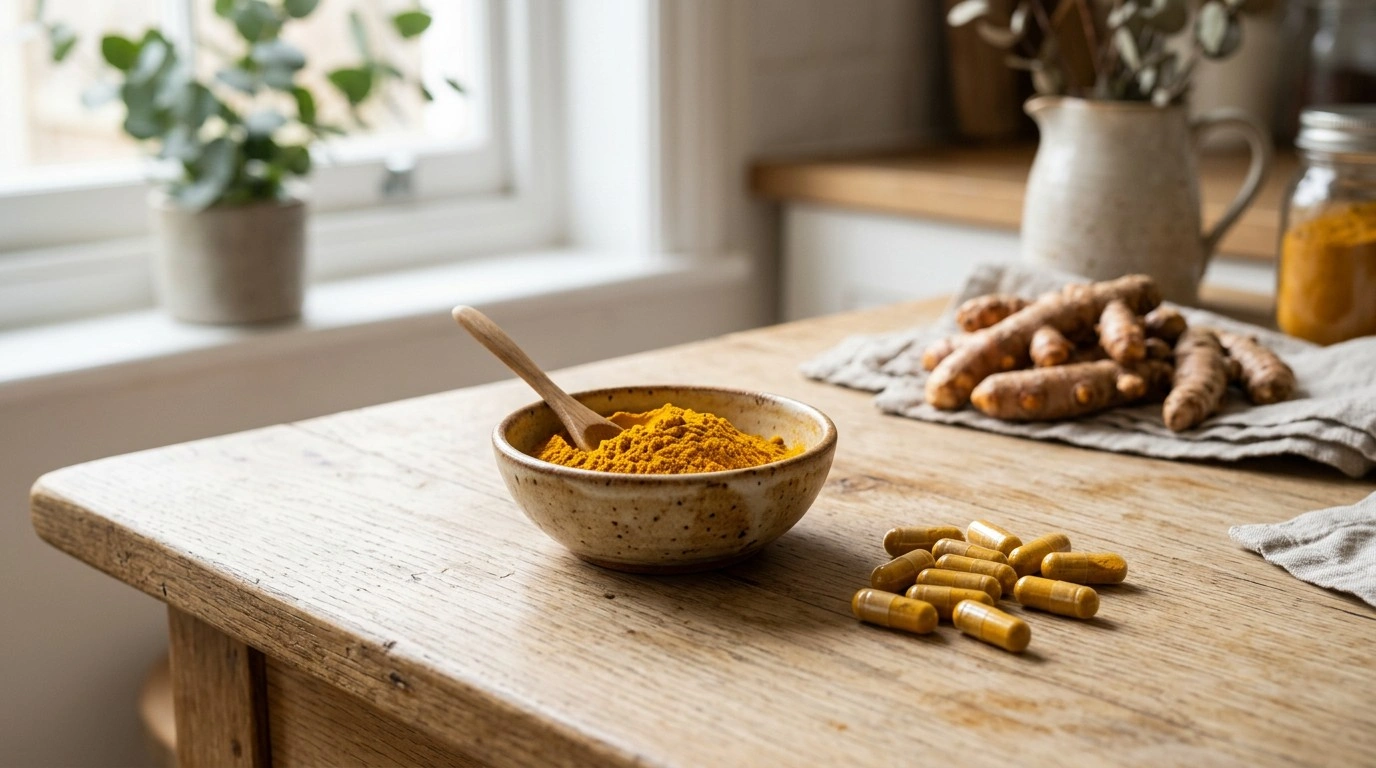
Turmeric powder supplements may contain ground turmeric in loose powder, capsule or tablet form.
About Turmeric Powder Supplements
Who Might Consider Turmeric Powder Supplements?
People may consider turmeric powder supplements because they want a convenient way to include turmeric in their daily routine.
Joint health is one of the main areas of interest. Turmeric and particularly curcumin have been studied for their potential effects on inflammatory processes, joint pain and stiffness, including research involving osteoarthritis.
Others may simply be interested in turmeric for general wellbeing or prefer a whole turmeric powder supplement rather than a concentrated extract.
However, evidence varies considerably between health outcomes and formulations. Many clinical studies use concentrated curcumin extracts rather than ordinary turmeric powder, so their findings cannot automatically be applied to every turmeric supplement.
What Are Turmeric Powder Supplements?
Turmeric powder is produced from the rhizome of the Curcuma longa plant, which is dried and ground into a distinctive yellow-orange powder.
As a supplement, turmeric powder may be sold loose, placed inside capsules or compressed into tablets.
A capsule or tablet does not automatically mean the product contains concentrated turmeric extract. It may simply contain ground turmeric powder, which is why checking the ingredients matters.
Where Can You Buy Turmeric Powder Supplements?
Turmeric powder supplements are widely available from online health and nutrition retailers, pharmacies, and health-food shops.
Look for products from reputable manufacturers that clearly identify the ingredients, amount per serving, recommended use and relevant safety information.
When Should You Take Turmeric Powder Supplements?
There is no single best time of day that applies to every turmeric powder supplement.
Follow the manufacturer’s serving instructions. Some people take turmeric with food, although individual products may contain other ingredients that affect how they should be used.
Why Do People Take Turmeric Powder Supplements?
People take turmeric supplements for different reasons, including convenience, general wellbeing and interest in the potential health effects of turmeric and curcumin.
Joint health is a particularly prominent area of research and consumer interest. Curcumin has also been widely studied for its effects on biological processes associated with inflammation and oxidative stress.
However, potential benefits should not be assumed simply because a product contains turmeric. The evidence depends on the health outcome, amount and formulation studied.
How Can You Compare Turmeric Powder Supplements?
Start by checking what is actually inside the product.
Look at:
- Whether it contains ground turmeric powder or an extract
- The amount provided per serving
- Curcuminoid content, if stated
- Whether black pepper or piperine is included
- Any additional ingredients
- Recommended serving instructions
- Safety information
- Manufacturing and quality information
Do not assume the product displaying the largest turmeric milligram number is automatically the strongest or best choice.
For more guidance, see how to choose a turmeric supplement.
Person Comparing Turmeric Powder Supplements

Comparing the ingredients can help identify whether a supplement contains turmeric powder, concentrated extracts or additional ingredients.
Table of Contents
- What Are the Potential Benefits of Turmeric Powder Supplements?
- Are Turmeric Powder Supplements Good for Joint Health?
- What Does Turmeric Powder Do in the Body?
- What is the Difference Between Turmeric Powder & Turmeric Extract?
- Are Turmeric Powder Capsules and Tablets the Same Thing?
- Turmeric Powder and Black Pepper
- Does Turmeric Powder Contain Curcumin?
- How Do You Take Turmeric Powder as a Supplement?
- How Much Turmeric Powder Should You Take?
- Can You Take Turmeric Powder Every Day?
- When Is the Best Time to Take Turmeric Powder?
- How Should You Choose a Turmeric Powder Supplement?
- Frequently Asked Questions
- What Are the Side Effects of Turmeric Powder Supplements?
- Can Turmeric Powder Supplements Interact with Medicines?
- Who Should Seek Medical Advice Before Taking Turmeric Powder Supplements?
- Summary and related guides
- Sources and Further information
What Are the Potential Benefits of Turmeric Powder Supplements?
Turmeric powder contains naturally occurring plant compounds called curcuminoids, with curcumin being the most extensively researched.
Research into turmeric and curcumin has investigated potential effects involving inflammation, joint health, exercise recovery and several other areas.
However, there is an important distinction when looking at the research.
Much of the clinical research investigates specific curcumin extracts or specially formulated supplements rather than ordinary ground turmeric powder.
A positive study involving a concentrated curcumin formulation therefore does not automatically mean that every turmeric powder supplement will produce the same result.
Turmeric powder comes from turmeric root and contains other naturally occurring components as well as curcumin, making it different from a purified or concentrated extract.
Are Turmeric Powder Supplements Good for Joint Health?
Joint health is one of the major reasons people become interested in turmeric and curcumin supplements.
Research has investigated turmeric and particularly curcumin preparations for conditions including osteoarthritis, with some studies reporting improvements in symptoms such as joint pain and stiffness.
However, formulations and study quality vary.
Evidence involving a concentrated or enhanced-absorption curcumin formulation does not necessarily demonstrate that ordinary turmeric powder will produce the same effect.
Turmeric supplements should not replace appropriate medical assessment or treatment for persistent, severe or unexplained joint pain.
What Does Turmeric Powder Do in the Body?
Turmeric powder p rovides numerous naturally occurring plant compounds, including curcuminoids.
Curcumin has received particular scientific attention because laboratory and clinical research has investigated its potential effects on biological processes associated with inflammation and oxidative stress.
However, curcumin has relatively low oral bioavailability in conventional forms. This is one reason supplement manufacturers have developed formulations intended to alter its absorption.
For consumers, the important distinction is simple:
Eating turmeric powder, taking a turmeric powder capsule and taking a concentrated high-bioavailability curcumin supplement are not necessarily equivalent.
What Is the Difference Between Turmeric Powder and Turmeric Extract?
This is an important difference to understand when comparing turmeric supplements.
Turmeric powder is generally made by drying and grinding turmeric root. You can learn more about dried turmeric and how it differs from other forms.
Turmeric extract is made by extracting and concentrating particular components from turmeric. Some extracts are standardised to provide specified amounts of curcuminoids.
Therefore, 1,000 mg of turmeric powder cannot automatically be compared with 1,000 mg of concentrated turmeric extract.
The number on the front of the bottle is only useful when you understand what that number actually represents.
Turmeric Powder vs Turmeric Extract
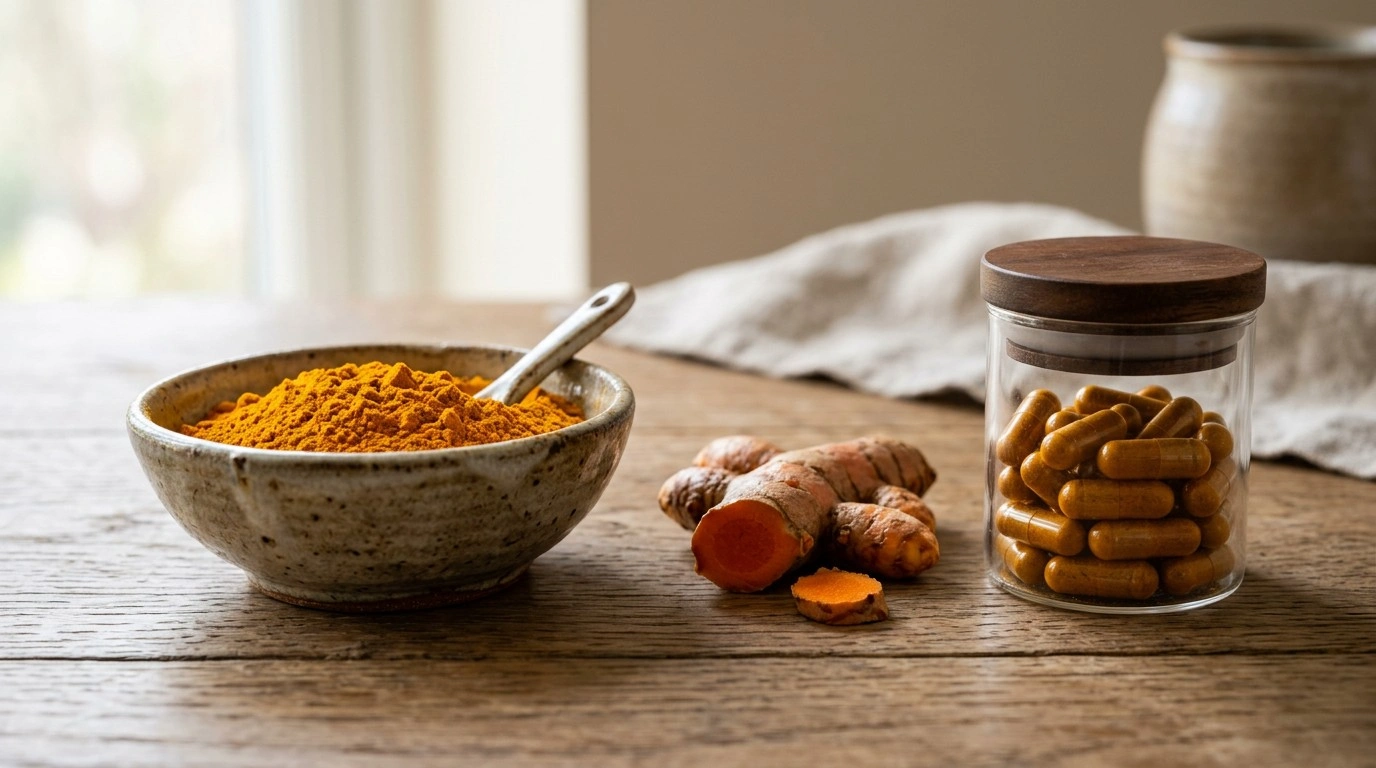
Turmeric powder and concentrated turmeric extracts are different forms and should not be compared by milligrams alone.
Are Turmeric Powder Capsules and Tablets the Same Thing?
Not necessarily.
Capsule and tablet describe the format of the supplement, rather than precisely what it contains.
A turmeric capsule or tablet could contain:
- Ground turmeric powder
- Turmeric extract
- Curcumin or curcuminoids
- Turmeric combined with black pepper
- Turmeric combined with ginger
- A mixture of powder and concentrated extracts
Someone looking for turmeric powder capsules, tablets or pills should therefore check the ingredients rather than assuming every turmeric supplement contains ordinary ground powder.
Turmeric Powder and Black Pepper
Turmeric powder is frequently combined with black pepper in foods and supplements.
The main reason is piperine, a naturally occurring compound in black pepper that has been investigated for its effect on curcumin bioavailability.
One frequently cited human study reported that adding piperine substantially increased the bioavailability of curcumin under the specific conditions studied. The increase is commonly described as 2,000%.
However, this does not mean that adding black pepper makes every turmeric product 2,000% more effective. Bioavailability and clinical effectiveness are not the same thing.
Our guide to turmeric and black pepper supplements explains the combination, piperine and curcumin absorption in more detail.
Turmeric Powder and Black Pepper
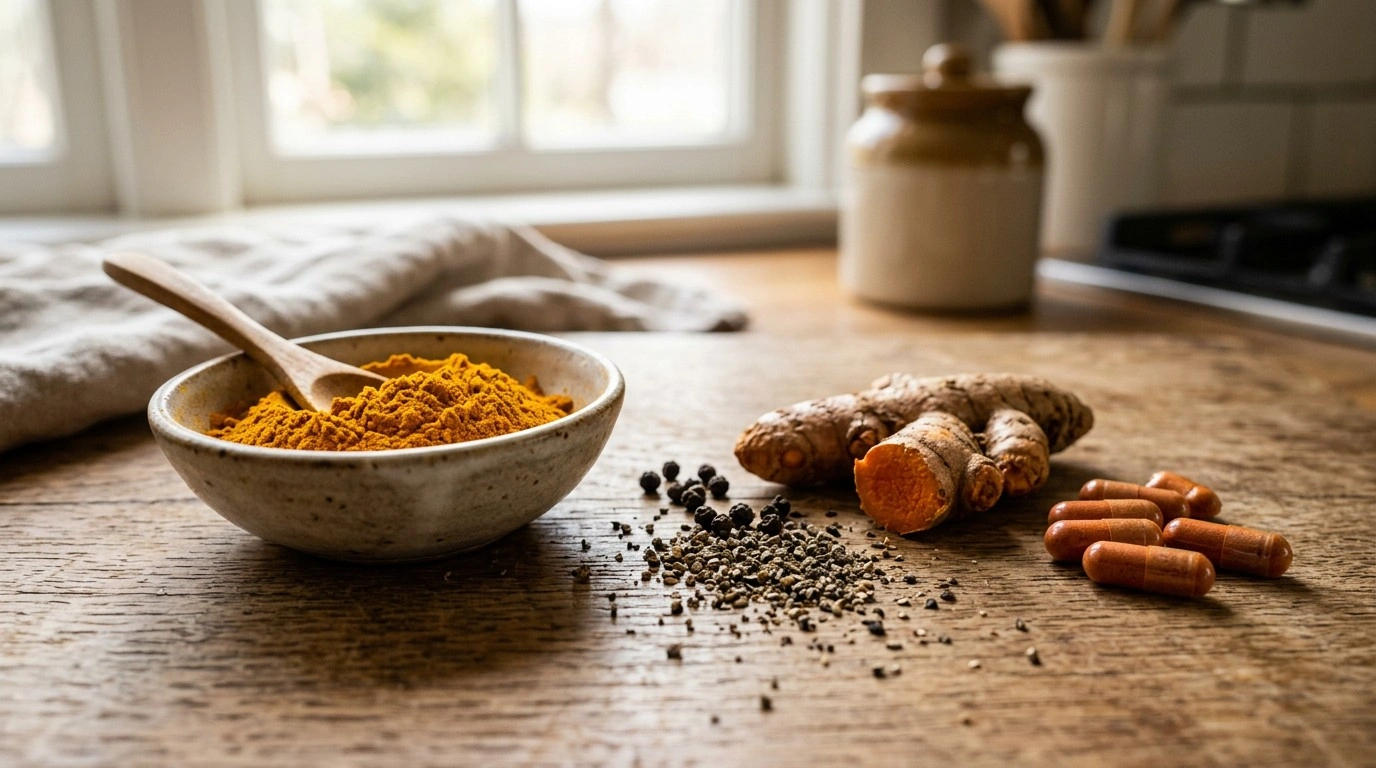
Black pepper is commonly combined with turmeric because its piperine content has been studied for its effect on curcumin bioavailability.
Does Turmeric Powder Contain Curcumin?
Yes. Curcumin is one of the naturally occurring curcuminoids found in turmeric.
However, turmeric powder and curcumin are not interchangeable terms.
Whole turmeric powder contains many naturally occurring components, while curcumin supplements may contain concentrated or extracted curcuminoids. The natural composition of turmeric can also vary.
This distinction matters when reading scientific studies because research involving concentrated curcumin cannot automatically tell you what to expect from ordinary turmeric powder.
How Do You Take Turmeric Powder as a Supplement?
Turmeric powder can be consumed in several ways.
People may:
- Take powder contained in capsules or tablets
- Mix turmeric powder into food
- Add it to milk or other drinks
- Use it in turmeric tea
- Combine it with black pepper
- Add it to smoothies
There is no requirement to consume turmeric in one particular format.
The appropriate method depends on the product, amount and reason for using it. If using a commercial supplement, follow its instructions.
How Much Turmeric Powder Should You Take?
There is no single amount of turmeric powder that is appropriate for everyone.
Turmeric powder, concentrated extracts and curcumin supplements can provide very different amounts and forms of curcuminoids. Dosages used for one formulation therefore cannot simply be transferred to another.
This is also why terms such as “high strength” can be difficult to interpret without knowing what the stated milligram amount represents.
For a commercial turmeric powder supplement, follow the recommended serving information rather than assuming that taking more will provide greater benefits.
Can You Take Turmeric Powder Every Day?
Turmeric is commonly consumed as part of the diet, but using turmeric in food is not necessarily equivalent to consuming larger amounts specifically for health purposes or taking concentrated supplements.
UK scientific authorities have considered the potential risks associated with turmeric and curcumin supplements, including differences between dietary exposure and supplemental use.
If you plan to take turmeric regularly as a supplement, follow the product directions and seek appropriate advice if you take medicines or have relevant health conditions.
When Is the Best Time to Take Turmeric Powder?
There is no established best time of day for everyone to take turmeric powder.
Morning versus evening is generally less important than following the instructions for the particular product and using it appropriately.
Some people prefer taking supplements alongside meals because it fits naturally into their routine.
Rather than choosing a time because turmeric supposedly “works better” in the morning or evening, concentrate on the formulation, serving instructions and what the supplement actually contains.
How Should You Choose a Turmeric Powder Supplement?
When choosing a turmeric supplement, don’t base your decision only on the largest number printed on the front.
Check:
- Whether it contains turmeric powder, extract or both
- Amount per serving
- Curcuminoid content where provided
- Whether black pepper or piperine is included
- Whether ginger or other ingredients are included
- Other ingredients and additives
- Serving instructions
- Safety information
- Manufacturing and quality information
Choosing a Turmeric Powder Supplement

Check the form of turmeric, amount per serving, curcuminoid information and additional ingredients when comparing supplements.
Frequently asked questions
Is turmeric powder healthy?
Turmeric is widely used as a food and spice and contains naturally occurring compounds including curcuminoids. Whether taking additional turmeric powder provides a particular health benefit depends on the amount, formulation and health outcome being considered.
What does turmeric powder do for your body?
Turmeric provides naturally occurring plant compounds including curcuminoids. Curcumin has been extensively researched for potential effects involving inflammatory and oxidative processes, although findings from concentrated preparations cannot automatically be applied to ordinary turmeric powder.
Is turmeric powder good for arthritis?
Research involving turmeric and particularly curcumin formulations has investigated osteoarthritis and joint symptoms, with some encouraging findings. However, formulations differ and the evidence should not be interpreted as proving that ordinary turmeric powder treats arthritis.
Is turmeric powder the same as a turmeric supplement?
Turmeric powder can be used as a supplement, but not every turmeric supplement contains ordinary powder. Some contain concentrated extracts, curcumin or specially formulated curcuminoids.
Does turmeric powder stain teeth?
Turmeric contains strong yellow pigments and can stain surfaces. If concerned about staining, avoid prolonged contact with the teeth and rinse your mouth after consuming strongly coloured turmeric preparations.
Does turmeric powder reduce belly fat?
There is insufficient evidence to treat turmeric powder as a proven method of reducing belly fat. Sustainable weight management depends on overall diet, physical activity and other lifestyle and health factors.
Is turmeric powder better with black pepper?
Black pepper contains piperine, which has been investigated for its ability to increase curcumin bioavailability. That does not mean every turmeric product requires black pepper or that adding pepper guarantees greater health benefits.
What Are the Side Effects of Turmeric Powder Supplements?
Turmeric used as a normal food ingredient is different from consuming larger quantities or concentrated supplements.
Some people may experience digestive effects such as stomach discomfort, nausea or diarrhoea.
Safety and potential side effects can depend on the formulation, amount and individual.
Can Turmeric Powder Supplements Interact with Medicines?
Turmeric and its naturally occurring compounds may interact with some medicines.
Potential interactions can also differ between ordinary turmeric powder and concentrated supplement formulations.
If you regularly take prescription medicines, check with a pharmacist, doctor or other appropriately qualified healthcare professional before taking turmeric specifically as a supplement.
Who Should Seek Medical Advice Before Taking Turmeric Powder Supplements?
Consider seeking professional advice before taking turmeric powder specifically as a supplement if you:
- Take prescription medicines
- Have an existing medical condition
- Have liver or gallbladder problems
- Are pregnant or breastfeeding
- Are preparing for surgery
- Have previously reacted to turmeric or related ingredients
Do not stop or change prescribed medication because of information about turmeric or dietary supplements.
Summary
Turmeric powder supplements provide a convenient way to consume ground turmeric without adding the spice to food or drinks every day.
People may be particularly interested in turmeric because of research involving joint health and inflammatory processes, but it is important to distinguish ordinary turmeric powder from the concentrated curcumin preparations used in many clinical studies.
Turmeric powder, turmeric extracts and concentrated curcumin supplements are not the same thing.
When comparing products, look beyond headline milligram figures and check the form of turmeric provided, amount per serving, curcuminoid information where available, additional ingredients such as black pepper and the manufacturer’s directions.
Understanding those differences makes it considerably easier to compare turmeric powder supplements realistically.
Related guides
- Turmeric Supplements – Learn about different types of turmeric supplements and how their formulations differ.
- Turmeric Capsules – Find out what turmeric capsules can contain and what to check when comparing them.
- Turmeric Tablets – Learn about turmeric tablets, potential benefits and different formulations.
- Turmeric and Black Pepper – Discover why turmeric and black pepper are commonly combined and what research says about curcumin absorption.
- Turmeric: The Complete Guide – Learn about turmeric, its potential benefits, uses, forms, curcumin and safety.
Sources and further information
Videos About Turmeric
Prefer to watch rather than read? We have also selected a few educational videos featuring qualified doctors, nutritional specialists and health professionals discussing turmeric and food supplements from different perspectives.
These videos are provided for further learning and do not replace medical advice or the scientific sources used throughout this guide.
1. Should You Take Turmeric Every Day? Here’s What Doctors Say
Doctors discuss the evidence, potential benefits and safety of taking turmeric regularly.
2. Turmeric is Good – Dr. Berg
Dr. Berg discusses how turmeric can support areas of your health.
3. Health reason turmeric needs black pepper (food or supplement) – Dr. Dhand
Dr. Suneel Dhand explains why black pepper is often combined with turmeric.
Articles and Further Reading
1. Influence of Piperine on the Pharmacokinetics of Curcumin in Animals and Human Volunteers – PubMed
The 1998 study investigating how piperine affected curcumin bioavailability, including the research behind the frequently quoted 2,000% figure.
2. Turmeric and Curcumin Supplements – UK Committee on Toxicity
A scientific assessment covering turmeric and curcumin supplements, exposure, bioavailability and safety considerations.
3. Turmeric – National Center for Complementary and Integrative Health
An evidence-based overview of turmeric and curcumin, including potential health effects, research and safety.
4. Curcuma longa Rhizome – European Medicines Agency
Scientific information and the European herbal assessment of turmeric (Curcuma longa) rhizome.
5. Curcumin Research – PubMed
Search published clinical trials, systematic reviews and other scientific research involving turmeric and curcumin.
6. Turmeric and Curcumin Research – PubMed Central
Browse full-text scientific papers and reviews covering turmeric, curcumin, bioavailability and related research.
Medical Disclaimer
The information on this page is provided for general educational and informational purposes only. It is not intended to provide medical advice, diagnosis or treatment and should not replace advice from an appropriately qualified healthcare professional.
Turmeric powder, turmeric extracts and curcumin supplements can differ considerably in their composition and concentration. Findings from research involving one formulation may not apply to another.
If you take medicines, have a medical condition, are pregnant or breastfeeding, or are considering regularly taking turmeric specifically for a health condition, seek appropriate professional advice before use.
Author
Written by J. Henderson
Health & Wellness Research Writer
J. Henderson writes evidence-based articles on nutrition, botanical supplements and everyday wellbeing. His work focuses on translating scientific research into clear, practical guidance that helps readers make informed decisions about natural health products.
- Written by J. Henderson
- Reviewed by Fiona Finlay
- Reviewed on the 01 September 2026