Turmeric and Black Pepper
Quick Answer
Turmeric and black pepper are commonly combined because piperine, a compound in black pepper, may increase the bioavailability of curcumin from turmeric. In a small human study, 20 mg of piperine taken with 2 g of curcumin increased measured curcumin bioavailability by 2,000% under the study conditions.
However, this does not mean every turmeric and black pepper supplement increases absorption by 2,000%, or that greater absorption produces an equivalent increase in health benefits. The formulation, ingredients, amounts and individual response can all matter.
Key Points
- Turmeric naturally contains curcumin.
- Black pepper contains piperine.
- Curcumin naturally has low bioavailability.
- Piperine may increase curcumin absorption.
- One human study reported a 2,000% increase.
- Potential benefits are still being researched.
- Powder, capsules and tablets can differ considerably.
- Ginger is also commonly combined with turmeric and black pepper.
- Side effects and medicine interactions are possible.
Turmeric and Black Pepper

Turmeric and black pepper are commonly combined in foods, drinks and dietary supplements.
About Turmeric and Black Pepper
Who Might Consider Turmeric and Black Pepper?
People interested in turmeric or curcumin supplements may encounter products containing black pepper or piperine. These products are often marketed to people interested in potential benefits such as joint health.
People taking medicines or with existing health conditions should be particularly careful when considering concentrated supplements and may need advice from a doctor or pharmacist.
What Are Turmeric and Black Pepper?
Turmeric comes from the rhizome of Curcuma longa and contains naturally occurring compounds called curcuminoids, including curcumin.
Black pepper comes from Piper nigrum. It contains piperine, a compound that has been studied partly because of its potential effects on the absorption and metabolism of other substances.
Where Are Turmeric and Black Pepper Used Together?
Turmeric and black pepper are used together in cooking, drinks and dietary supplements.
In supplements, black pepper extract or piperine may be combined with turmeric or curcumin specifically to influence bioavailability. This is different from simply seasoning food with turmeric powder and ordinary black pepper.
When Are Turmeric and Black Pepper Taken Together?
There is no universally established best time of day to take turmeric and black pepper.
Supplement formulations and directions vary, so follow the instructions provided with the particular product. If you take medicines, check whether the ingredients could interact with them.
Why Is Black Pepper Added to Turmeric?
Black pepper is commonly added because curcumin naturally has low oral bioavailability.
Piperine may influence processes involved in the absorption and metabolism of curcumin. A frequently cited human study found substantially greater curcumin bioavailability when piperine was given alongside curcumin.
However, this finding should not be interpreted as meaning every turmeric and black pepper product produces the same effect.
How Does Black Pepper Affect Curcumin Absorption?
Piperine appears to influence processes involved in the metabolism and intestinal handling of curcumin.
This may allow more curcumin to become available to the body. However, bioavailability is complex, and piperine is not the only method used in modern curcumin supplements to try to improve absorption.
Increased bioavailability should not be confused with increased clinical effectiveness.
Comparing Turmeric and Black Pepper Supplements

Turmeric and black pepper supplements can contain different ingredients, amounts and formulations.
Table of Contents
- Why Are Turmeric and Black Pepper Often Combined?
- Does Black Pepper Increase Curcumin Absorption?
- Does Black Pepper “Activate” Turmeric?
- Turmeric and Black Pepper: Potential Benefits
- What Is Turmeric and Black Pepper Good For?
- Turmeric, Ginger and Black Pepper Supplements
- Turmeric Powder and Black Pepper
- Turmeric and Black Pepper Capsules
- Turmeric and Black Pepper Tablets
- Is Black Pepper Necessary with Turmeric?
- How Do You Take Turmeric and Black Pepper?
- How Should You Compare Turmeric and Black Pepper Supplements?
- Turmeric and Black Pepper vs Curcumin and Piperine
- Frequently Asked Questions
- Are there any Side Effects of Turmeric and Black Pepper Supplements?
- Can Turmeric and Black Pepper Interact with Medicines?
- Who Should Seek Medical Advice Before Taking Turmeric and Black Pepper Supplements?
- Summary
- Further Information
Why Are Turmeric and Black Pepper Often Combined?
The main scientific reason for combining turmeric or curcumin with black pepper is bioavailability.
Curcumin is poorly absorbed when taken orally and is rapidly metabolised and eliminated. This has led researchers and turmeric supplement manufacturers to investigate different ways of increasing the amount of curcumin available to the body.
Piperine is one of the best-known approaches.
This explains why terms such as turmeric and black pepper, curcumin with piperine and turmeric with black pepper extract frequently appear on supplement labels.
However, piperine is only one approach. Modern curcumin supplements may use other formulation technologies designed to improve bioavailability.
Turmeric, Black Pepper and Curcumin Absorption
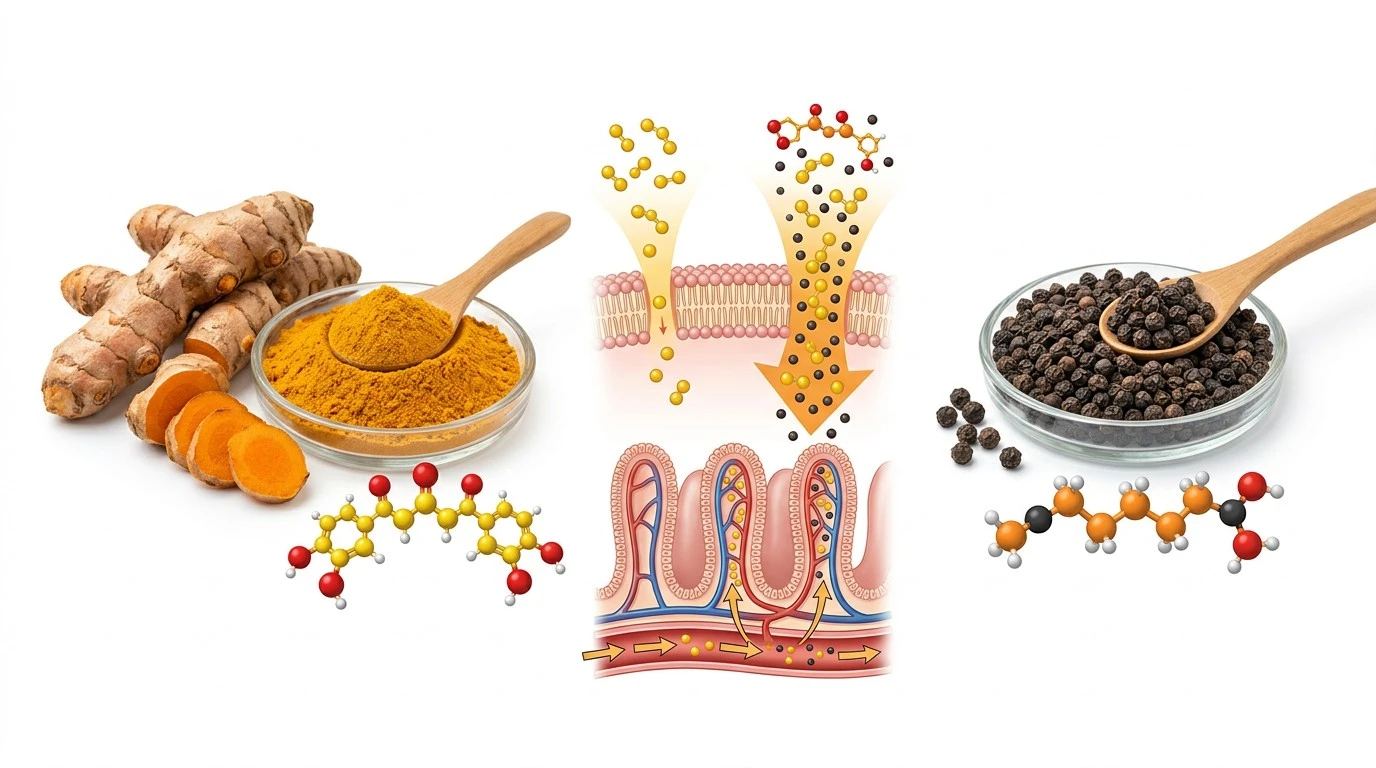
Piperine in black pepper has been studied for its potential to increase the bioavailability of curcumin.
Does Black Pepper Increase Curcumin Absorption?
Research suggests that piperine can increase the bioavailability of curcumin under certain conditions. Our guide to whether black pepper increases turmeric absorption explains how this works and what the research actually shows.
One frequently cited human study published in 1998 investigated curcumin alone and curcumin combined with piperine.
Healthy volunteers received 2 g of curcumin followed by 20 mg of piperine. Researchers reported that adding piperine increased measured curcumin bioavailability by 2,000%.
What Does the 2,000% Figure Actually Mean?
The figure is scientifically interesting, but it is frequently presented without enough context.
It means researchers measured substantially greater curcumin bioavailability under the conditions used in that particular study.
It does not mean:
- Every turmeric and black pepper product increases absorption by 2,000%.
- Adding ordinary black pepper to food guarantees the same effect.
- The combination produces 2,000% greater health benefits.
- Every supplement containing piperine performs equally.
- More black pepper or piperine is necessarily better.
The study provides evidence that piperine can influence curcumin bioavailability. It does not provide a universal absorption figure for every turmeric and black pepper product.
Does Black Pepper “Activate” Turmeric?
You may see claims that black pepper “activates” turmeric.
This is easy to understand but scientifically imprecise.
Black pepper does not switch turmeric on or make turmeric become active.
A better explanation is:
Piperine in black pepper may increase the bioavailability of curcumin under certain conditions, meaning more curcumin may become available to the body.
Turmeric still contains its naturally occurring compounds whether or not black pepper is present.
Turmeric and Black Pepper: Potential Benefits
People commonly search for the benefits of turmeric and black pepper, but the evidence needs to be interpreted carefully.
Most clinical research investigates turmeric, curcumin or particular curcumin formulations rather than demonstrating that every combination of turmeric and black pepper provides the same benefits.
Black pepper is primarily relevant because piperine may influence curcumin bioavailability. It should not be viewed as automatically creating additional turmeric benefits.
Joint Health and Osteoarthritis
Joint health is one of the most researched reasons people consider turmeric and curcumin supplements.
Clinical trials and systematic reviews have investigated different turmeric and curcumin preparations for symptoms associated with osteoarthritis, particularly knee osteoarthritis.
Some findings are encouraging, but studies use different formulations, doses and treatment periods. Research involving one curcumin preparation cannot automatically be applied to every turmeric and black pepper supplement.
Turmeric and Black Pepper and Joint Health

Joint health is one of several areas investigated in research involving turmeric and curcumin.
Inflammation
Curcumin has been extensively investigated for its effects on biological pathways associated with inflammation.
This helps explain why turmeric supplements are frequently promoted for inflammatory conditions.
However, demonstrating effects on inflammatory processes or biomarkers is not the same as proving that a supplement can prevent, treat or cure a disease.
Antioxidant Activity
Curcumin and other compounds found in turmeric have demonstrated antioxidant activity in laboratory research.
Human health outcomes are more complicated, and laboratory antioxidant activity should not automatically be interpreted as evidence of a particular clinical benefit.
Metabolic Health
Researchers have also investigated turmeric and curcumin in relation to areas of metabolic health, including blood glucose and lipid markers.
Results vary between studies, and further high-quality research is needed to establish which formulations, if any, produce clinically meaningful effects.
What Is Turmeric and Black Pepper Good For?
People take turmeric and black pepper supplements for several reasons, particularly interest in joint health and the potential effects associated with turmeric and curcumin.
However, there is an important distinction between:
what people use a supplement for
and
what good-quality clinical evidence has demonstrated that the supplement can do.
Potential benefits depend on the formulation, amount, duration and health outcome being investigated.
Turmeric and black pepper should not be presented as a treatment or cure for a medical condition.
Turmeric, Ginger and Black Pepper Supplements
Turmeric, ginger and black pepper are also commonly combined in dietary supplements.
Turmeric and ginger both belong to the Zingiberaceae, or ginger, plant family, but they contain different naturally occurring compounds. Our turmeric vs ginger guide compares the two in more detail.
Turmeric is particularly associated with curcuminoids such as curcumin. Ginger contains compounds including gingerols and shogaols. Black pepper contains piperine.
Why Are Turmeric, Ginger and Black Pepper Combined?
People may choose supplements containing all three ingredients because of interest in areas such as joint health, digestion and inflammatory processes.
Black pepper may also be included because of piperine’s potential effect on curcumin bioavailability.
However, combining more ingredients does not automatically make a supplement more effective.
Research into curcumin alone cannot automatically be used as evidence that a turmeric, ginger and black pepper supplement provides the same effect.
The amounts and formulations of all three ingredients should be considered when comparing products.
Turmeric, Ginger and Black Pepper

Turmeric, ginger and black pepper are frequently combined in dietary supplements, although each contains different naturally occurring compounds.
Turmeric Powder and Black Pepper
Turmeric powder and black pepper are commonly combined in food and drinks as well as being sold together in some supplements.
However, ordinary turmeric powder and ground black pepper are not necessarily equivalent to the concentrated ingredients used in clinical research.
Turmeric powder naturally contains curcumin, but generally in much lower concentrations than concentrated curcumin extracts.
Ordinary black pepper contains piperine, but the amount is not equivalent to taking a measured, standardised black pepper or piperine extract.
Can You Simply Add Black Pepper to Turmeric Powder?
You can use turmeric and black pepper together as culinary ingredients.
However, it would be misleading to assume that adding an unspecified amount of ordinary black pepper to turmeric powder reproduces the results of a study using measured quantities of curcumin and piperine.
Cooking with turmeric and black pepper and taking a concentrated supplement are different situations.
Turmeric Powder and Black Pepper vs Supplements
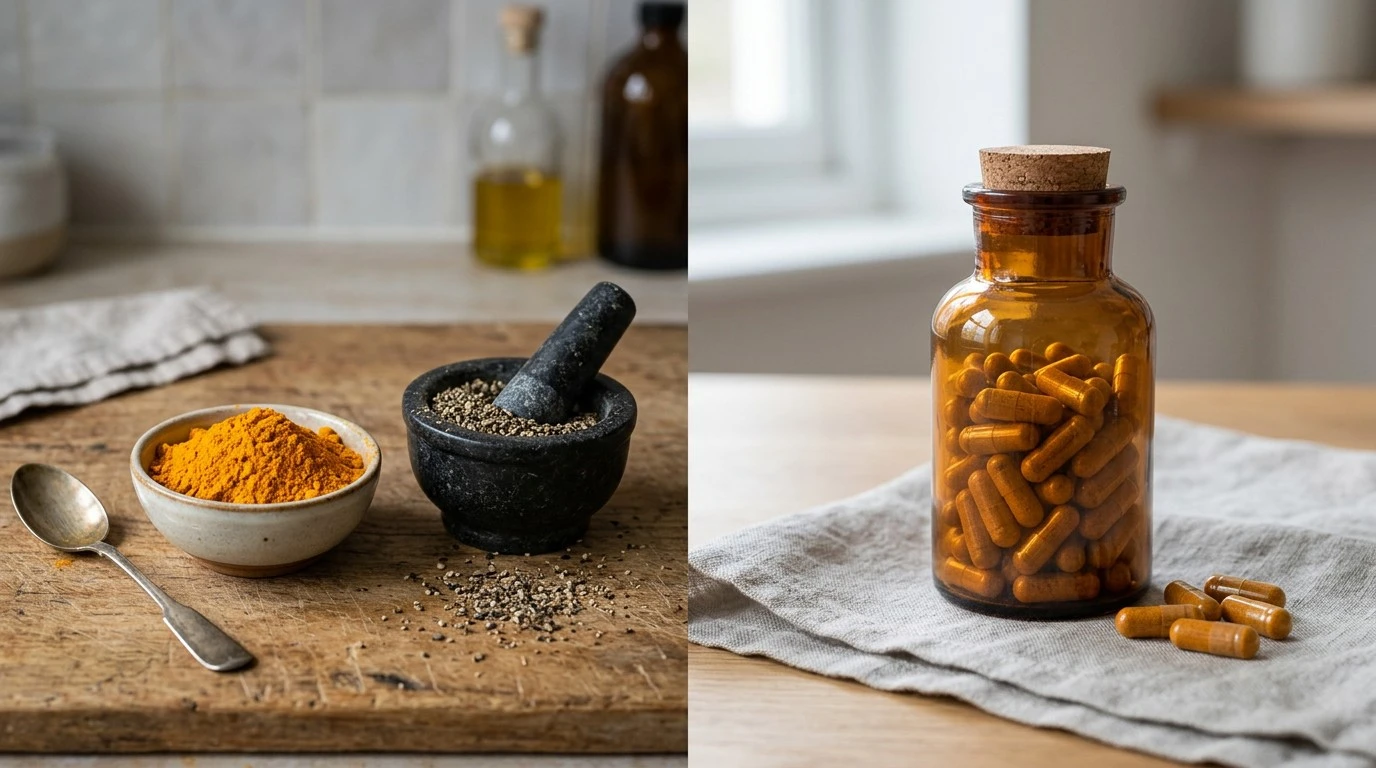
Culinary turmeric and black pepper should not be assumed to provide the same amounts as concentrated supplement formulations.
Turmeric and Black Pepper Capsules
Capsules are one of the most common supplement formats containing turmeric and black pepper.
They may contain turmeric powder, turmeric extract, concentrated curcumin or combinations of these ingredients alongside black pepper extract or piperine.
Capsules provide a convenient, pre-measured format, but products can differ substantially.
The fact that two products are both labelled turmeric and black pepper capsules does not mean their formulations are equivalent.
Turmeric and Black Pepper Tablets
Turmeric and black pepper are also available in tablet form.
As with capsules, tablets may contain very different amounts and types of turmeric, curcumin and black pepper extract.
The delivery format itself does not establish how effective a product is.
When comparing turmeric tablets, look beyond the total milligram number and check what the product actually contains.
Turmeric and Black Pepper Supplements
The growing number of supplement formats makes understanding the label particularly important.
Turmeric and black pepper supplements may contain:
- Turmeric powder
- Turmeric extract
- Curcumin or curcuminoids
- Ground black pepper
- Black pepper extract
- Standardised piperine
- Ginger
- Additional ingredients
Some formulations therefore bear little resemblance to others despite being marketed under the same broad description.
A large number such as “10,000 mg” or “15,000 mg” on the front of a product should not automatically be interpreted as meaning that the supplement provides that amount of curcumin or is more effective.
Turmeric and Black Pepper Capsules and Tablets
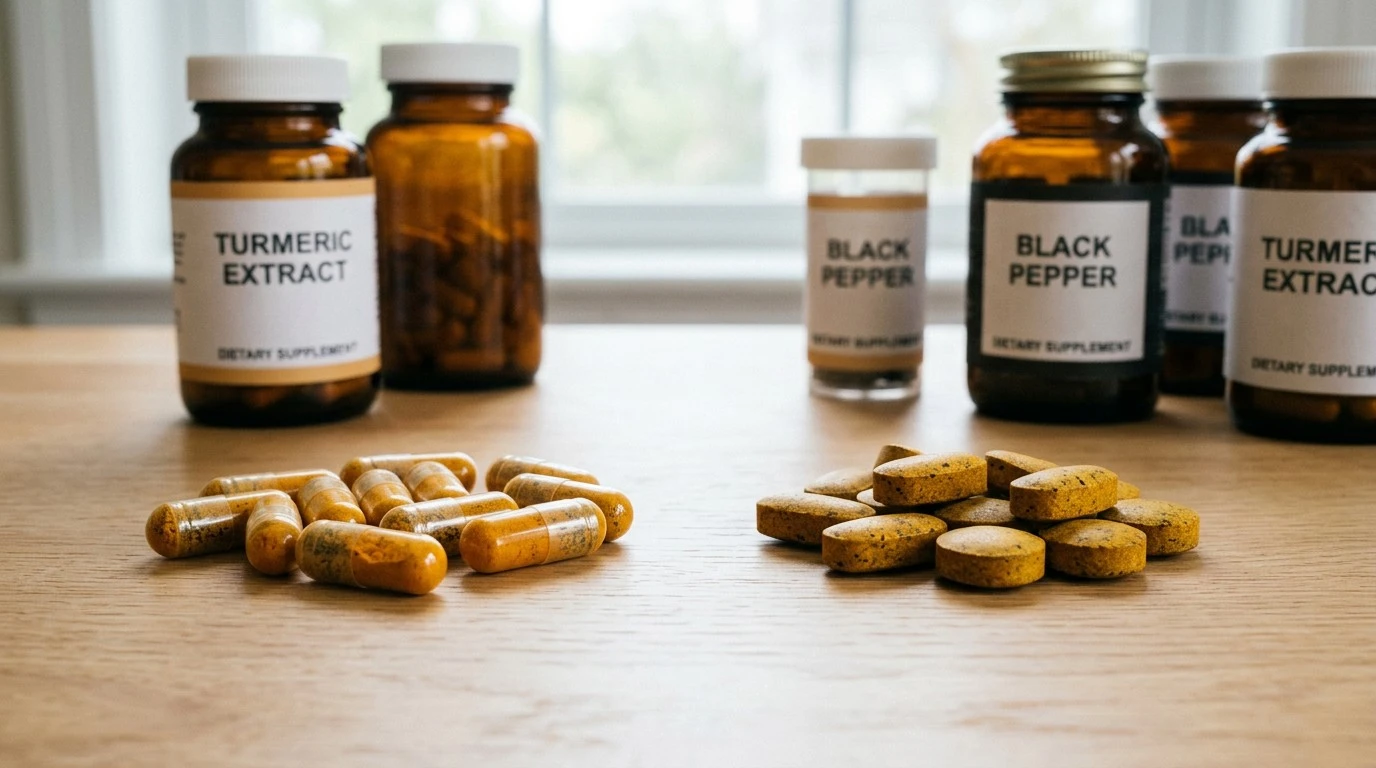
Turmeric and black pepper supplements are available in different formats and can contain very different formulations.
Is Black Pepper Necessary with Turmeric?
No. Turmeric does not have to be consumed with black pepper.
Turmeric has long been used as a culinary ingredient without black pepper being necessary for its use.
Black pepper becomes particularly relevant when discussing curcumin bioavailability.
Piperine is one approach researchers and manufacturers have used to increase curcumin exposure, but it is not the only approach. Other curcumin formulations use different delivery technologies.
Therefore:
Turmeric does not “need” black pepper, but piperine may increase the bioavailability of curcumin under certain conditions.
How Do You Take Turmeric and Black Pepper?
There is no single method or amount appropriate for everyone.
Turmeric and black pepper may be consumed in food, drinks, powders or supplements. These should not be assumed to provide equivalent amounts of turmeric, curcumin or piperine.
For supplements, follow the manufacturer’s directions rather than attempting to reproduce quantities used in individual clinical studies.
If you take medicines or have a relevant medical condition, seek appropriate professional advice before taking concentrated turmeric, curcumin or piperine supplements.
How Should You Compare Turmeric and Black Pepper Supplements?
Start by looking at what the product actually contains rather than relying on the marketing claims on the front.
Check:
- Whether it contains turmeric powder, extract or curcumin
- The amount provided per serving
- Curcuminoid content, where stated
- Whether black pepper or piperine is included
- The amount of piperine, where stated
- Whether ginger or other ingredients are included
- Other ingredients and additives
- Recommended serving instructions
- Safety information and warnings
- Manufacturing and quality information
Do not assume the product with the highest turmeric milligram number is automatically the strongest, most effective or most appropriate.
For a more detailed checklist, see our guide on how to choose a turmeric supplement.
Turmeric and Black Pepper vs Curcumin and Piperine
These terms are often used as though they mean the same thing, but they do not.
Turmeric is the plant material or a product derived from it.
Curcumin is one of the naturally occurring curcuminoids found within turmeric.
Black pepper contains numerous naturally occurring compounds.
Piperine is one compound found in black pepper.
A study involving isolated curcumin and piperine therefore does not necessarily tell us what happens when somebody consumes ordinary turmeric powder and ground black pepper.
This distinction is particularly important when interpreting supplement marketing claims.
Frequently asked questions
What Does Taking Turmeric and Black Pepper Do?
Black pepper contains piperine, which may increase the bioavailability of curcumin under certain conditions. Potential health effects depend on the ingredients, formulation and outcome being studied.
What Is Turmeric and Black Pepper Good For?
People commonly take the combination because of interest in potential turmeric or curcumin benefits, particularly joint health. However, evidence varies according to the formulation and health outcome studied.
Is Turmeric and Black Pepper Good for You?
Turmeric and black pepper can form part of a normal diet. Concentrated supplements are different, and their potential benefits and risks depend on their formulation, amounts and the individual taking them.
Does Black Pepper Activate Turmeric?
Not literally. Piperine may increase curcumin bioavailability, but it does not switch turmeric on or “activate” it.
What Are Turmeric, Ginger and Black Pepper Good For?
People take supplements containing these ingredients for several reasons, including interest in joint health, digestion and inflammatory processes. However, evidence for individual ingredients should not automatically be interpreted as evidence for every three-ingredient supplement.
What Is the Best Time to Take Turmeric and Black Pepper?
There is no universally established best time. Follow the instructions for the particular supplement rather than assuming morning or evening is inherently better.
How Long Does Turmeric with Black Pepper Take to Work?
There is no universal timeframe. Results investigated in clinical studies vary according to the health outcome, formulation, dose and duration, and some people may experience no noticeable effect.
What Are the Side Effects of Turmeric and Black Pepper Supplements?
Turmeric and black pepper supplements are generally different from the amounts used in normal foods. Some people may experience side effects such as stomach discomfort, nausea or diarrhoea.
Rare cases of liver injury have also been reported with some turmeric and curcumin supplements. Side effects can depend on the ingredients, amounts and individual.
Can Turmeric and Black Pepper Interact with Medicines?
Turmeric, curcumin and piperine may interact with some medicines. Piperine can also affect how certain substances are absorbed or metabolised.
If you regularly take prescription medicines, check with a pharmacist or doctor before taking a concentrated turmeric and black pepper supplement.
Who Should Seek Medical Advice Before Taking Turmeric and Black Pepper Supplements?
Speak to an appropriately qualified healthcare professional before taking a concentrated supplement if you take medicines, have a medical condition, are pregnant or breastfeeding, are preparing for surgery, or have previously reacted to any of the ingredients.
Do not stop or change prescribed medication because of information about turmeric or dietary supplements.
Summary
Turmeric and black pepper are frequently combined because piperine in black pepper may increase the bioavailability of curcumin.
A small human study reported a 2,000% increase in measured curcumin bioavailability when 20 mg of piperine was given with 2 g of curcumin. This is an important finding, but it does not prove that every turmeric and black pepper product produces the same increase or greater health benefits.
People are also interested in turmeric and black pepper benefits, powders, capsules and tablets, while turmeric, ginger and black pepper are commonly combined in supplements.
These different products should not be assumed to be equivalent.
The simplest approach is to look beyond headline numbers and consider what the product contains, what scientific evidence supports it and whether it is appropriate for the individual taking it.
Related guides
If you would like to learn more about turmeric supplements and the ingredients commonly used in them, these related guides may help:
Turmeric Supplements – Learn about the different types of turmeric supplements, what they contain and how they compare.
Turmeric Capsules – A closer look at turmeric capsules, formulations, ingredients and what to consider when comparing products.
Turmeric Tablets – Learn what turmeric tablets contain, their potential benefits and how different formulations compare.
What Is Curcumin? – Learn about curcumin, the naturally occurring compound in turmeric that is the focus of much scientific research.
Sources and further information
Videos and Further Learning
Videos can provide an easier introduction to turmeric, curcumin and supplement research before exploring the scientific sources above.
1. Should You Take Turmeric Every Day? Here’s What Doctors Say
The doctors break down the truth about turmeric. From its anti-inflammatory reputation to its role in chronic disease prevention, they take a medically reviewed look at what the science actually says about turmeric.
2. Important HEALTH reason TURMERIC needs BLACK PEPPER (food or supplement)
Dr. Dhand explains what black pepper does to turmeric.
Further Reading
The information on this page is based on scientific research and guidance from recognised health and scientific organisations. The following resources provide further information about turmeric, curcumin, black pepper and piperine.
1. PubMed – Piperine and Curcumin Bioavailability
Read the 1998 human study investigating how piperine affected the bioavailability of curcumin, which is the source of the frequently cited 2,000% figure.
2. National Center for Complementary and Integrative Health (NCCIH)
The NCCIH provides an evidence-based overview of turmeric and curcumin, including current research, potential health applications and safety considerations.
3. UK Committee on Toxicity
Explore the Committee on Toxicity’s UK scientific assessment of turmeric and curcumin supplements, covering bioavailability, exposure and potential safety considerations.
4. PubMed Central – Turmeric and Curcumin Research
Search scientific papers and reviews available through PubMed Central covering turmeric, curcumin, piperine, bioavailability and related research.
5. UK Government – Herb-Induced Liver Injury
Read the UK government’s scientific information on herb-induced liver injury, which includes consideration of turmeric and curcumin supplements.
PubMed – Curcumin Research
Explore current scientific research on curcumin through PubMed, including clinical trials, systematic reviews and other published research.
Medical Disclaimer
The information on this page is provided for general educational and informational purposes only. It is not intended to provide medical advice, diagnosis or treatment, and should not be used as a substitute for advice from a qualified healthcare professional.
Research into turmeric, curcumin, black pepper and piperine continues, and findings from individual studies may not apply to every person, product or supplement formulation.
Turmeric and black pepper used in normal foods may also differ considerably from concentrated turmeric, curcumin or piperine supplements.
If you take medicines, have a medical condition, are pregnant or breastfeeding, or are considering taking a concentrated turmeric or curcumin supplement, speak to an appropriately qualified healthcare professional before use.
Author
Written by J. Henderson
Health & Wellness Research Writer
J. Henderson writes evidence-based articles on nutrition, botanical supplements and everyday wellbeing. His work focuses on translating scientific research into clear, practical guidance that helps readers make informed decisions about natural health products.
- Written by J. Henderson
- Reviewed by Fiona Finlay
- Reviewed on the 01 September 2026