Turmeric Supplements and Food
Turmeric supplements are often taken with food, but whether food makes a meaningful difference depends on the type of turmeric or curcumin supplement being used. Turmeric contains naturally occurring compounds called curcuminoids, including curcumin, which have relatively poor absorption when consumed on their own. Research suggests that the food matrix, the formulation of a supplement and ingredients such as piperine can all affect how curcuminoids are absorbed.
For many people, taking a turmeric supplement with a meal may also be easier on the stomach. However, there is no single rule that applies to every turmeric product. Some supplements are specifically formulated to improve curcumin absorption and may have their own instructions.
Quick answer: Should you take turmeric supplements with food?
Usually, taking a turmeric or curcumin supplement with food is a reasonable approach, particularly if the product instructions recommend it. Food can influence curcuminoid absorption, although the effect varies according to the formulation and the food itself.
Key points
- Check the product label for specific instructions.
- Take with food if recommended or if it helps avoid stomach upset.
- Food can affect curcumin absorption.
- Black pepper may increase absorption, but can interact with some medicines.
- Higher absorption does not always mean greater benefits.
- Ask a doctor or pharmacist if you take medicines or have health conditions.
Turmeric Supplements and Food
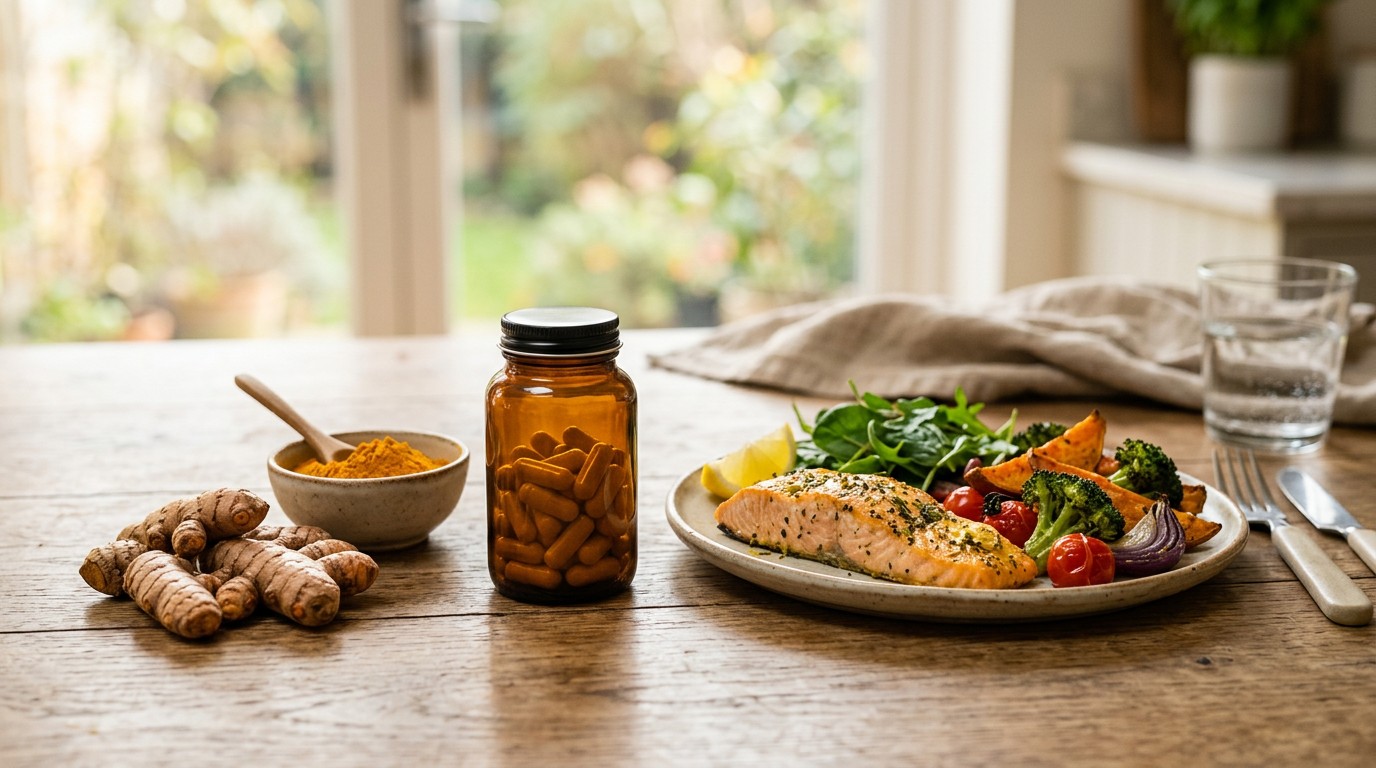
Turmeric supplements can be taken with food depending on the product formulation and label instructions.
Table of Contents
- Turmeric supplements and food: what is the connection?
- Does taking turmeric with food improve absorption?
- Turmeric food versus turmeric supplements
- What about turmeric with fat or black pepper?
- When should you take a turmeric supplement?
- Safety and precautions
- Frequently asked questions
- Summary
- Sources and further information
Turmeric supplements and food: what is the connection?
Turmeric comes from the rhizome of Curcuma longa. It contains a group of compounds known as curcuminoids, with curcumin being the best known.
One reason food matters is that curcumin has relatively poor water solubility and is rapidly metabolised after oral consumption. Consequently, the amount of unchanged curcumin that reaches the bloodstream can be low. Researchers have investigated different ways of improving its bioavailability, including combining it with other ingredients and changing the formulation.
Food itself can also form part of the environment in which turmeric compounds are digested and absorbed. This means that asking whether turmeric should be taken “with food” is slightly more complicated than simply saying that food always increases absorption.
Does taking turmeric with food improve absorption?
There is evidence that the food matrix can affect the absorption of curcuminoids.
In a human crossover study, researchers compared meals containing turmeric powder, fresh turmeric root and curcumin powder. The turmeric meals produced higher plasma concentrations of curcuminoids than the curcumin powder meal, suggesting that compounds naturally present in turmeric and the structure of the food may influence bioavailability.
Another human study detected curcuminoid metabolites in the blood after people consumed turmeric-containing foods. This demonstrates that turmeric consumed as part of a normal food matrix can result in measurable exposure to turmeric compounds, although this does not establish a particular health benefit.
More recent research has also examined how different food matrices affect curcuminoid absorption from formulated turmeric products. This supports the broader conclusion that what is eaten alongside a supplement can matter, but the effect depends on the particular formulation.
Therefore, it is more accurate to say food can influence turmeric and curcumin absorption, rather than claiming that taking every turmeric supplement with food will automatically make it work better.
How Food Can Affect Curcumin Absorption
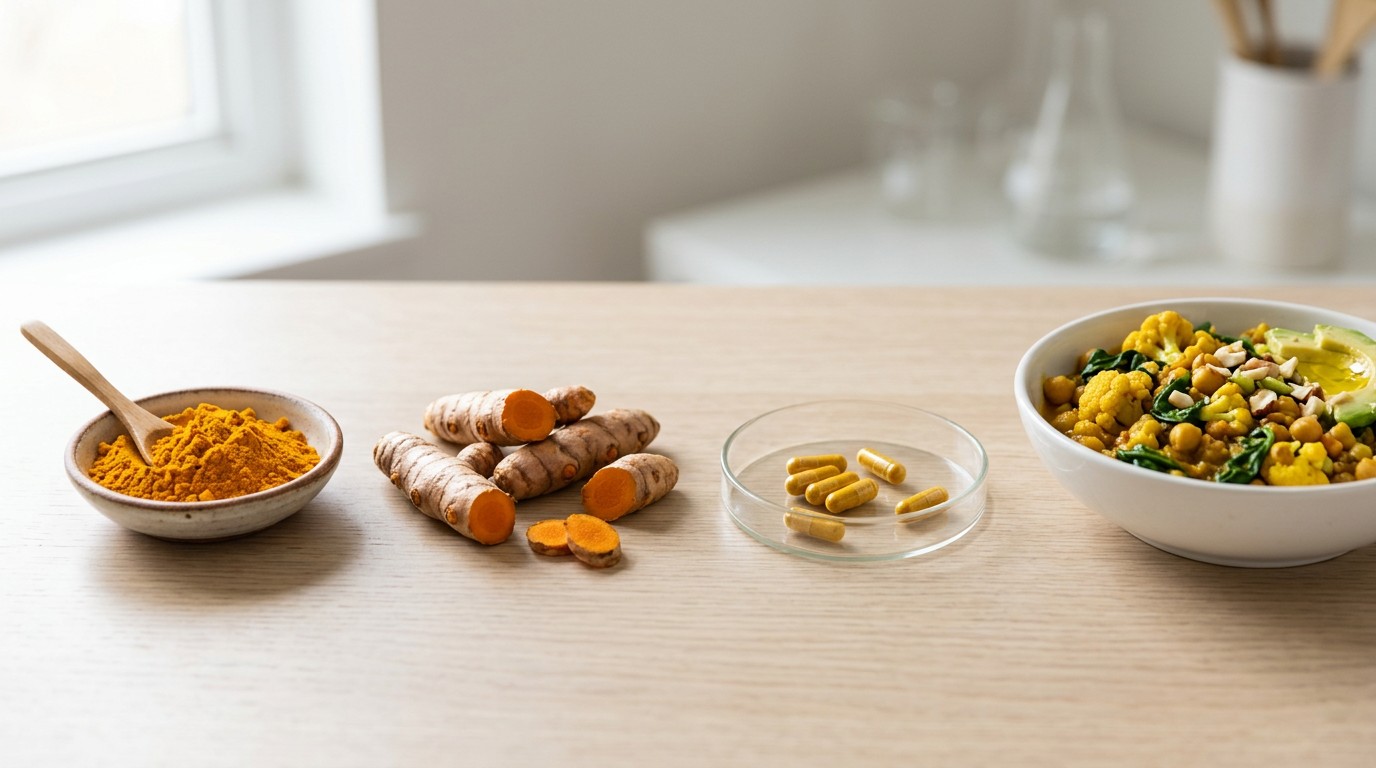
Food and the food matrix can influence how curcuminoids are absorbed after turmeric is consumed.
Turmeric food versus turmeric supplements
Turmeric used in cooking and concentrated turmeric supplements should not be treated as equivalent
| Form | Typical use | What to know |
| Fresh turmeric | Cooking and food | Contains curcuminoids alongside other plant compounds. |
| Turmeric powder | Food and cooking | Can be incorporated into meals and drinks. |
| Turmeric extract | Supplement | Usually more concentrated than culinary turmeric. |
| Curcumin supplement | Supplement | May contain a concentrated amount of selected curcuminoids. |
| Curcumin with piperine | Supplement | Designed to increase curcumin exposure; may have additional interaction considerations. |
| Enhanced-bioavailability formulation | Supplement | Uses a formulation or delivery system intended to improve absorption. |
The European Medicines Agency distinguishes medicinal turmeric preparations from ordinary food use and notes that traditional turmeric medicines have been used for mild digestive complaints. It also states that clinical evidence for this use is limited.
This distinction is important because a food ingredient consumed in ordinary culinary amounts does not necessarily have the same effects, risks or pharmacological exposure as a concentrated supplement.
Turmeric Food vs Turmeric Supplements
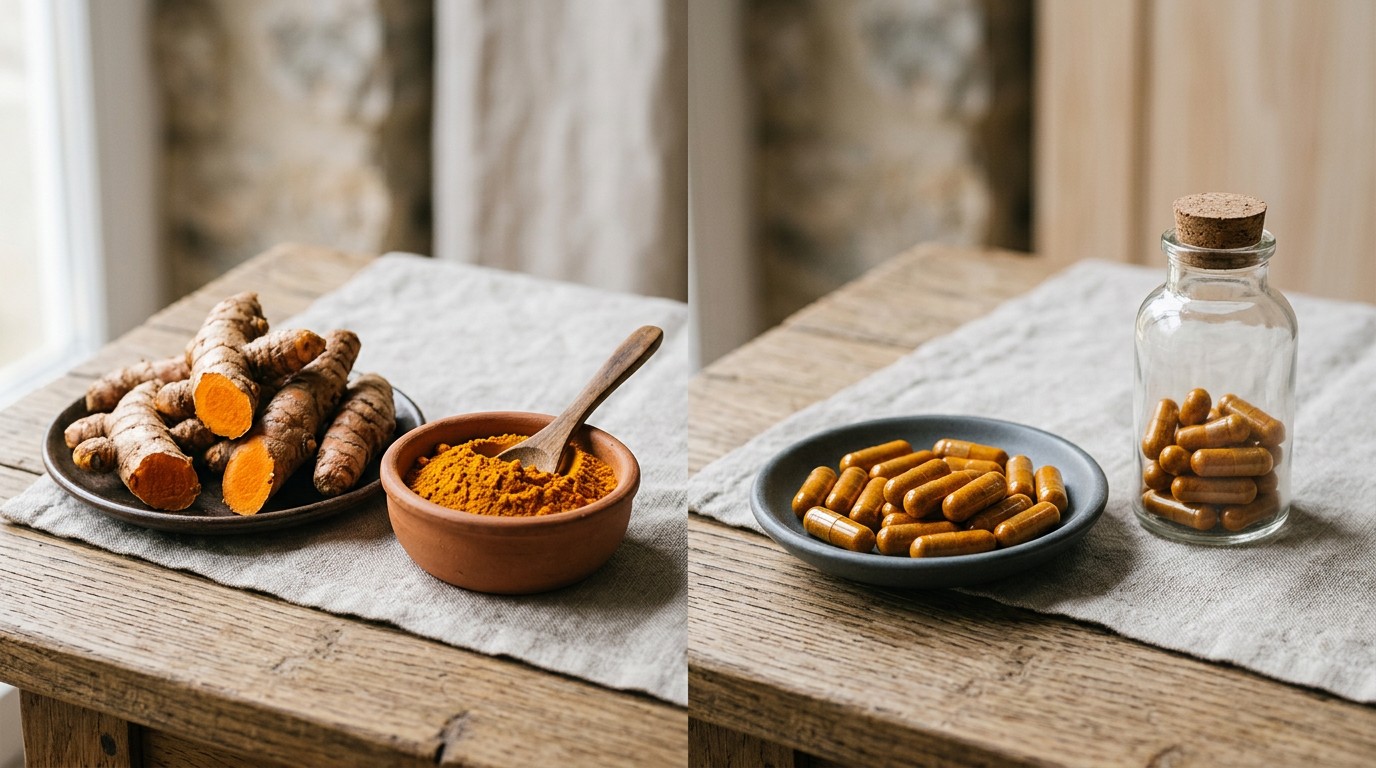
Culinary turmeric and concentrated turmeric supplements can provide very different amounts and forms of turmeric compounds.
What about turmeric with fat or black pepper?
Two commonly discussed approaches to improving curcumin absorption are consuming it with food containing fat and using piperine, a compound found in black pepper.
Piperine has been shown in a human pharmacokinetic study to substantially increase measured curcumin bioavailability. However, this does not mean that adding black pepper to every turmeric supplement is necessary or that a higher blood concentration automatically produces a greater clinical benefit.
Piperine can also influence drug metabolism. A review of pharmacokinetic interactions reported potential effects involving several classes of medicines, including anticoagulants and cardiovascular medicines.
The evidence around dietary fat is less straightforward than some online claims suggest. Rather than assuming that a high-fat meal is required, it is better to follow the instructions for the specific supplement. Modern turmeric products may use different delivery systems intended to alter absorption, and their behaviour can differ considerably.
Turmeric and Black Pepper
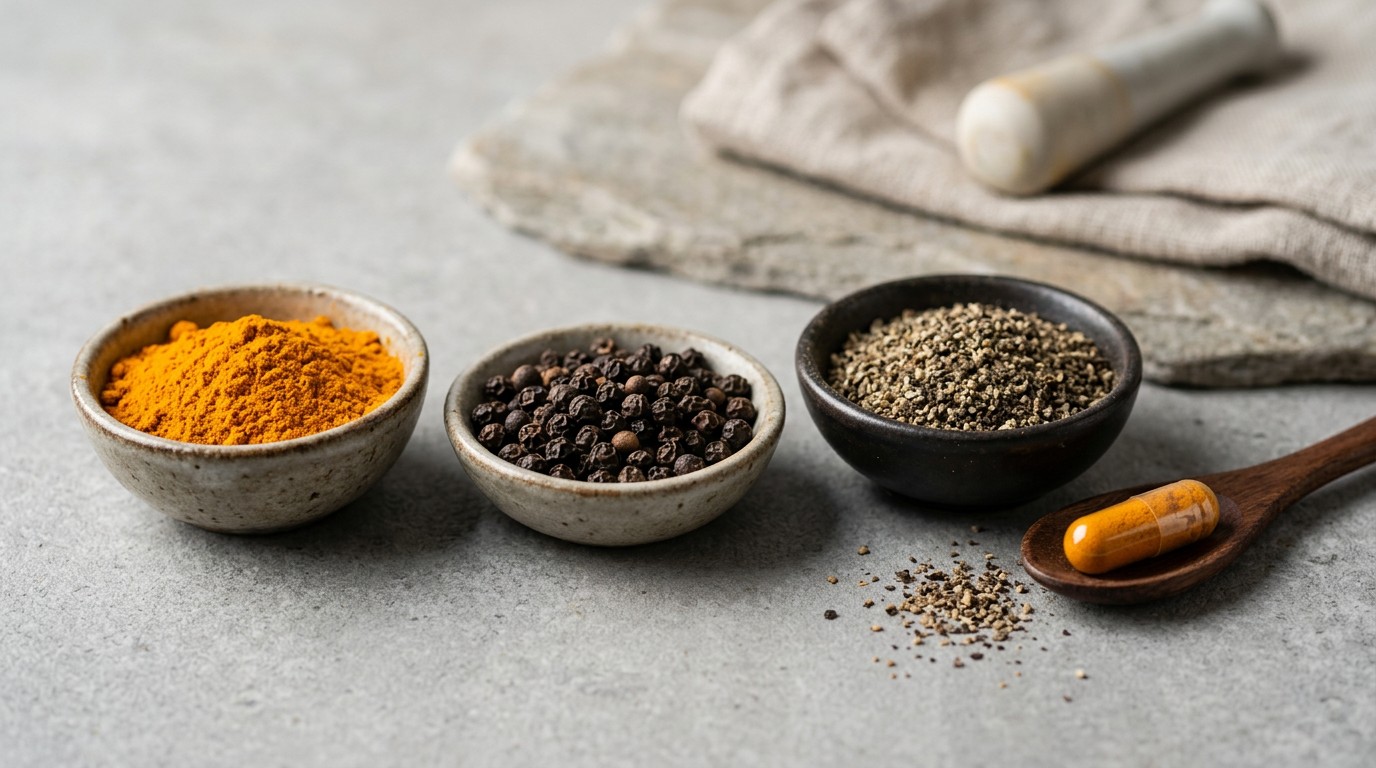
Piperine from black pepper can increase exposure to curcumin, although it may also affect medicines.
When should you take a turmeric supplement?
There is no universally established “best time” of day for taking turmeric supplements.
For a product that recommends taking it with food, taking it alongside a normal meal can be a practical way to follow the manufacturer’s instructions and may help people who find turmeric products irritating to the stomach.
Consistency may also be more useful than choosing a particular time of day. If a supplement is being taken regularly, following the product directions at roughly the same time each day can make it easier to remember.
Do not change the recommended dose simply because a supplement is described as having enhanced absorption. Different formulations can produce very different levels of exposure, and greater bioavailability is not automatically evidence of greater effectiveness.
Taking Turmeric Supplements with Food
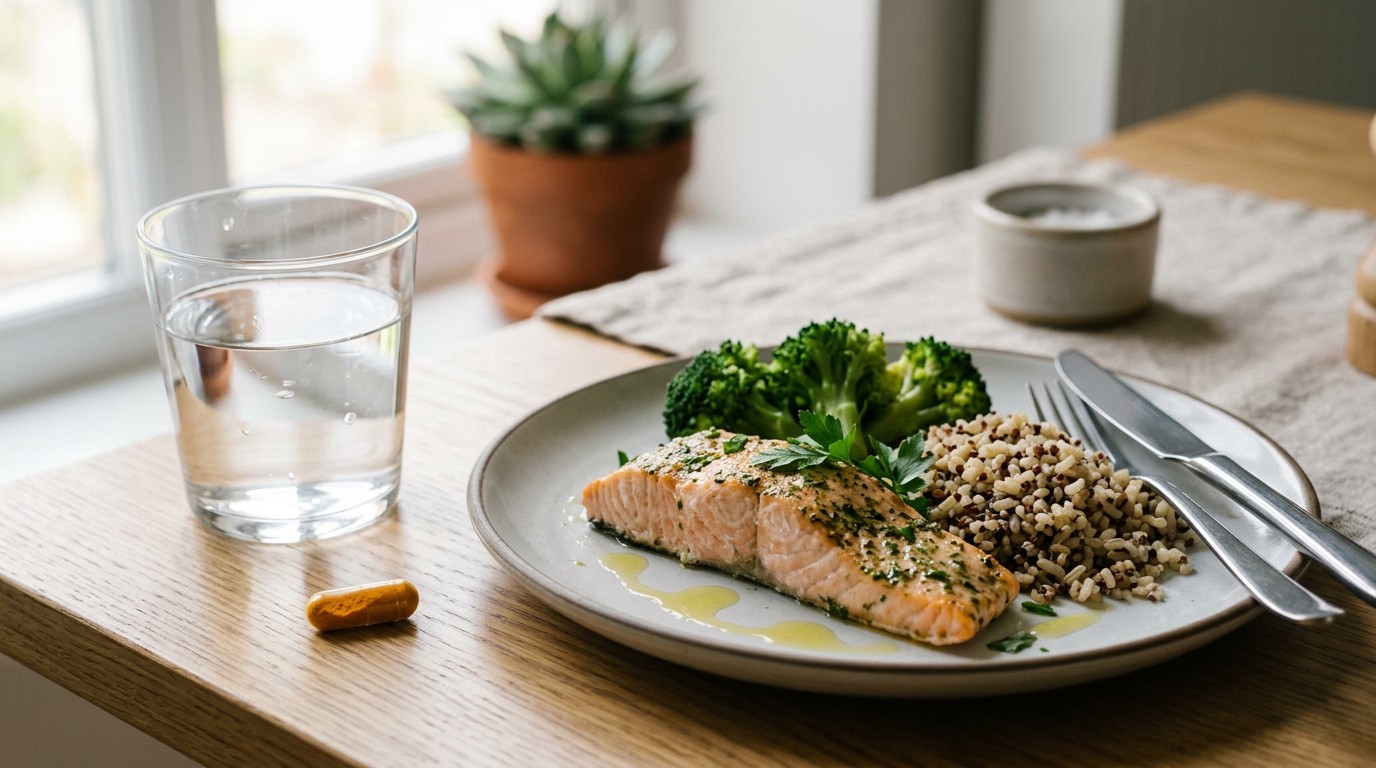
A turmeric supplement shown alongside a meal, illustrating one practical way supplements may be taken.
Safety and precautions
Turmeric is widely consumed as a food, but concentrated turmeric and curcumin supplements deserve more caution.
The European Medicines Agency notes that turmeric preparations can cause effects such as dry mouth, flatulence and stomach irritation. Its herbal monograph also advises against medicinal turmeric use in certain biliary conditions, including bile duct obstruction and gallstones.
There have also been rare reports of liver injury associated with turmeric and curcumin supplements. A recent comprehensive USP review found that clinically apparent liver injury has been reported rarely and that cases have often involved concentrated products and, in some instances, other medicines or supplements.
This does not mean that turmeric supplements commonly cause liver problems. Rather, it highlights why concentrated supplements should not automatically be assumed to be harmless simply because turmeric is a familiar food ingredient.
People should speak with a doctor or pharmacist before taking turmeric supplements if they:
- take regular prescription or over-the-counter medicines;
- have liver or gallbladder problems;
- are pregnant or breastfeeding;
- have previously experienced a reaction to turmeric or related products; or
- are considering a high-dose or highly bioavailable turmeric formulation.
The EMA states that safety during pregnancy and lactation has not been established for the medicinal turmeric preparations covered by its monograph.
If symptoms such as yellowing of the skin or eyes, dark urine, significant abdominal pain or unexplained illness develop after starting a turmeric supplement, medical advice should be sought promptly. Rare cases of supplement-associated liver injury have been documented.
Frequently asked questions
Should turmeric supplements be taken with food?
Often, yes, particularly when the product label recommends taking it with a meal. Food can influence the absorption of curcuminoids and may improve stomach tolerance for some people. However, the ideal approach depends on the formulation.
Is turmeric better absorbed with fat?
Some evidence suggests that the food matrix can affect curcuminoid absorption, but there is no universal requirement to take every turmeric supplement with a high-fat meal. Modern formulations can use different methods to improve bioavailability, so the manufacturer’s instructions should take priority.
Should I take turmeric with black pepper?
Piperine from black pepper can substantially increase curcumin exposure. However, piperine can also affect the metabolism of medicines, so people taking medication should check with a doctor or pharmacist before using a piperine-containing supplement.
Can I take turmeric supplements on an empty stomach?
Some products can be taken without food, but this depends on the specific supplement. If turmeric causes stomach discomfort, taking it with a meal may be more comfortable. Always follow the product’s directions rather than assuming that all turmeric supplements work in the same way.
Is turmeric in food the same as taking a turmeric supplement?
No. Culinary turmeric is normally consumed in much smaller and less concentrated amounts than many supplements. Supplements can contain concentrated turmeric extracts or formulations designed to increase exposure to curcuminoids, so their effects and safety considerations are not necessarily equivalent to ordinary dietary turmeric.
Summary – Should you take turmeric supplements with food?
Taking turmeric supplements with food can be a sensible option, but there is no universal rule that applies to every product. Research shows that the food matrix can affect curcuminoid absorption, while supplement formulations and ingredients such as piperine can also substantially alter exposure.
The most important point is to distinguish culinary turmeric from concentrated turmeric or curcumin supplements. Food use is generally very different from taking a high-dose extract.
For anyone considering a turmeric supplement, the practical approach is to check the product instructions, avoid assuming that higher absorption means greater health benefits, and seek professional advice where medicines, pregnancy, liver or gallbladder conditions or other health concerns are relevant.
Turmeric Supplement and a Healthy Meal
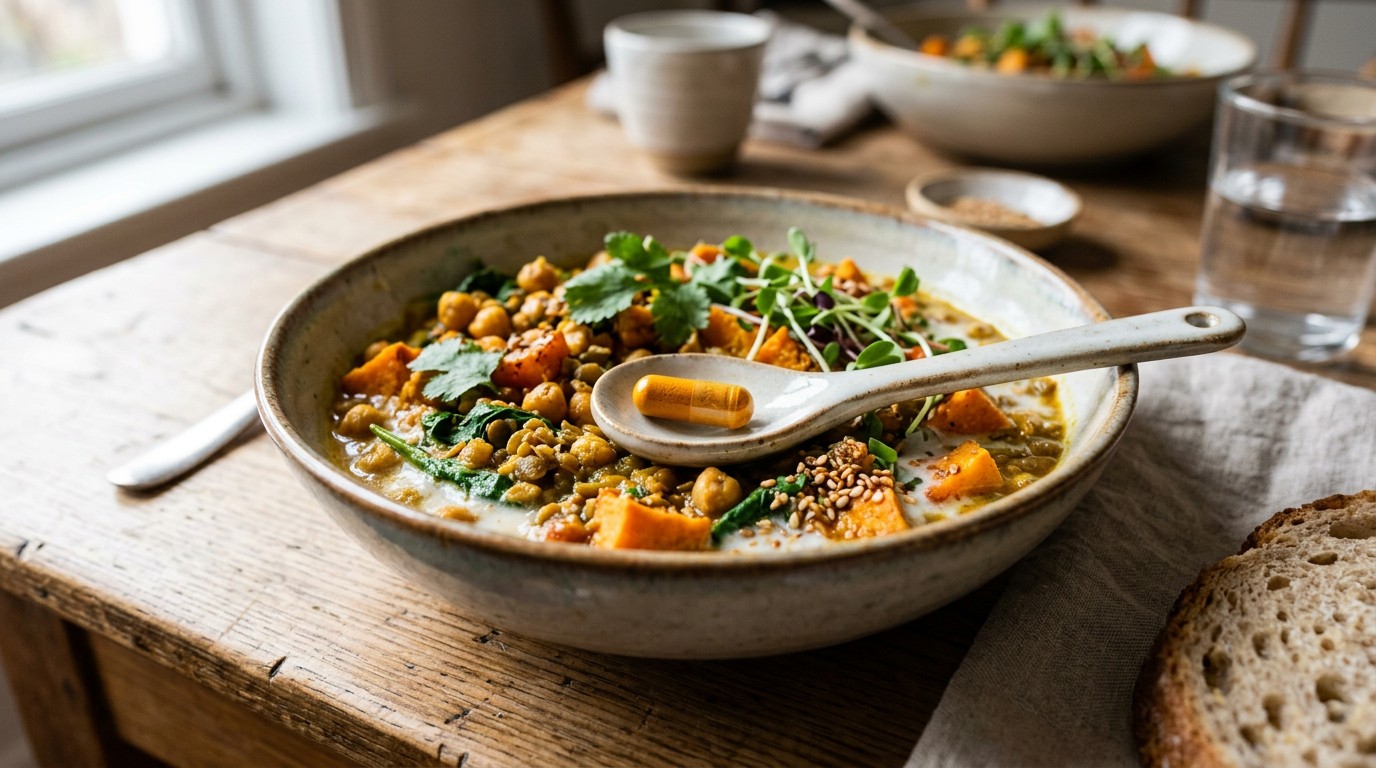
Turmeric supplement and a healthy meal.
Sources and Further Information
1. The best foods to fight inflammation this spring | Prof. Tim Spector and Dr. Federica Amati
2. 3 Ways to Get Full Absorption of TURMERIC Dr. Mandell
3. National Center for Complementary and Integrative Health (NCCIH) — Nutritional Approaches for Musculoskeletal Pain: What the Science Says.
Provides an evidence-based overview of turmeric/curcumin and notes that evidence for many proposed uses remains limited. NCCIH evidence review
4. European Medicines Agency — Curcumae longae rhizoma.
European scientific assessment covering turmeric preparations, traditional use, precautions and safety considerations. European Medicines Agency turmeric assessment
5. Food & Function / PubMed — Food matrix and co-presence of turmeric compounds influence bioavailability of curcumin in healthy humans.
Human crossover research examining turmeric and curcumin consumed as part of a meal. PubMed: Food matrix and turmeric compounds study
6. PubMed — Detection of Plasma Curcuminoids from Dietary Intake of Turmeric-Containing Food in Human Volunteers.
Human research investigating curcuminoids following consumption of turmeric-containing foods. PubMed: Dietary turmeric pharmacokinetic study
7. PubMed — Influence of piperine on the pharmacokinetics of curcumin in animals and human volunteers.
Found that piperine can substantially increase curcumin exposure. PubMed: Piperine and curcumin bioavailability study
8. PubMed — Pharmacokinetic interactions of curcuminoids with conventional drugs: A review.
Reviews potential interactions between curcuminoids and medicines. PubMed: Curcuminoid drug-interaction review
9. PubMed — Rarely reported cases of hepatotoxicity associated with turmeric- and curcuminoid-containing dietary supplements.
Recent comprehensive review of reported liver injury associated with turmeric and curcuminoid supplements. PubMed: 2026 turmeric hepatotoxicity review
Medical disclaimer
This page is provided for general informational and educational purposes only. It is not medical advice, does not diagnose or treat any condition and should not be used as a substitute for advice from a qualified doctor, pharmacist or other healthcare professional.
Always consult a medical doctor before starting a turmeric, curcumin or other dietary supplement, particularly if you take medication, have an existing medical condition, are pregnant or breastfeeding, or are considering a concentrated or high-bioavailability formulation. Never stop or change prescribed medication because of information on this page.
Author
Written by J. Henderson
Health & Wellness Research Writer
J. Henderson writes evidence-based articles on nutrition, botanical supplements and everyday wellbeing. His work focuses on translating scientific research into clear, practical guidance that helps readers make informed decisions about natural health products.