Turmeric vs Boswellia: Which Supplement Is Best?
If you are researching turmeric vs Boswellia, you may be wondering which supplement is the better choice for joint health, inflammation and general wellbeing. Both Boswellia and Turmeric have a long history of traditional use and have been studied for their potential health benefits, particularly in relation to joint comfort.
The main difference is that turmeric provides curcuminoids, including curcumin, while Boswellia serrata provides naturally occurring compounds known as boswellic acids.
At a glance:
- Turmeric and curcumin are widely researched for their potential anti-inflammatory and joint health benefits.
- Boswellia serrata is particularly associated with joint comfort, mobility and inflammatory conditions.
- Both turmeric and Boswellia have been studied in people with osteoarthritis and joint symptoms.
- There is currently no clear evidence that one is universally better than the other.
- The best supplement for you depends on your individual needs, the quality of the product and its formulation.
- Always consider potential medication interactions and seek professional advice where appropriate.
Turmeric vs Boswellia Comparison
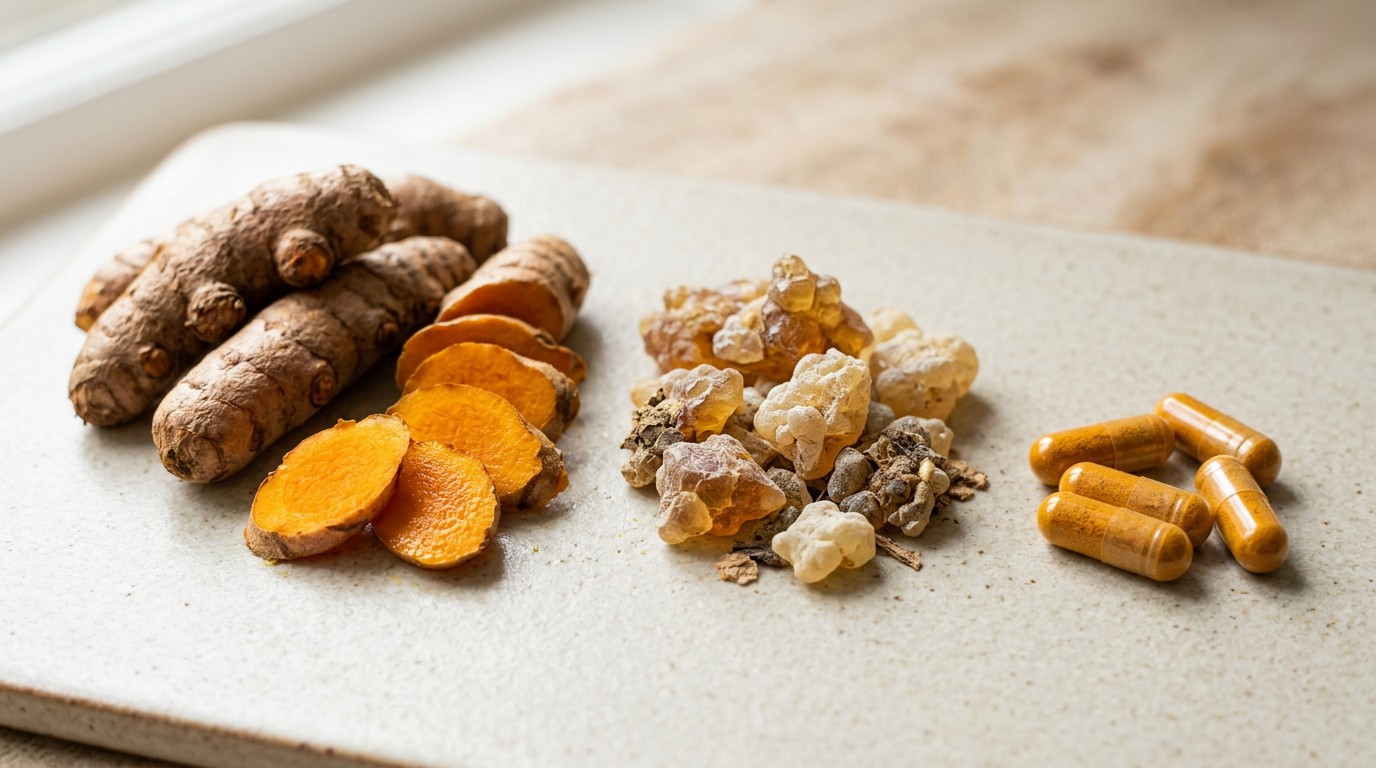
Turmeric and Boswellia are two popular botanical ingredients used in health supplements.
Related Guides
Explore related turmeric guides:
- Turmeric for Joint Pain and Arthritis — understanding turmeric and joint discomfort.
- Is Turmeric Good for Arthritis? — what the evidence says about arthritis.
- Turmeric vs Glucosamine — comparing options people explore for their joints.
- Turmeric vs Ginger — comparing two familiar plant ingredients.
- Turmeric Benefits — the wider picture of potential turmeric benefits.
Table of Contents
Turmeric vs Boswellia: Key Differences
| Feature | Turmeric | Boswellia |
| Main source | Turmeric root or rhizome | Resin from the Boswellia tree |
| Key compounds | Curcuminoids, including curcumin | Boswellic acids |
| Common use | Joint health, inflammation and general wellbeing | Joint health, mobility and inflammation |
| Joint health research | Promising but not conclusive | Promising but limited |
| Common supplement forms | Capsules, tablets, powders and extracts | Capsules, tablets and standardised extracts |
| Main buying consideration | Curcumin or curcuminoid content | Standardised Boswellia extract |
| Potential advantage | Well researched and widely available | Particularly associated with joint health |
| Overall winner | No definitive winner | No definitive winner |
Turmeric (Curcumin) vs Boswellia (Indian Frankincense)
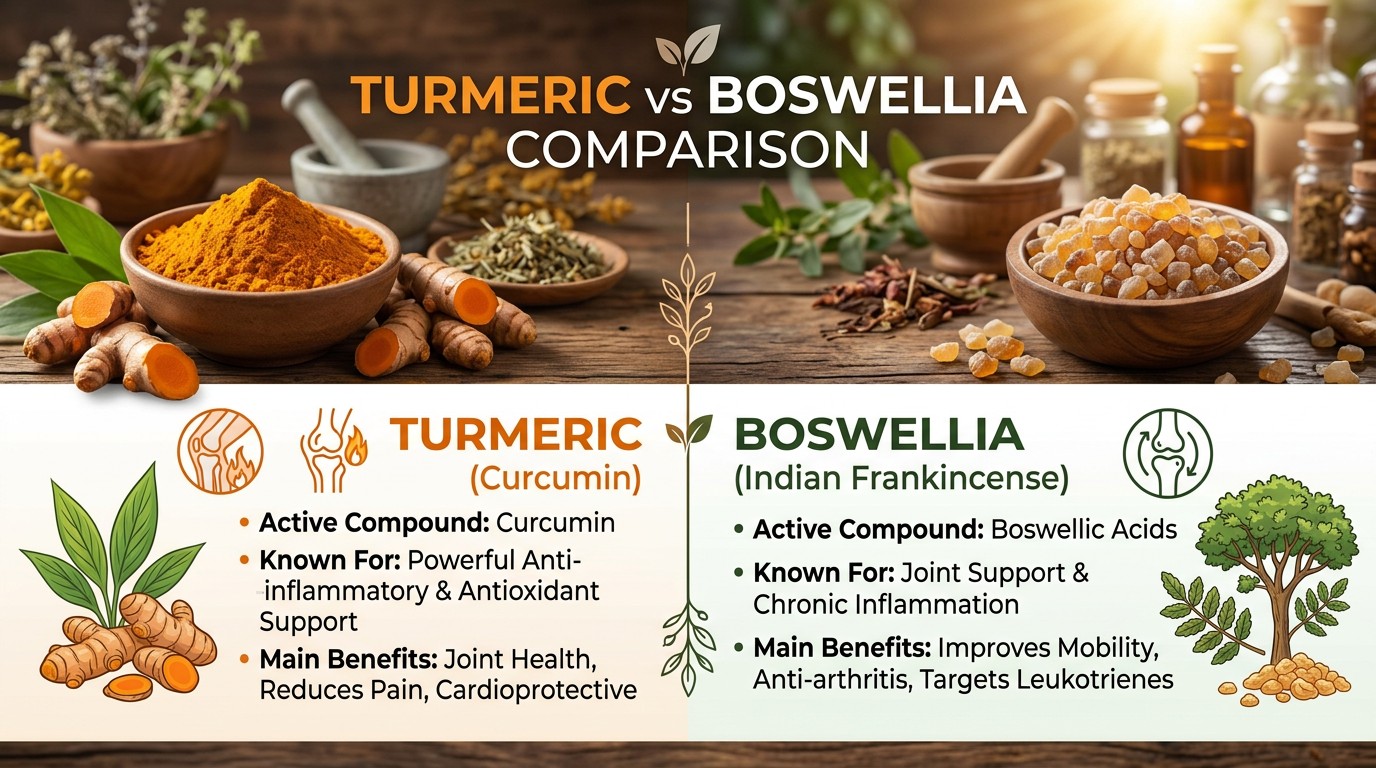
Turmeric’s active compound is Curcumin and Boswellia’s active compound are Boswellic Acids.
What Is Turmeric?
Turmeric, or Curcuma longa, is a plant from the ginger family and is widely used as a spice in cooking. It contains naturally occurring compounds called curcuminoids, with curcumin being the best known.
Turmeric and curcumin supplements are commonly used by people interested in joint health, inflammation and general wellbeing. Research has produced encouraging results in some areas, including osteoarthritis symptoms, although the available evidence is not strong enough to say that turmeric or curcumin will work for everyone.
An important distinction when comparing supplements is that turmeric is not the same as concentrated curcumin. A turmeric product may contain turmeric powder with relatively low levels of curcuminoids, whereas a concentrated curcumin supplement is designed to provide a higher amount of these compounds.
Some turmeric products also contain ingredients intended to improve curcumin absorption. However, a product with enhanced absorption is not necessarily better for everyone, and certain highly bioavailable curcumin products have been associated with reports of liver problems.
What Is Boswellia?
Boswellia serrata is a tree traditionally used in Ayurvedic medicine and other traditional healthcare systems. Supplements are generally made using an extract of the tree’s gum resin.
Boswellia is particularly popular among people looking for natural joint health supplements. Its active compounds include boswellic acids, which have been investigated for their potential effects on inflammation and joint symptoms.
Research into Boswellia has produced some promising findings, particularly in relation to osteoarthritis-related pain and stiffness. However, many studies have been relatively small, and more high-quality research is needed before firm conclusions can be made.
For consumers, one important consideration is whether a Boswellia product clearly states the type and standardisation of its extract.
Boswellia Serrata Resin
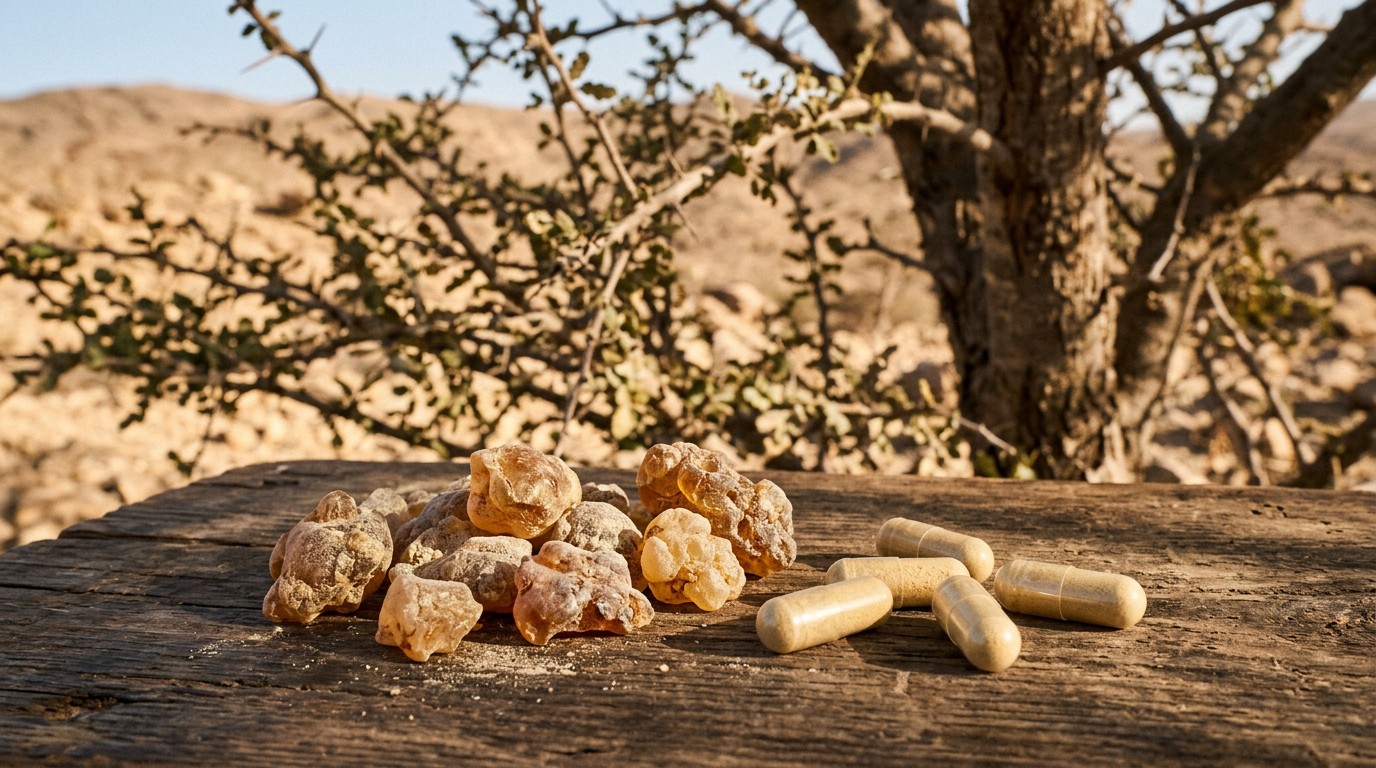
Boswellia serrata supplements are made from extracts of the tree’s resin.
Turmeric vs Boswellia for Joint Health
Joint health is one of the main reasons people compare turmeric and Boswellia.
Both ingredients have been investigated for conditions such as osteoarthritis, including symptoms such as joint pain, stiffness and reduced mobility. Research into turmeric and curcumin for arthritis suggests there may be potential benefits for some people, while studies of Boswellia have also reported encouraging results.
However, neither supplement should be considered a proven cure for arthritis or a guaranteed treatment for joint pain.
So, is turmeric or Boswellia better for joints?
There is currently no straightforward answer.
Turmeric may appeal to people who specifically want a curcumin-based supplement, particularly because curcumin has been extensively researched. Boswellia may be attractive to people whose main interest is a joint-focused herbal supplement containing a standardised Boswellia extract.
The quality and formulation of the individual product can be just as important as the choice of ingredient.
Boswellia and Turmeric have been studied for help with inflammation support

Some people regularly take herbal supplements as part of a healthy lifestyle.
Why Choose Turmeric or Boswellia?
Why Choose Turmeric?
Turmeric may be worth considering if you are looking for a supplement containing curcuminoids or curcumin and want an ingredient that has been researched across several areas of health.
When buying turmeric, check the label carefully. Look for the amount of curcuminoids or curcumin provided rather than simply choosing a product because it contains a large amount of turmeric.
Turmeric may therefore be a good choice for someone who wants a well-known, widely researched botanical ingredient and is particularly interested in curcumin.
Why Choose Boswellia?
Boswellia may be worth considering if your main reason for taking a supplement is joint comfort, mobility and joint health.
Look for products that clearly identify Boswellia serrata and provide information about the extract and its standardisation. A transparent label can make it easier to compare different products.
Boswellia may therefore suit someone looking for a more specifically joint-focused herbal supplement.
What Should You Look for When Buying a Supplement?
Whether you choose turmeric or Boswellia, don’t judge a supplement solely by its marketing claims.
Before buying, consider:
- The amount of active ingredients per serving.
- Whether the botanical ingredient is clearly identified.
- Whether the extract is standardised where appropriate.
- The manufacturer’s reputation and quality-control procedures.
- Clear dosage and ingredient information.
- Any additional ingredients used in the formulation.
- Independent testing or quality certification, where available.
- Whether the product is appropriate for your personal circumstances.
A higher dose is not automatically a better dose, and combining several supplements is not necessarily more effective.
Frequently asked questions
Is Turmeric Better Than Boswellia?
Neither supplement can currently be considered the overall winner. Both turmeric and Boswellia have shown potential benefits in research, particularly concerning joint health, but the evidence is not conclusive enough to say that one is better for everyone.
Which Is Better for Joint Pain: Turmeric or Boswellia?
Both have been studied for joint pain and osteoarthritis symptoms. Turmeric and curcumin may be attractive to people interested in curcumin, while Boswellia may appeal to people specifically looking for a joint-focused herbal supplement. Neither should be considered a guaranteed treatment for joint pain.
Can You Take Turmeric and Boswellia Together?
Some supplements contain both turmeric and Boswellia. However, taking two ingredients together does not necessarily mean that the combination will be more effective. If you take prescription medicines or have an existing medical condition, speak to a GP, pharmacist or other qualified healthcare professional before combining supplements.
Does Boswellia Reduce Inflammation?
Boswellia has traditionally been used for inflammatory conditions and has been studied for its potential effects on inflammation and joint symptoms. Some research is encouraging, but further high-quality clinical studies are needed.
What Is More Important When Buying Turmeric or Boswellia?
The quality and formulation of the product are important. For turmeric, check the stated curcumin or curcuminoid content. For Boswellia, look for the botanical name, extract information and standardisation where provided. Also consider the manufacturer’s quality controls and the full ingredient list.
Turmeric is used in curries, soups and roasted vegetables

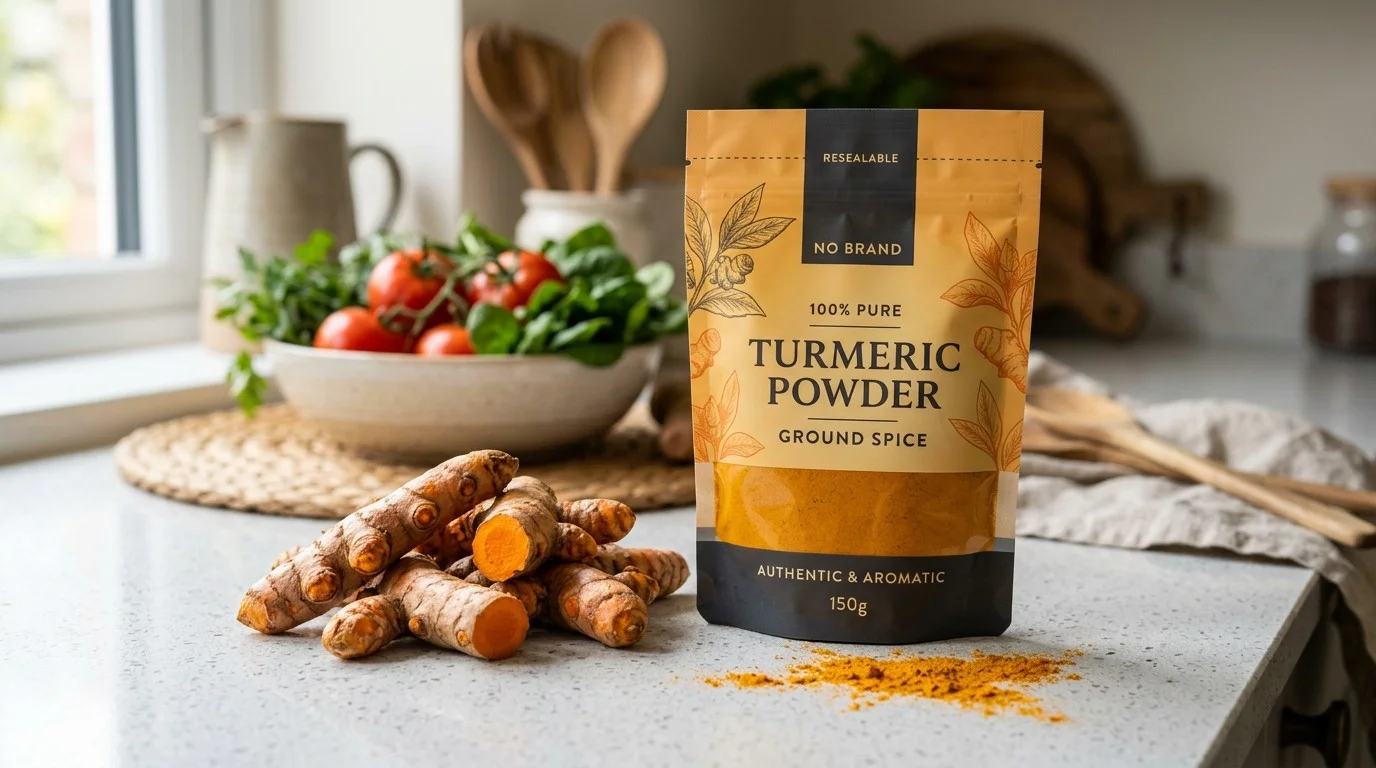
Boswellia is not meant for culinary flavouring in food, whilst turmeric is widely used in cooking recipes because it offers a warm, earthy, slightly bitter flavour and bright yellow colour used in curries, soups, and roasted vegetables.
Turmeric vs Boswellia: Which Should You Choose?
The best choice ultimately depends on what you want from your supplement.
Choose turmeric or curcumin if you are particularly interested in curcumin and want a widely researched botanical ingredient with potential benefits for joint health and general wellbeing.
Choose Boswellia if your main interest is joint health, mobility and a supplement based around a standardised Boswellia extract.
There is no universal winner in the turmeric vs Boswellia comparison. Instead, focus on your reason for taking a supplement, the quality of the product, the amount of active ingredients and whether it is suitable for you.
Supplements should also be viewed as part of a wider approach to health rather than a replacement for a balanced diet, regular physical activity, appropriate sleep and professional medical care when required.
Final Summary
Turmeric and Boswellia are both popular natural supplements for people interested in joint health, but they have different active compounds and slightly different reasons for being chosen.
Turmeric is best known for its curcuminoids, particularly curcumin, while Boswellia contains boswellic acids and is traditionally associated with joint and inflammatory health.
If you are primarily interested in curcumin, turmeric may be the more obvious choice. If your priority is joint health and mobility, Boswellia may be worth considering.
Ultimately, there is no single best supplement for everyone. Compare the actual formulation, ingredient levels, manufacturer quality and suitability for your individual circumstances before buying.
Further information
1. Boswellia Serrata – Video
2. Efficacy of Curcumin and Boswellia for Knee Osteoarthritis: Systematic Review and Meta-Analysis
Brief description: A peer-reviewed systematic review and meta-analysis examining clinical trials of curcumin (from turmeric) and Boswellia for knee osteoarthritis. It found evidence of improvements in pain and function compared with placebo, while noting that larger, higher-quality studies are still needed.
Published by: National Library of Medicine / PubMed; originally published in Seminars in Arthritis & Rheumatism.
Direct webpage: Read the article on PubMed
3. Boswellia: Usefulness and Safety
Brief description: An authoritative overview of Boswellia serrata, covering its traditional uses, evidence for inflammation and osteoarthritis, potential benefits, safety, and limitations of the existing research. The page also cites research specifically examining curcumin and Boswellia together.
Published by: National Center for Complementary and Integrative Health (NCCIH), National Institutes of Health.
Direct webpage: Read the NCCIH article
4. Herbs and Supplements for UC: What the Science Says”
Brief description: A recent evidence-focused article discussing several supplements for ulcerative colitis, including turmeric and Boswellia. It reviews what the scientific evidence says rather than simply presenting the supplements as treatments.
Published by: WebMD.
Direct webpage: Read the WebMD article
Disclaimer
This article is provided for general information and educational purposes only and does not constitute medical advice. Food supplements are not intended to diagnose, treat or cure disease. Evidence for turmeric, curcumin and Boswellia varies, and individual results may differ.
Always read the product label and follow the manufacturer’s directions. If you are pregnant or breastfeeding, have a medical condition, take prescription or over-the-counter medicines, or are unsure whether a supplement is suitable for you, consult a GP, pharmacist or other qualified healthcare professional before use.
Author
Written by J. Henderson
Health & Wellness Research Writer
J. Henderson writes evidence-based articles on nutrition, botanical supplements and everyday wellbeing. His work focuses on translating scientific research into clear, practical guidance that helps readers make informed decisions about natural health products.