How to Choose a Turmeric Supplement?
Choosing a turmeric supplement can be confusing because products differ considerably in their turmeric content, curcumin concentration, formulation, dosage and claims about absorption. The best turmeric supplement is not necessarily the one with the highest strength or the most impressive marketing. Instead, it is important to look at the type of turmeric or curcumin, the amount provided, the ingredients used to improve absorption, product quality, labelling and potential safety concerns.
Turmeric (Curcuma longa) contains a group of compounds called curcuminoids, with curcumin being the best-known. However, turmeric powder and concentrated curcumin extracts are not interchangeable, and research on one formulation cannot automatically be applied to every turmeric supplement.
Quick answer: How do you choose a turmeric supplement?
- Check what it contains – turmeric powder, turmeric extract or curcumin.
- Check the amount – see how much turmeric or curcumin is in each serving.
- Look at the ingredients – check for added ingredients such as black pepper extract.
- Check the dosage – follow the recommended daily amount.
- Look for clear labelling – the product should clearly state its ingredients and manufacturer.
- Consider quality – look for reputable manufacturers and appropriate quality testing.
- Check safety first – ask a doctor or pharmacist if you take medicines or have a health condition.
In simple terms, choose a turmeric supplement with clear ingredients, a clearly stated amount and dosage, transparent labelling and appropriate safety information. Don’t assume that the highest-strength or highest-absorption product is necessarily the best choice.
How to Choose a Turmeric Supplement by Reading the Label
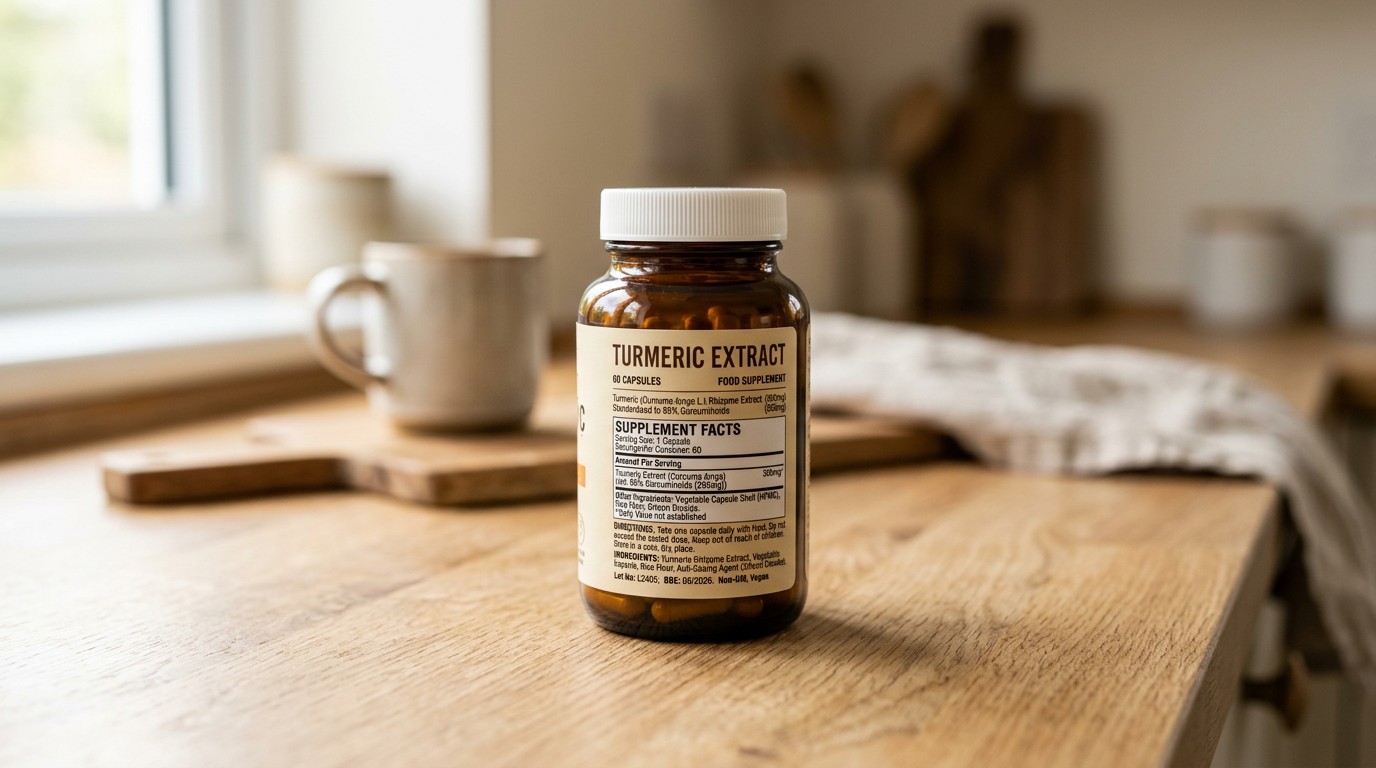
Understanding the turmeric, curcumin, dosage and ingredient information on a supplement label.
Table of Contents
- What is the difference between turmeric and curcumin?
- What should you look for on a turmeric supplement label?
- Turmeric powder vs curcumin extract
- What does “high absorption” mean?
- Should you choose turmeric with black pepper?
- How much turmeric or curcumin should you take?
- How important is supplement quality?
- What should you avoid when choosing a turmeric supplement?
- Who should speak to a doctor before taking turmeric?
- Frequently asked questions
- Summary
- Sources and Further Information
- Medical disclaimer
Turmeric supplement comparison at a glance
| What to compare | What it means | What to look for |
| Turmeric powder | Ground turmeric rhizome | Clear amount of turmeric per serving |
| Turmeric extract | A concentrated preparation | Standardisation and ingredient details |
| Curcumin | A major turmeric compound | Clearly stated curcumin or curcuminoid content |
| Curcumin with piperine | Curcumin combined with black pepper extract | Clear amounts and safety information |
| Enhanced-bioavailability formula | Designed to increase absorption | Transparent explanation of the formulation |
| Capsules/tablets | Convenient measured dose | Full ingredient and dosage information |
| Powder | Flexible serving format | Accurate measuring instructions and storage information |
| Quality testing | Helps assess product consistency and contamination risks | Transparent manufacturer and testing information |
This table is a starting point rather than a ranking. A more concentrated or highly bioavailable product is not automatically a better or safer product.
Turmeric Root and Powder Used in Supplements
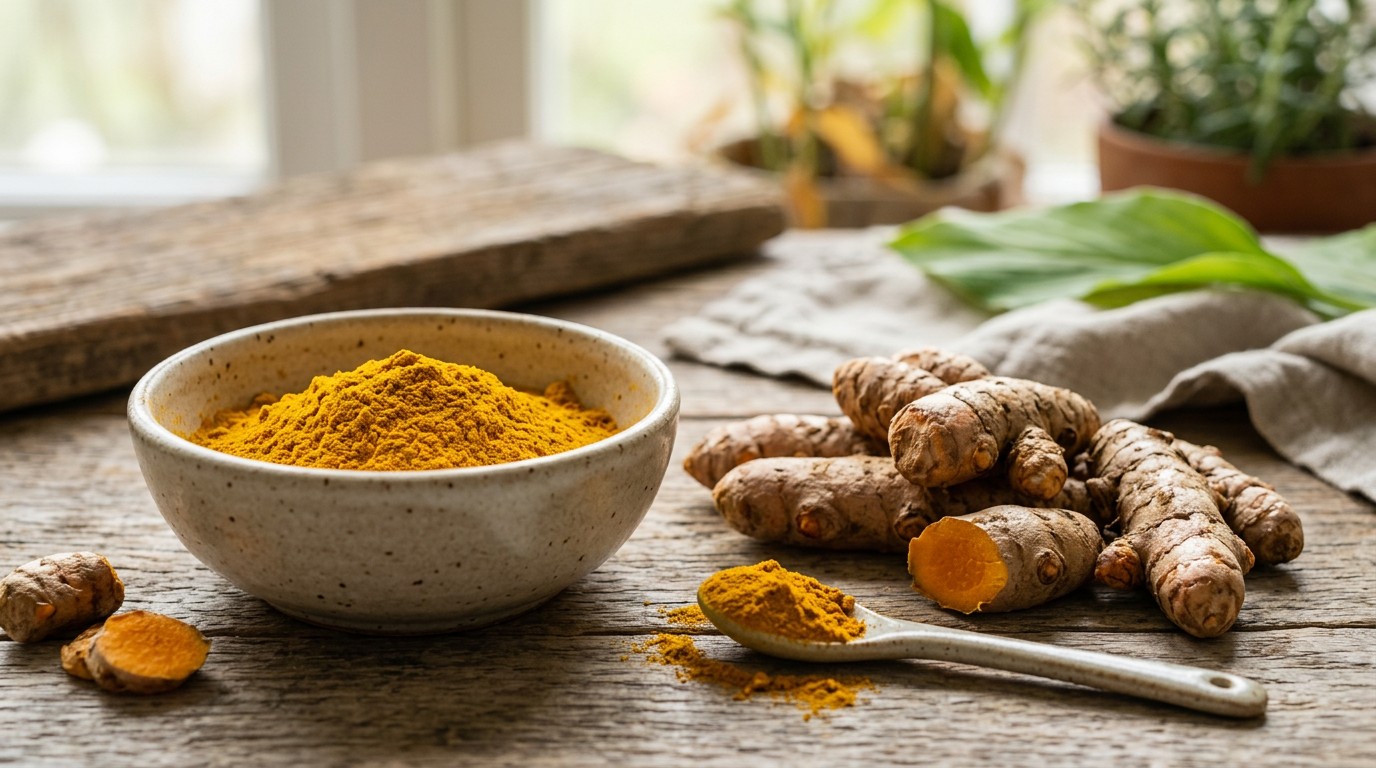
Turmeric root and powder provide the starting point for understanding turmeric supplements.
What is the difference between turmeric and curcumin?
Turmeric is a plant, Curcuma longa, whose rhizome is widely used as a culinary spice. It contains several naturally occurring compounds, including curcuminoids. Curcumin is one of the best-known curcuminoids and is responsible for much of turmeric’s characteristic yellow colour.
This distinction matters when choosing a supplement.
A product labelled turmeric powder may contain the whole powdered rhizome, whereas a turmeric extract may be concentrated and standardised for particular compounds. A product marketed as curcumin may contain a much more concentrated amount of curcuminoids.
Consequently, two products can both say “turmeric” on the front of the packaging while providing very different amounts and forms of active compounds.
This is one reason it is useful to read the full ingredient panel rather than judging a supplement by the large number printed on the front of the bottle.
Types of Turmeric Supplements
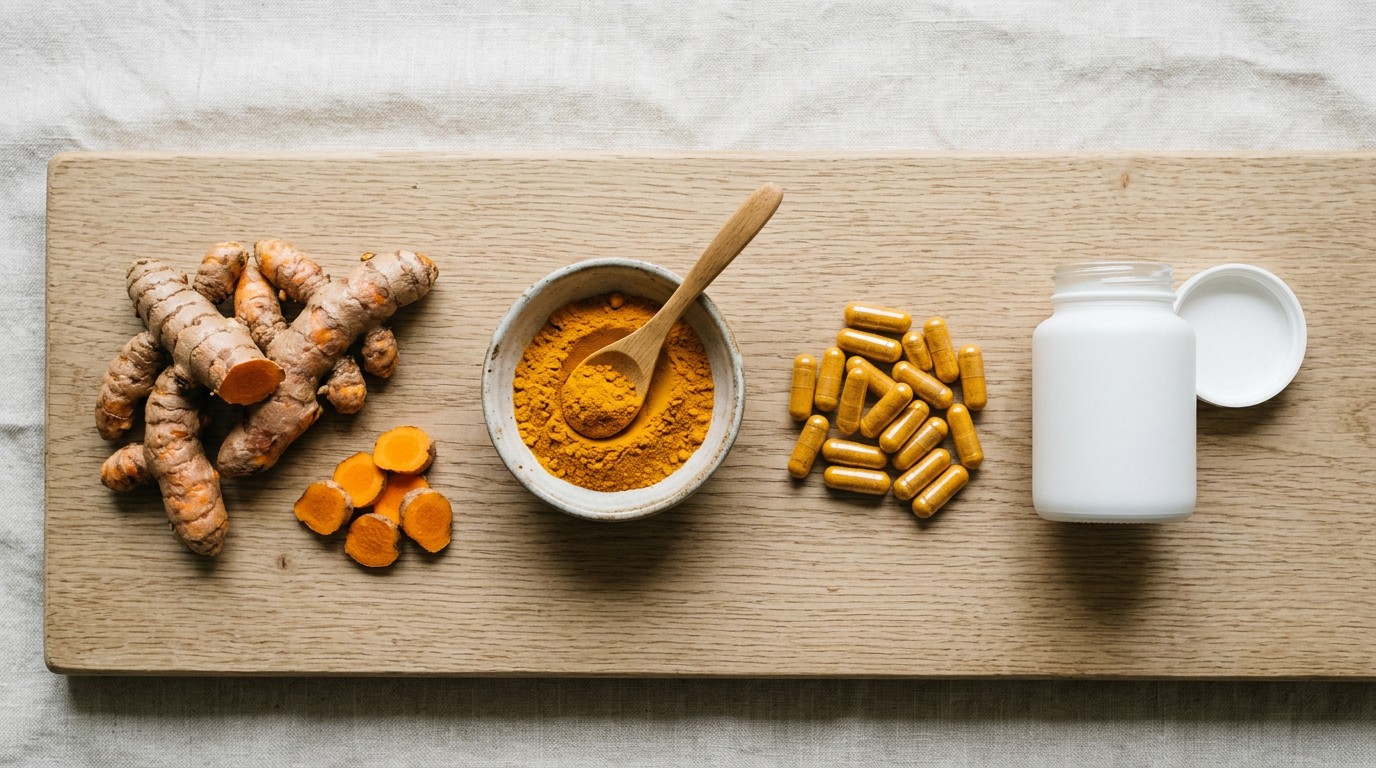
Turmeric supplements can contain powder, extracts or concentrated curcuminoids in different formulations.
Turmeric powder vs curcumin extract
Neither form can automatically be described as the best choice.
Turmeric powder is closer to the culinary form of turmeric and contains a wider mixture of naturally occurring compounds. Curcumin extracts, meanwhile, are generally designed to provide a more concentrated amount of curcuminoids.
Research is also complicated by differences between formulations. A systematic methodological review of 171 curcumin systematic reviews found that differences in the bioavailability of the formulations used in clinical studies were often not adequately considered.
That means you should be cautious about reading a study of one specific curcumin formulation and assuming the results apply equally to every turmeric supplement.
Related information: For further information on the differences between Turmeric and Curcumin read our comparison guide.
Turmeric vs Curcumin: What Is the Difference?
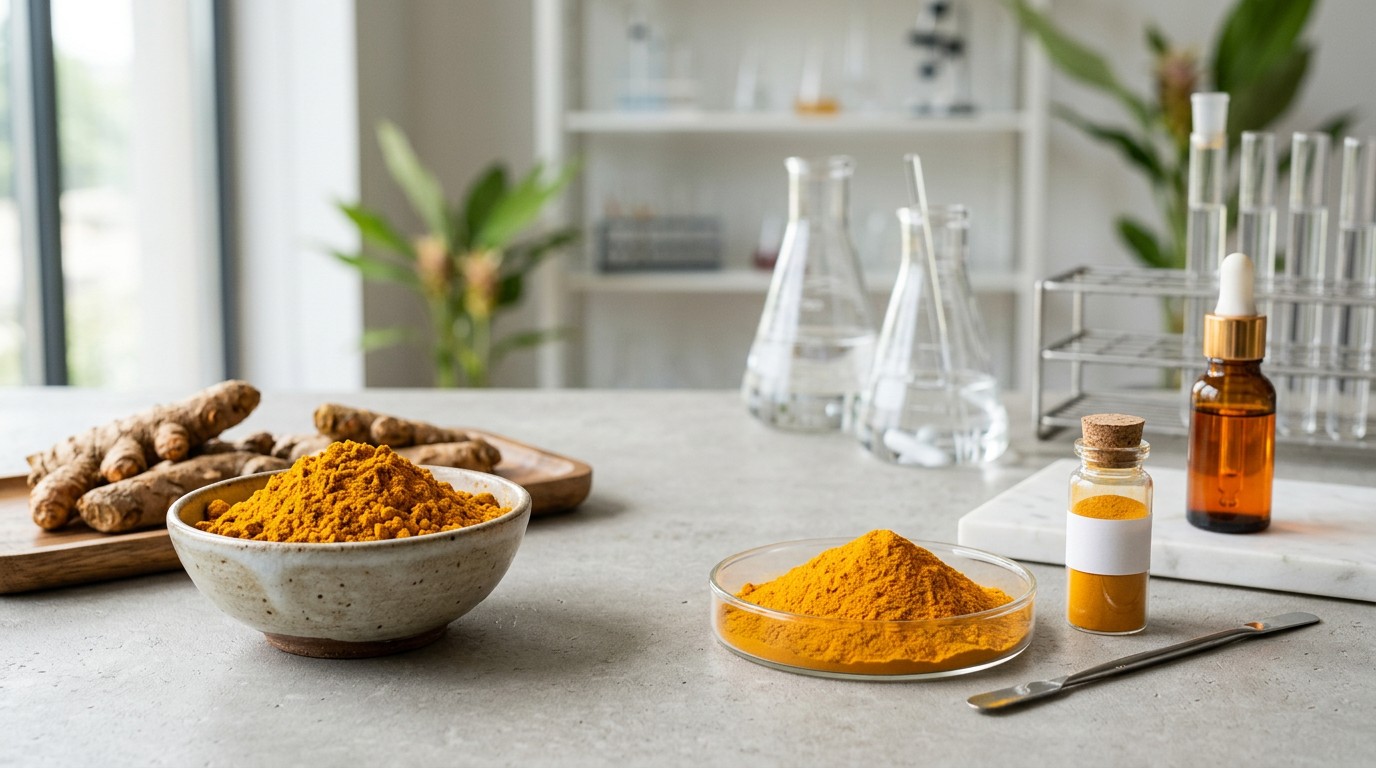
Turmeric is the plant source, while curcumin is one of its major naturally occurring compounds.
What should you look for on a turmeric supplement label?
A good starting point is transparency.
For a UK food supplement, the packaging should provide important information such as the ingredients, recommended daily dosage, warnings, storage information and the quantity of relevant substances. UK government guidance also states that food supplements should not be presented as substitutes for a varied diet.
When comparing products, check the following.
1. The actual ingredient
Look for the botanical name where appropriate, such as Curcuma longa, and determine whether the product contains turmeric powder, turmeric extract, curcumin or a combination.
2. The amount per serving
Do not confuse the weight of an extract with the amount of curcuminoids it contains.
For example, “500 mg turmeric extract” does not necessarily mean 500 mg of curcumin.
The label should make it reasonably clear what you are actually getting.
3. Standardisation
Some extracts specify a standardised curcuminoid content. This can make products easier to compare than labels that simply state the total weight of a turmeric extract.
However, standardisation alone does not prove that a product will provide a particular health benefit.
4. Other active ingredients
Some supplements contain piperine, oils, phospholipids or other ingredients intended to change how curcumin is absorbed.
These formulations can be scientifically interesting, but additional ingredients also mean there are additional factors to consider for safety and interactions.
5. Recommended use
Choose a product with clear instructions rather than one that encourages unnecessarily high intake.
UK Food Standards Agency guidance advises consumers to follow the label, not exceed the recommended dose and seek professional advice before taking high-dose supplements.
What to Look for on a Turmeric Supplement Label

A turmeric supplement label should make important information such as ingredients, dosage and warnings easy to identify.
What does “high absorption” or “high bioavailability” mean?
Curcumin has relatively poor oral bioavailability, meaning that only a limited amount is absorbed and becomes available in the body after it is taken by mouth. This has led researchers and manufacturers to investigate formulations designed to increase absorption.
You may therefore see terms such as:
- enhanced absorption
- increased bioavailability
- bioavailable curcumin
- high-absorption curcumin
- sustained-release curcumin
These terms should not automatically be interpreted as meaning “more effective”.
Increasing exposure to curcumin changes how the body encounters the compound, but greater absorption does not by itself demonstrate a clinically meaningful benefit for a particular condition.
It is therefore sensible to treat bioavailability claims as one factor when comparing products, rather than the deciding factor.
Should you choose turmeric with black pepper?
Some turmeric supplements contain piperine, a compound found in black pepper, because piperine can increase the absorption of curcumin.
This is supported by research, and studies have specifically examined curcumin-piperine combinations.
However, “more absorption” should not be confused with “better for everyone”.
The increased bioavailability of some formulations is relevant to safety as well as potential effects. The US National Center for Complementary and Integrative Health notes that liver injury has been reported with some highly bioavailable turmeric or curcumin formulations.
For that reason, choosing a product simply because it contains piperine or advertises exceptionally high absorption is not necessarily the safest approach.
Turmeric, Curcumin and Black Pepper
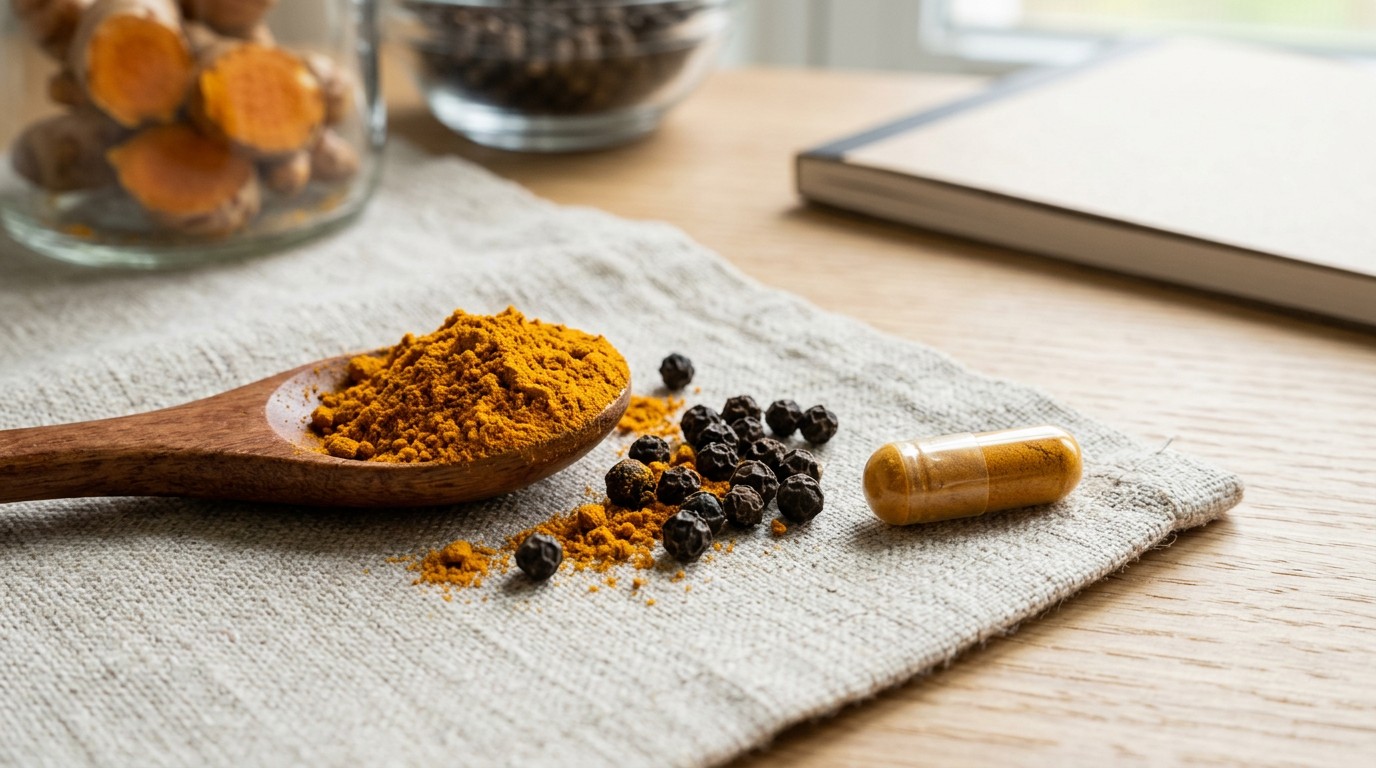
Piperine from black pepper is used in some curcumin formulations to increase absorption.
How much turmeric or curcumin should you take?
There is no universally established dose of turmeric or curcumin that can be recommended for everyone for general health.
Clinical studies have used different preparations, doses and treatment periods. This makes it difficult to translate an individual study into a single recommended supplement dose.
The safest approach is to follow the manufacturer’s instructions and avoid assuming that a higher dose will produce a greater benefit.
The UK Food Standards Agency advises consumers not to exceed the recommended dose and says that people should seek advice from a GP or healthcare professional before taking high-dose supplements.
It is also important to distinguish between turmeric used as a food ingredient and concentrated supplements. The quantities consumed as part of ordinary cooking are not necessarily equivalent to concentrated extracts.
How important is supplement quality?
Quality is an important consideration because food supplements can vary in composition and manufacturing standards.
A product should have clear labelling and provide enough information for you to identify what it contains. UK guidance says that food supplement labels should include information such as ingredients, dosage instructions, warnings, storage instructions and relevant quantities.
Independent testing or recognised quality-control processes can provide additional reassurance, but consumers should still look at what is actually being tested and what the testing organisation verifies.
A quality mark is not proof that a supplement works for a particular health condition.
How to Read a Turmeric Supplement Label
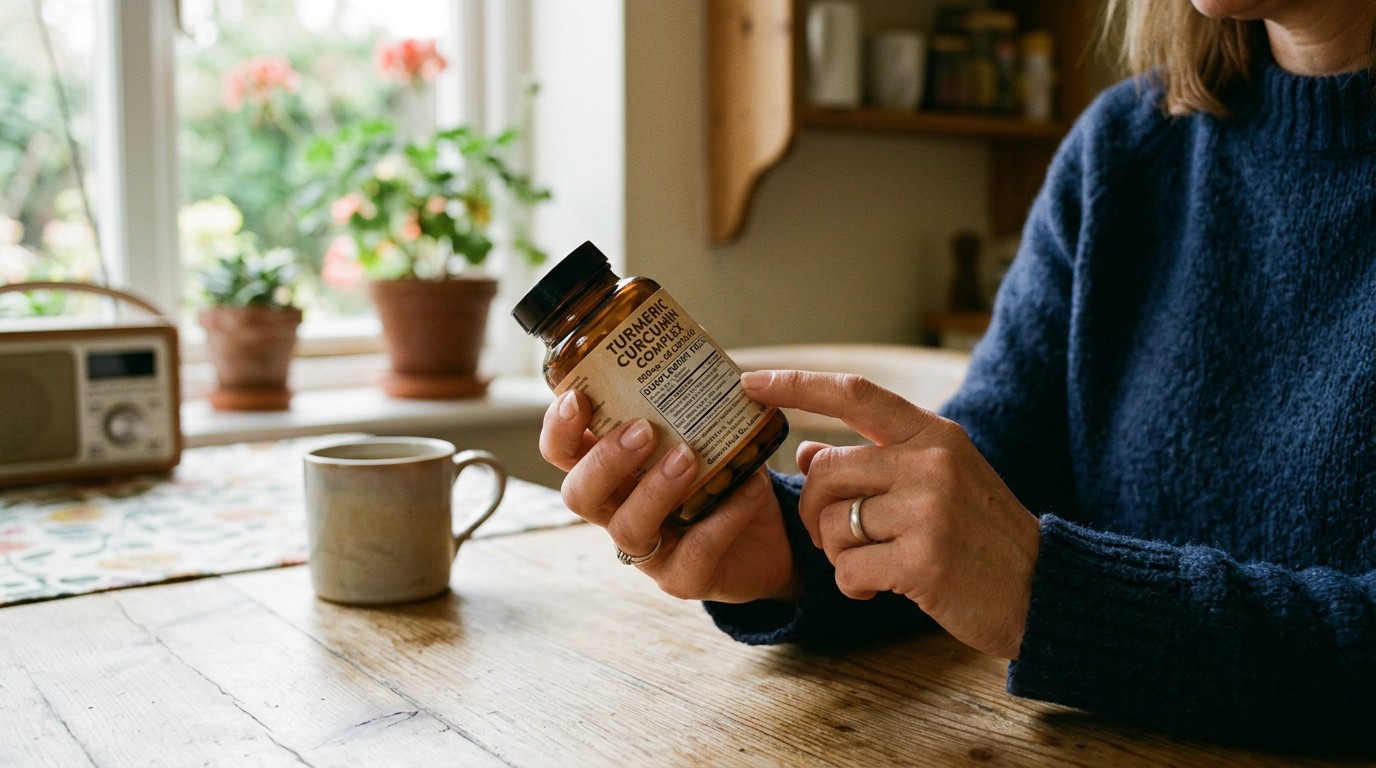
Check the ingredients, serving size, dosage, warnings and manufacturer information before choosing a supplement.
What should you avoid when choosing a turmeric supplement?
Be cautious about products that:
- promise to treat or cure a disease;
- make unusually broad claims about multiple health conditions;
- do not clearly state the amount of turmeric, extract or curcuminoids;
- hide important ingredients behind vague proprietary blends;
- encourage taking more than the recommended amount;
- provide little information about the manufacturer;
- rely almost entirely on testimonials rather than evidence;
- claim that “natural” means risk-free;
- suggest that a supplement can replace prescribed treatment.
In Great Britain, food supplements cannot legally be marketed as products that prevent, treat or cure disease.
This is particularly important when evaluating turmeric products because laboratory findings and preliminary clinical research can sometimes be presented more strongly in marketing material than the available human evidence justifies.
What does the research say about turmeric supplements?
Research into turmeric and curcumin is extensive, but the evidence is not uniform.
The NCCIH states that there is not enough evidence to definitively conclude whether oral turmeric or curcumin is beneficial for many health conditions. There is more encouraging preliminary evidence in areas such as symptoms associated with knee osteoarthritis, but higher-quality research is still needed.
For example, systematic reviews have investigated curcumin for musculoskeletal symptoms and exercise-related outcomes, but results differ according to the population, formulation and outcome measured.
This is an important principle when choosing a supplement: the existence of research on curcumin does not mean that every turmeric supplement has been proven to produce the same result.
The formulation, dose, duration and population studied all matter.
Who should speak to a doctor before taking turmeric?
Turmeric supplements are not suitable for everyone.
The NHS advises particular caution with herbal medicines in people who are pregnant or breastfeeding, people with kidney or liver problems, and people taking certain medicines. It also recommends checking with a pharmacist before taking herbal medicines alongside other medicines.
The NHS Specialist Pharmacy Service also highlights the need to consider interactions between complementary products and conventional medicines.
You should therefore speak to a doctor or pharmacist before starting a turmeric or curcumin supplement if you:
- take prescription medicines;
- take regular over-the-counter medicines;
- have liver or kidney problems;
- are pregnant or breastfeeding;
- have an existing medical condition;
- are preparing for surgery;
- are considering a high-dose product;
- have previously experienced an adverse reaction to a supplement.
Turmeric and curcumin can also cause side effects such as nausea, stomach upset, acid reflux, diarrhoea or constipation.
Liver injury has been reported with some turmeric and curcumin products, particularly formulations designed to increase bioavailability. Research into reported cases has identified an association between some high-bioavailability, high-dose formulations and acute liver injury.
If symptoms such as unusual tiredness, loss of appetite, dark urine or jaundice develop after starting a turmeric or curcumin supplement, stop taking it and seek medical advice.
Speak to a Doctor or Pharmacist Before Taking Supplements

Medical and pharmacy advice can help identify potential interactions and safety concerns before using a turmeric supplement.
Frequently asked questions
What is the best type of turmeric supplement?
There is no single best type for everyone. Compare the form of turmeric or curcumin, the stated amount, formulation, ingredients, quality information and safety considerations. The most appropriate choice also depends on why you are considering taking a supplement.
Is turmeric or curcumin better?
They are not exactly the same. Turmeric is the plant material, while curcumin is a major compound within turmeric. Turmeric powders, turmeric extracts and concentrated curcumin products can therefore have substantially different compositions.
Should I choose a turmeric supplement with black pepper?
Piperine from black pepper can increase curcumin absorption, which is why it is included in some formulations. However, increased bioavailability does not automatically mean better health outcomes and may be relevant to safety.
Is a high-strength turmeric supplement better?
Not necessarily. A higher amount does not automatically mean greater benefit, and concentrated or highly bioavailable formulations may introduce additional safety considerations. Follow the product instructions and seek professional advice before using high doses.
How can I tell if a turmeric supplement is good quality?
Look for clear ingredient and dosage information, identifiable manufacturer details, appropriate warnings and transparent labelling. Be cautious with products making unusually strong health claims.
Can I take turmeric supplements with medication?
You should check first with a doctor or pharmacist if you take medication. Herbal products can interact with medicines, and the NHS specifically recommends checking with a pharmacist before taking herbal medicines alongside other medicines.
Is turmeric safe to take every day?
Safety depends on the formulation, amount, duration of use and the individual. Conventional oral turmeric formulations are generally considered likely to be safe for most people for limited periods at recommended amounts, but side effects and liver injury have been reported, particularly with some enhanced-bioavailability formulations.
Final summary
The simplest way to choose a turmeric supplement is to look beyond the front of the packet.
First, establish whether you are buying turmeric powder, turmeric extract or a concentrated curcumin product. Then check exactly how much of the relevant ingredient is provided per serving.
Next, consider whether the product contains an ingredient such as piperine that is intended to increase absorption. Higher bioavailability can be useful when interpreting research, but it does not automatically make a product better and can be relevant to safety.
Finally, check the complete label, recommended dosage, warnings, manufacturer information and quality controls. Avoid products that make claims to cure or prevent diseases, and do not assume that a supplement is safe simply because it is described as natural.
The evidence for turmeric and curcumin is still developing. Some areas of research are promising, but evidence differs between conditions and formulations, so a sensible choice should be based on the actual product and the available evidence rather than marketing claims.
Sources and Further Information
1. What TURMERIC Really Does to Your BODY – Dr. Suneel Dhand
2. Should You Take Turmeric Every Day? Here’s What Doctors Say
3. National Center for Complementary and Integrative Health (NCCIH) — Turmeric: Usefulness and Safety.
Provides an overview of turmeric and curcumin, current evidence, adverse effects, bioavailability and reported liver injury. NCCIH: Turmeric — Usefulness and Safety
4. PubMed — Bioavailability of Oral Curcumin in Systematic Reviews: A Methodological Study.
Reviews how bioavailability and formulation differences have been handled in systematic reviews of oral curcumin. PubMed: Bioavailability of Oral Curcumin in Systematic Reviews
5. PubMed — Curcumin-piperine co-supplementation and human health.
Reviews clinical and preclinical evidence concerning curcumin combined with piperine. PubMed: Curcumin-piperine co-supplementation and human health
6. PubMed — Acute liver injury following turmeric use in Tuscany.
Reviews reported cases of liver injury associated with turmeric products. PubMed: Acute liver injury following turmeric use in Tuscany
7. UK Food Standards Agency — Food supplements guidance.
Provides current UK consumer guidance on buying and using food supplements safely, including labelling, dosage and interactions. Food Standards Agency: Food supplements guidance
8. GOV.UK — Food supplements.
Sets out UK requirements and definitions concerning food supplements, including labelling requirements. GOV.UK: Food supplements
9. NHS — Herbal medicines and complementary therapies.
Provides consumer guidance on herbal medicines, safety and potential medicine interactions. NHS: Herbal medicines and complementary therapies
10. NHS Specialist Pharmacy Service — Managing complementary products and conventional medicines.
Provides professional guidance on assessing interactions and safety considerations involving complementary products. NHS Specialist Pharmacy Service: Managing complementary products and conventional medicines
11. EFSA — Food supplements.
Provides European-level background on food supplements, their role, safety considerations and regulation. EFSA: Food supplements
Medical disclaimer
This page is provided for general educational and informational purposes only. It is not medical advice, does not diagnose or treat any condition and should not be used as a substitute for advice from a qualified doctor, pharmacist or other healthcare professional.
Turmeric and curcumin supplements can cause side effects and may interact with medicines or be unsuitable for people with certain medical conditions. Always speak to your doctor or pharmacist before starting a turmeric or curcumin supplement, particularly if you take medication, are pregnant or breastfeeding, have a medical condition, or are considering a high-dose product.
If you develop concerning symptoms after taking a supplement, stop taking it and seek appropriate medical advice.
Author
Written by J. Henderson
Health & Wellness Research Writer
J. Henderson writes evidence-based articles on nutrition, botanical supplements and everyday wellbeing. His work focuses on translating scientific research into clear, practical guidance that helps readers make informed decisions about natural health products.