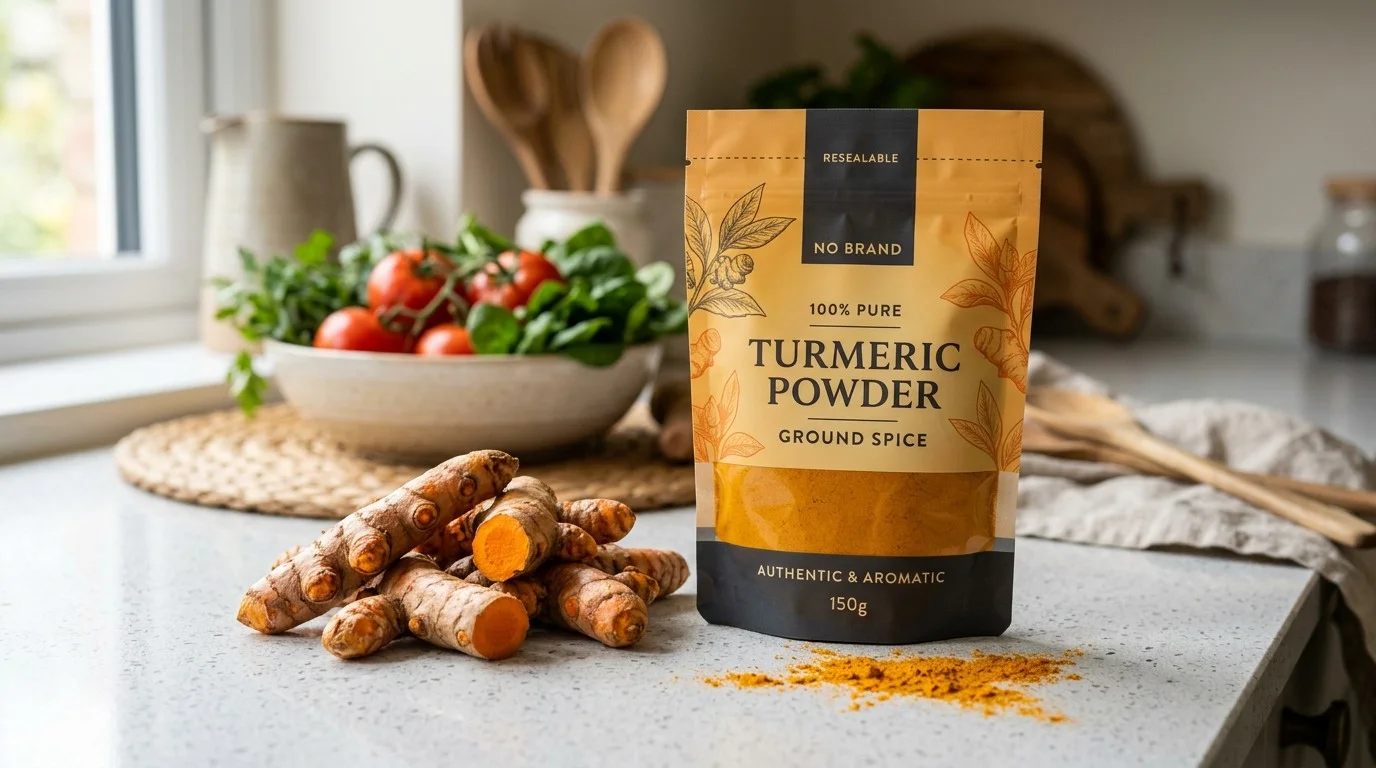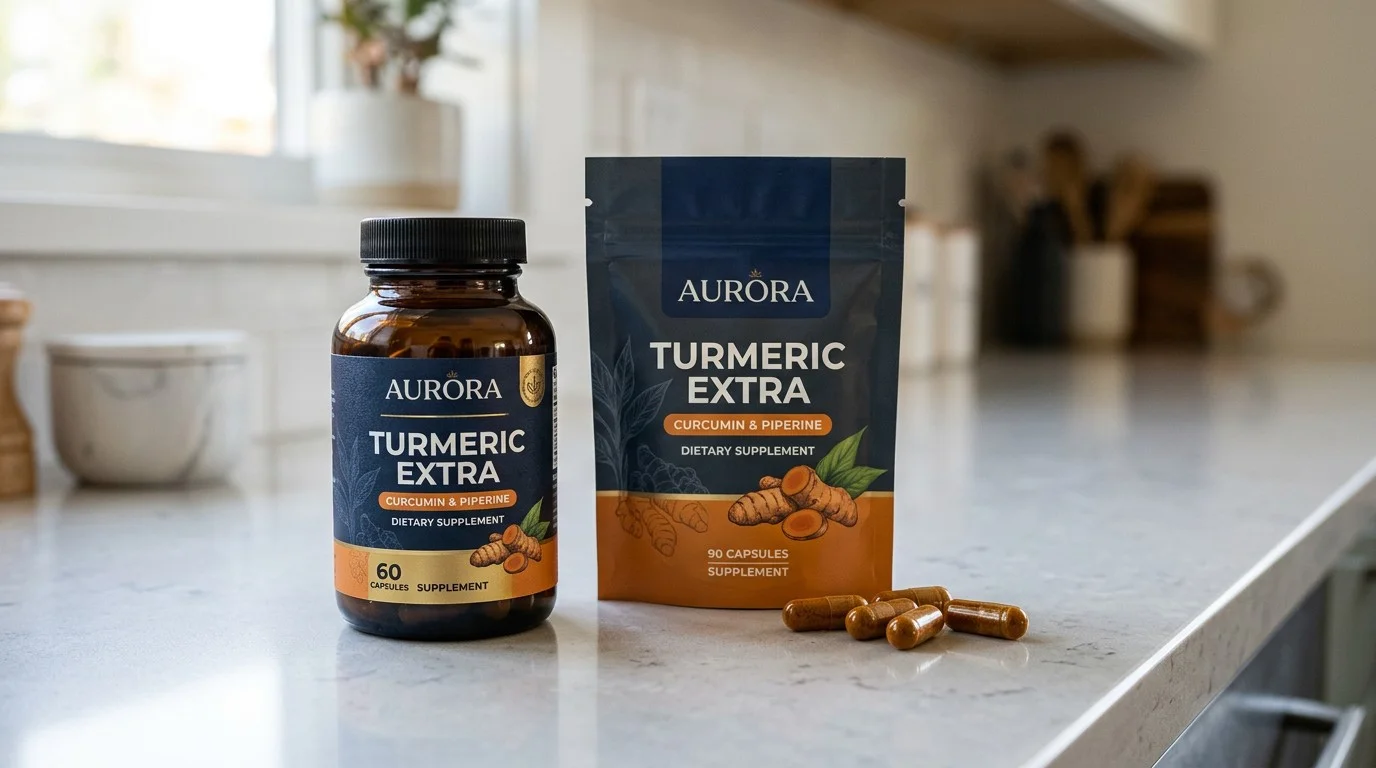
Liquid Turmeric (Curcumin) Supplements
Quick Answer
Liquid turmeric supplements provide turmeric or curcumin in a liquid or liquid-based form rather than as ordinary dry powder, tablets or capsules.
They include products such as liquid turmeric extracts, drops and specially formulated liquid curcumin products. Some are designed to improve the absorption of curcumin, which is naturally difficult for the body to absorb.
However, liquid does not automatically mean better absorbed. The ingredients, amount of curcumin and formulation matter more than simply whether the supplement is liquid.
If you are comparing products, look beyond the number of milligrams on the front of the label. Check what form of turmeric or curcumin it contains, how much it provides and whether the formulation has been designed to improve absorption.
Key Points
- Liquid turmeric comes in several different forms.
- It can be easier to take than tablets or capsules.
- Many products contain concentrated turmeric or curcumin extracts.
- Curcumin is naturally difficult for the body to absorb.
- Some liquid formulations are designed to improve absorption.
- One small human study found 185-fold higher bioavailability with a specific liquid micellar curcumin formulation than native curcumin.
- Liquid does not automatically mean better.
- Check the formulation, not just the milligrams.
- Turmeric and curcumin supplements may not be suitable for everyone.
Related Guides
Explore more about turmeric and your options:
- Turmeric Capsules — understanding turmeric capsule formulations.
- Taking Turmeric Supplements with Food — practical questions about taking supplements with food.
- How to Choose Turmeric Supplements — what to consider when comparing products.
- Turmeric Powder — exploring turmeric powders sold as supplements.
- Turmeric with Black Pepper — why black pepper is paired with turmeric.
Different Types of Liquid Turmeric Supplements
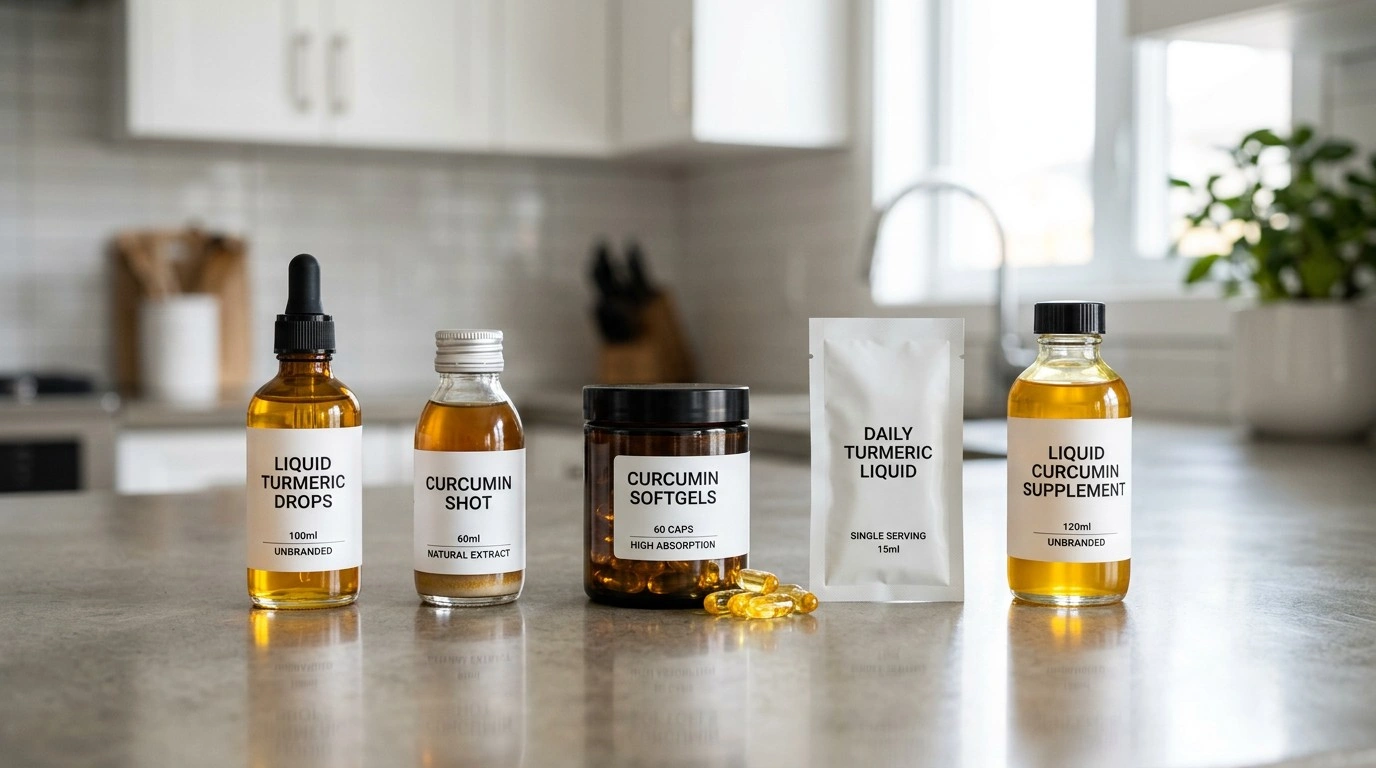
Liquid turmeric and curcumin supplements are available in several forms, including drops, liquid-filled capsules and single-serving products.
About Liquid Turmeric Supplements
What are liquid turmeric supplements?
Liquid turmeric supplements contain turmeric, turmeric extracts or curcumin in a liquid or liquid-based formulation.
Unlike ordinary turmeric powder used in food, they are generally designed to provide a convenient and measurable amount of turmeric or curcumin.
Why do people choose liquid turmeric?
People may choose liquid turmeric because they:
- prefer liquids to tablets or capsules;
- find large tablets difficult to swallow;
- want a convenient way to take turmeric;
- are looking for concentrated curcumin;
- are interested in formulations designed to improve absorption.
What forms are available?
Liquid turmeric and curcumin products can include:
- liquid turmeric extracts;
- curcumin drops;
- liquid curcumin preparations;
- liquid-filled capsules or softgels;
- micellar curcumin;
- liposomal formulations;
- turmeric or curcumin combined with oils;
- formulations containing black pepper or piperine.
These products are not necessarily equivalent. The ingredients, concentration and formulation can differ considerably.
Who might choose liquid turmeric?
Liquid turmeric may appeal to people who dislike swallowing tablets or want an alternative to ordinary turmeric capsules and powders.
Some people may also specifically look for liquid curcumin because they have heard about curcumin’s poor natural absorption.
When is liquid turmeric taken?
This depends on the individual product.
Some products are taken directly, while others can be mixed into water or another drink. Concentrations and recommended servings vary, so always follow the individual product instructions.
How is liquid turmeric different from other supplements?
The biggest difference is not necessarily the liquid itself.
It is what is in the liquid and how the turmeric or curcumin has been formulated.
That becomes particularly important when comparing absorption.
Liquid Turmeric Supplement

Liquid turmeric products can contain turmeric extracts or concentrated curcumin in several liquid-based formulations.
Table of Contents
- What Are Liquid Turmeric Supplements?
- Why Do People Take Liquid Turmeric?
- What Types of Liquid Turmeric Are Available?
- Why Is Curcumin Absorption Important?
- Is Liquid Curcumin Better Absorbed?
- What Are the Potential Benefits of Liquid Turmeric?
- What Are the Advantages of Liquid Turmeric?
- What Are the Disadvantages of Liquid Turmeric?
- Liquid Turmeric vs Capsules, Tablets and Powder
- Liquid Turmeric vs Liquid Curcumin
- What Should You Look for When Choosing Liquid Turmeric?
- What About Liquid Turmeric with Black Pepper?
- Are High-Absorption Liquid Formulations Better?
- How Do You Take Liquid Turmeric?
- Frequently Asked Questions
- What Are the Side Effects of Liquid Turmeric?
- Can Liquid Turmeric Interact with Medicines?
- Who Should Seek Medical Advice Before Taking Liquid Turmeric?
- Summary
- Further Information and Reading
What Are Liquid Turmeric Supplements?
Liquid turmeric supplements provide turmeric, turmeric extract or curcumin in a liquid-based product.
The term covers several different formulations rather than one standard type of supplement.
A simple liquid turmeric extract, for example, can be very different from a specialised micellar or liposomal curcumin formulation designed to improve bioavailability.
This is why “liquid turmeric” on the front of a product does not tell you everything you need to know about what is inside it.
Why Do People Take Liquid Turmeric?
People take turmeric and curcumin supplements for several reasons, but joint health and inflammation are among the areas that have attracted the greatest scientific interest.
Liquid products may additionally appeal to people who want:
- an alternative to swallowing tablets;
- a convenient daily supplement;
- concentrated turmeric or curcumin;
- adjustable servings;
- a formulation designed to improve absorption.
The important distinction is between why someone wants turmeric and why they choose a liquid format.
Liquid is the delivery method. Turmeric or curcumin is the ingredient being studied for its potential health effects.
What Types of Liquid Turmeric Are Available?
Liquid turmeric is not one standard product.
Common forms can include:
Liquid turmeric extracts
These contain turmeric-derived ingredients in a liquid preparation. Their concentration can vary considerably.
Liquid curcumin
These generally focus more specifically on curcumin or curcuminoids rather than ordinary whole turmeric powder.
Turmeric or curcumin drops
Drops can provide smaller, measurable servings and may be taken directly or added to drinks, depending on the product.
Liquid-filled capsules and softgels
Some formulations place liquid or oil-based ingredients inside a soft capsule shell, combining a pre-measured serving with a liquid-based formulation.
Enhanced-absorption formulations
Some products use technologies such as micelles, liposomes or phospholipid-based formulations to address curcumin’s naturally poor bioavailability.
These technologies are not interchangeable, and being liquid alone does not establish that a product will be better absorbed.
Why Is Curcumin Absorption Important?
Curcumin is one of the main naturally occurring curcuminoids found in turmeric.
It has attracted considerable scientific interest, but ordinary curcumin has relatively poor oral bioavailability. This means that only a limited amount may reach the circulation after it is swallowed.
Supplement manufacturers therefore use several approaches intended to improve curcumin absorption.
These can include:
- micellar formulations;
- phospholipid or phytosome formulations;
- liposomal formulations;
- oils and other lipid-based formulations;
- smaller particle sizes;
- black pepper extract containing piperine.
This is one reason two supplements containing apparently similar amounts of curcumin may behave very differently in the body.
Is Liquid Curcumin Better Absorbed?
Some specially formulated liquid curcumin products can be substantially better absorbed than ordinary curcumin, but this does not apply to every liquid turmeric supplement.
A small human crossover study involving 23 healthy adults compared 500 mg of curcuminoids provided as native curcumin powder, micronised powder and liquid micelles.
Across all participants, researchers calculated that the specific liquid micellar formulation had approximately 185 times the oral bioavailability of native curcumin.
The micronised powder also improved bioavailability, but by approximately nine-fold across all participants.
The important lesson is not that all liquid turmeric is 185 times better.
It is that the way curcumin is formulated can make a substantial difference to its absorption.
Liquid Curcumin and Absorption

Some liquid curcumin products use specialised formulations designed to improve bioavailability, but liquid does not automatically mean better absorbed.
What Are the Potential Benefits of Liquid Turmeric?
Most clinical research concerns turmeric extracts and curcumin formulations, rather than liquid turmeric as one single product category. Research has investigated a range of potential benefits of turmeric, although the strength of evidence varies depending on the health outcome and formulation studied.
One of the better-studied areas is joint health and osteoarthritis.
A systematic review and meta-analysis examining 15 randomised controlled trials involving 1,621 participants found that Curcuma longa extracts and curcumin supplementation improved several measures of osteoarthritis pain, function and stiffness compared with placebo.
However, formulations and doses differed between studies.
This means the research provides evidence for the potential effects of turmeric extracts and curcumin, but it does not demonstrate that every liquid turmeric supplement will produce the same result.
Healthy Eating as Part of a Balanced Lifestyle

Turmeric supplements can be considered as one part of a healthy lifestyle alongside a balanced diet and regular physical activity.
What Are the Advantages of Liquid Turmeric?
Liquid turmeric can have several practical advantages compared with other supplement formats.
1. Easier to take
Liquid products can be useful for people who dislike swallowing large tablets or capsules.
2. Flexible servings
Some liquid products allow the amount taken to be measured rather than being restricted to a fixed tablet or capsule.
3. Different formulations are available
Liquid turmeric includes simple extracts as well as more specialised curcumin formulations.
4. Some formulations can improve absorption
Certain specially formulated liquid curcumin products have demonstrated substantially improved bioavailability in human research.
5. Another convenient way to take turmeric
Depending on the product, liquid turmeric may be taken directly or added to a drink, making it a practical alternative to tablets and powders.
What Are the Disadvantages of Liquid Turmeric?
Liquid turmeric also has disadvantages worth considering.
1. Liquid does not automatically mean better absorbed
A simple liquid turmeric product is not necessarily better absorbed than a well-formulated capsule or tablet.
2. Concentrations vary considerably
Two products containing the same volume of liquid can provide very different amounts and types of turmeric or curcumin.
3. Taste can be an issue
Some people may dislike the strong or bitter flavour of certain liquid turmeric products.
4. Measuring can be less convenient
A pre-measured capsule or tablet may be simpler than measuring drops or liquid each day.
5. Specialist formulations may cost more
Products using advanced absorption technologies can be more expensive than ordinary turmeric powders, tablets or capsules.
The simple comparison: liquid turmeric can offer convenience, flexibility and access to specialised formulations, but liquid itself is not a guarantee of better absorption or greater benefits.
Liquid Turmeric vs Capsules, Tablets and Powder
There is no single format that is automatically best.
Liquid turmeric can suit people who dislike swallowing tablets, want flexible servings or are interested in particular liquid formulations.
Capsules provide a convenient, pre-measured serving and can contain either ordinary turmeric powder or sophisticated curcumin formulations.
Tablets are also pre-measured and convenient, although some people find larger tablets difficult to swallow.
Turmeric powder is versatile and can be added to foods and drinks, but ordinary culinary powder is very different from concentrated curcumin extracts used in many supplements and clinical studies.
The most useful question therefore is not simply:
“Is liquid better than capsules?”
It is:
“What form of turmeric or curcumin am I actually getting?”
Liquid Turmeric vs Capsules, Tablets and Powder

Liquid turmeric is one option alongside capsules, tablets and powder, with each format offering different practical advantages.
Liquid Turmeric vs Liquid Curcumin
Turmeric and curcumin are not the same thing.
Turmeric is the plant material or an extract derived from it. Curcumin is one of the principal curcuminoids naturally present in turmeric.
A liquid turmeric product may therefore contain a broader turmeric extract, while a liquid curcumin supplement may concentrate more specifically on curcumin or curcuminoids.
Neither description automatically makes one product better.
Look at what the product actually contains rather than relying solely on the name on the front.
What Should You Look for When Choosing Liquid Turmeric?
Do not choose a liquid turmeric supplement simply because the bottle says high strength or displays a very large milligram number.
Check what type of turmeric it contains
Look for whether the product contains:
- turmeric
- turmeric extract
- curcumin
- curcuminoids
- a specialised enhanced-bioavailability formulation
Check the actual amount
A large milligram figure does not necessarily tell you how much curcumin or curcuminoids the product provides.
Check how absorption is addressed
If a product claims enhanced absorption, find out what formulation it uses.
This could involve piperine, oils, micelles, phospholipids, liposomes or another approach.
Check the other ingredients
Liquid products may contain oils, flavourings, sweeteners or other ingredients.
Check the manufacturer’s instructions and quality information
Look for clear labelling, serving information, ingredient transparency and appropriate manufacturing standards.
For a broader explanation of labels, formulations and ingredients, read our guide on how to choose a turmeric supplement.
Most importantly:
Do not assume liquid means high absorption.
Liquid describes the format. Bioavailability describes what happens to the ingredient after you take it.
Person Checking a Liquid Turmeric Label

Check the type of turmeric or curcumin, concentration, ingredients and formulation rather than relying only on front-label claims.
What About Liquid Turmeric with Black Pepper?
Black pepper is commonly included in turmeric and curcumin supplements because it contains piperine.
In a small human study, adding 20 mg of piperine to 2 g of curcumin increased measured curcumin bioavailability by 2,000% compared with curcumin alone under the conditions studied.
This does not mean black pepper makes turmeric 2,000% more effective.
It means piperine substantially changed the measured bioavailability of curcumin in that particular study.
Piperine is also only one approach to improving curcumin absorption. Other formulations use technologies including micelles, phospholipids and liposomes.
Are High-Absorption Liquid Formulations Better?
Higher absorption can sound automatically better, but there is an important difference between absorbing more curcumin and achieving a greater health benefit.
A pharmacokinetic study can demonstrate that a particular formulation produces higher levels of curcumin in the body.
That does not automatically mean someone will experience proportionally greater improvements in joint pain, inflammation or another health outcome.
This distinction is particularly important when comparing more expensive high-absorption supplements.
How Do You Take Liquid Turmeric?
There is no single serving that applies to every liquid turmeric product.
Concentrations and formulations vary considerably.
Depending on the product, liquid turmeric may be:
- taken directly;
- measured using a dropper;
- mixed into water;
- added to another drink;
- supplied as a pre-measured liquid-filled capsule or softgel.
Follow the instructions supplied with the individual product rather than copying the serving used for another turmeric supplement.
Frequently asked questions
Is liquid turmeric better than capsules?
Not automatically. The ingredients, concentration and formulation are more important than whether the supplement comes as a liquid or capsule.
Is liquid curcumin absorbed better?
Some specially formulated liquid curcumin products have demonstrated substantially greater bioavailability than ordinary curcumin in human studies. This does not mean every liquid curcumin product is better absorbed.
What is the best liquid turmeric to take?
There is no single product that is best for everyone. Compare the type and amount of turmeric or curcumin, formulation, other ingredients, manufacturer information and whether the product suits why you want to take it.
Can you take liquid turmeric every day?
This depends on the individual product, amount, your health and any medicines you take. Follow the product directions and seek professional advice where appropriate.
Is liquid turmeric good for joints?
Research into turmeric extracts and curcumin suggests potential benefits for osteoarthritis symptoms such as pain and stiffness, but this does not establish that every liquid turmeric product will provide those benefits.
Does liquid turmeric need black pepper?
Not necessarily. Piperine from black pepper is one way of improving curcumin bioavailability, but it is not the only approach. Some formulations instead use micelles, phospholipids, lipids or liposomes to improve absorption.
Learn more about the research into black pepper and turmeric absorption.
Is higher-strength liquid turmeric better?
Not necessarily. A larger milligram figure alone does not establish greater absorption, curcumin content or effectiveness.
What Are the Side Effects of Liquid Turmeric?
Turmeric and curcumin supplements are generally well tolerated by many people, but unwanted effects can occur.
Reported effects can include:
- stomach upset;
- nausea;
- acid reflux;
- diarrhoea;
- constipation.
Cases of liver injury have also been reported in people using some turmeric and curcumin supplements, including certain highly bioavailable formulations.
Stop taking the product and seek medical advice if you experience symptoms that could indicate liver problems, such as yellowing of the skin or eyes, dark urine, unusual tiredness, nausea or loss of appetite.
Can Liquid Turmeric Interact with Medicines?
Turmeric and curcumin supplements may interact with medicines.
The potential for an interaction depends on the product, amount taken, formulation, medicine and individual.
This is particularly important because some enhanced-bioavailability formulations are specifically designed to increase the amount of curcumin absorbed by the body.
If you regularly take prescription medicines, check with an appropriate healthcare professional before starting a concentrated turmeric or curcumin supplement.
Who Should Seek Medical Advice Before Taking Liquid Turmeric?
Seek appropriate medical advice before taking a concentrated turmeric or curcumin supplement if you:
- regularly take prescription medicines;
- have an existing medical condition;
- have previously experienced liver problems;
- are pregnant or breastfeeding;
- are preparing for surgery;
- are unsure whether turmeric is appropriate for you.
Supplements should not be used as a substitute for prescribed treatment or professional medical advice.
Summary
Liquid turmeric supplements provide an alternative way to take turmeric or curcumin without relying on ordinary tablets or dry powders.
They can be particularly convenient for people who dislike swallowing tablets, want flexible servings or are interested in specialised curcumin formulations.
Their potential advantage, however, is not simply that they are liquid.
The formulation matters.
Human research illustrates how substantial that difference can sometimes be: one particular liquid micellar curcumin formulation produced approximately 185-fold greater measured oral bioavailability than native curcumin.
But that finding should not be applied to every liquid turmeric product.
When comparing products, look beyond the front of the bottle. Check what form of turmeric or curcumin you are getting, how much is provided, how absorption is addressed and whether the formulation has supporting evidence.
The product with the biggest number is not necessarily the best choice.
The better choice is the product whose ingredients, formulation and format make sense for what you actually want from it.
Further Information and Reading
Videos About Turmeric and Curcumin
Prefer to watch rather than read? These videos discuss turmeric and curcumin from different perspectives.
The videos are provided for further learning and represent the views of their respective presenters. They do not replace medical advice or the scientific evidence and sources referenced throughout this guide.
1. Should You Take Turmeric Every Day? Here’s What Doctors Say
Doctors Brad Weening and Paul Zalzal discuss turmeric and curcumin, including potential benefits, supplement forms, dosage, side effects and medicine interactions. Its coverage of supplement forms makes it particularly relevant to this page.
2. The Major Reason I Changed My Mind About Curcumin — Dr Boz
Dr Annette Bosworth discusses curcumin and explains her perspective on curcumin research and supplementation. Because curcumin itself is central to the page, this provides a particularly strong subject match.
3. Turmeric and Curcumin — Dr Berg
Dr Eric Berg discusses turmeric, curcumin, bioavailability and turmeric supplements. The video is broader than the first two, but its discussion of bioavailability and supplement use makes it relevant supporting material.
Further Reading
1. PubMed — The Oral Bioavailability of Curcumin from Micronized Powder and Liquid Micelles
This human crossover study compared the bioavailability of native curcumin, micronised curcumin and a liquid micellar formulation in healthy adults.
2. PubMed — Bioavailable Curcumin Formulations
This scientific review examined different curcumin formulations designed to improve bioavailability and compared pharmacokinetic research conducted in healthy volunteers.
3. PubMed — Curcuma longa Extract and Curcumin Supplements for Osteoarthritis
This systematic review and meta-analysis examined the efficacy and safety of Curcuma longa extract and curcumin supplements for osteoarthritis, covering 15 randomised controlled trials involving 1,621 participants.
4. NCCIH — Turmeric: Usefulness and Safety
The National Center for Complementary and Integrative Health provides an evidence-based overview of turmeric and curcumin, including current research, bioavailability, potential uses and important safety considerations.
Medical Disclaimer
This page is provided for general educational and informational purposes only. It is not medical advice, diagnosis or treatment and should not be used as a substitute for advice from a qualified healthcare professional.
Speak to your doctor or pharmacist before taking turmeric, ginger and black pepper supplements if you take medicines, have an existing health condition, are pregnant or breastfeeding, or have concerns about whether a supplement is suitable for you. Do not stop or change prescribed treatment based on information on this page.
Author
Written by J. Henderson
Health & Wellness Research Writer
J. Henderson writes evidence-based articles on nutrition, botanical supplements and everyday wellbeing. His work focuses on translating scientific research into clear, practical guidance that helps readers make informed decisions about natural health products.
- Written by J. Henderson
- Reviewed by Fiona Finlay
- Reviewed on the 06 September 2026