An evidence-based guide to the natural forms, different types and varieties of turmeric, and how they are used.
Published: 15 July 2026
Last updated: 9 October 2026
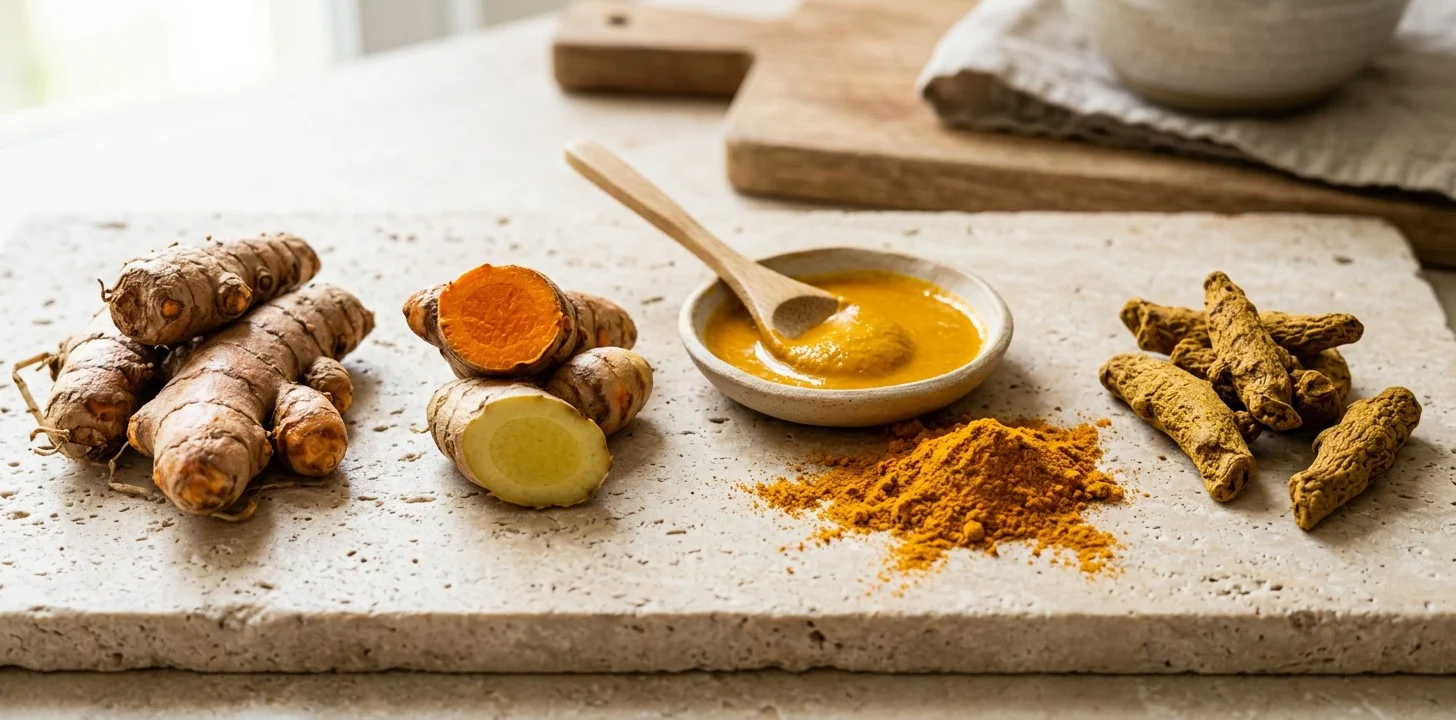
Turmeric comes in several natural forms, including fresh root, dried root, ground powder and paste. Most everyday culinary turmeric comes from the Curcuma longa plant, but there are also related species known as black, white and wild turmeric.
Different regional varieties of ordinary yellow turmeric, such as Lakadong, may vary in colour, aroma and natural composition.
The main distinction is between how turmeric is prepared and which plant species or variety it comes from. Understanding both makes it easier to choose the right turmeric for cooking and other traditional uses.
Explore the different forms of turmeric:
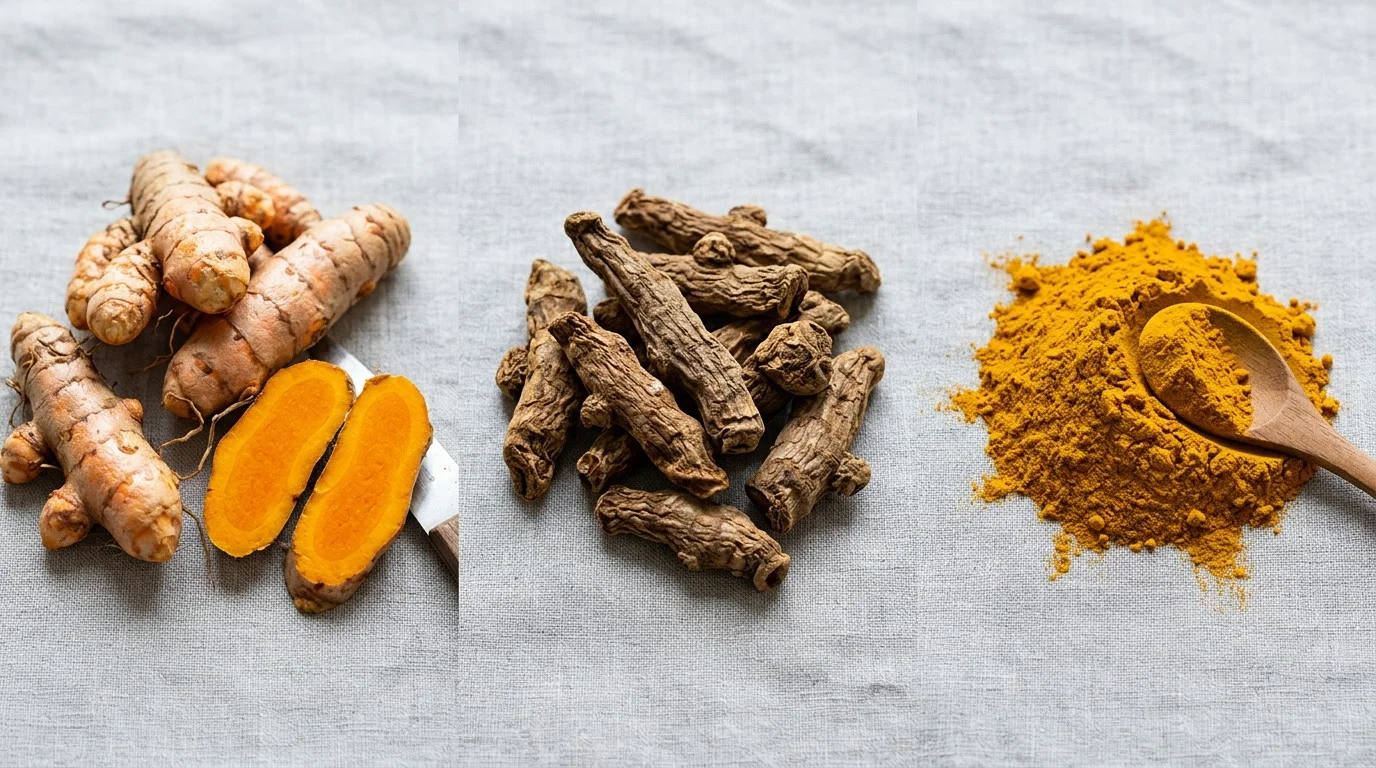
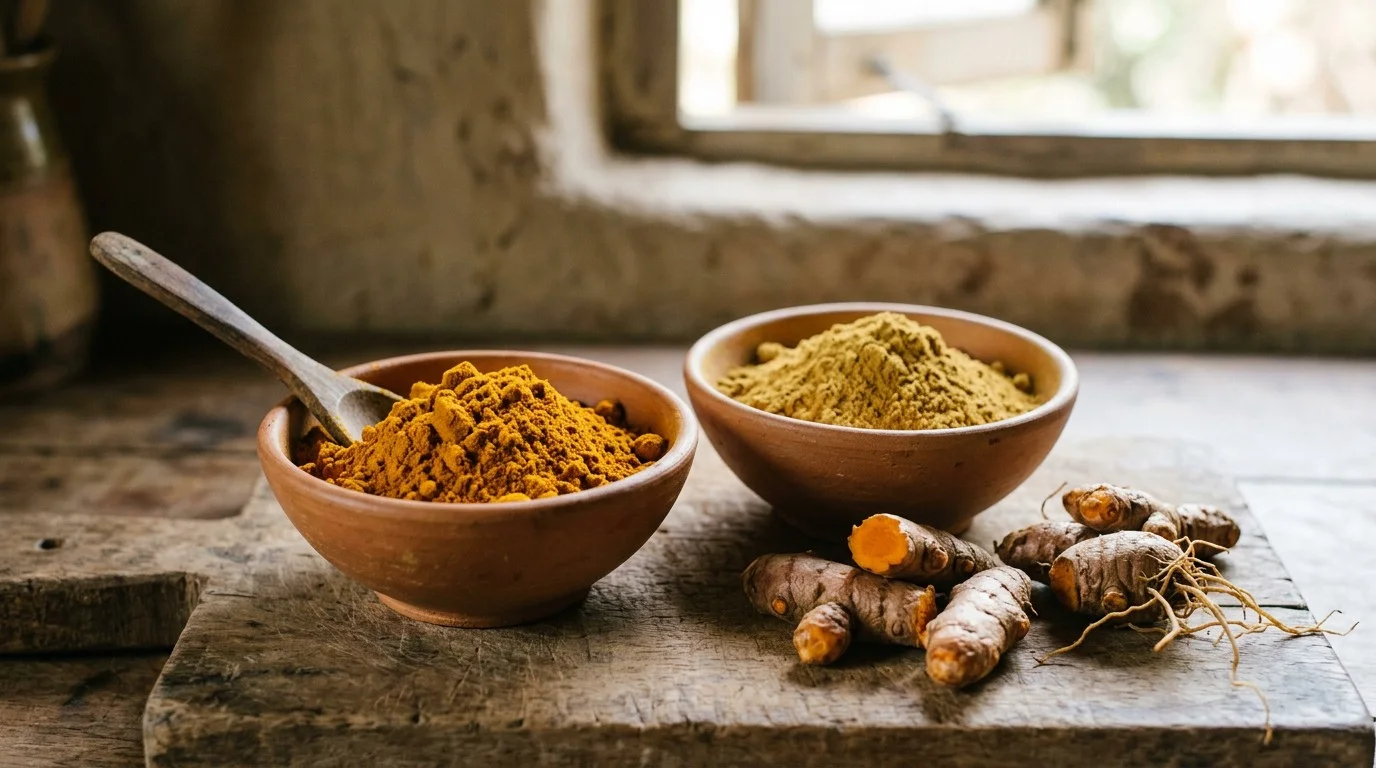
Fresh, dried and ground turmeric usually come from the same plant but differ in moisture, preparation and storage.
What are turmeric forms? The different physical ways turmeric is available, such as fresh root, dried root, ground powder and paste.
Who uses them? Home cooks, people exploring traditional foods, gardeners and those interested in different turmeric plants.
Where does turmeric come from? Ordinary culinary turmeric comes from Curcuma longa, a plant in the ginger family cultivated in Asia and other suitable growing regions.
When are different forms used? Fresh root is often chosen for its distinctive flavour, while dried and ground turmeric are convenient for everyday cooking.
Why are there different types? Some differences come from preparing the same plant in different ways. Others come from separate species or regional varieties.
How do you choose? Start with what you want to use turmeric for, then consider flavour, preparation, availability and storage.
| Form or type | What makes it different? | Common use |
| Fresh turmeric root | Moist, aromatic rhizome | Cooking and fresh preparations |
| Dried turmeric | Whole rhizome with moisture removed | Storage, grinding and cooking |
| Ground turmeric powder | Dried turmeric milled into a fine spice | Curries, soups and everyday recipes |
| Turmeric paste | Turmeric mixed into a paste | Cooking bases and traditional preparations |
| Organic turmeric | Turmeric grown under organic production standards | Culinary use and ingredient choice |
| Turmeric extract | Concentrated preparation of plant compounds | Formulated products |
| Black turmeric | Related species, Curcuma caesia | Traditional and botanical uses |
| White turmeric | Commonly associated with Curcuma zedoaria | Regional culinary and traditional uses |
| Wild turmeric | Commonly associated with Curcuma aromatica | Traditional cosmetic preparations |
| Lakadong turmeric | Regional variety of Curcuma longa | Cooking and spice preparations |
Common names can vary between regions and suppliers. The botanical name is particularly important when identifying less familiar turmeric plants.
The turmeric most people recognise is the golden-yellow spice used in cooking. However, it begins as a fresh underground stem, known as a rhizome, which looks rather like ginger.
That rhizome can be used fresh, dried whole, ground into powder or prepared as a paste.
These are different physical forms of turmeric, rather than different plant species.
Fresh turmeric root has a thin outer skin and a brightly coloured interior, usually yellow or orange.
It has an earthy, slightly bitter flavour with fresh, ginger-like aromatic notes.
People use fresh turmeric in curries, soups, grated spice mixtures and other recipes where its fresh flavour is useful.
Fresh turmeric needs washing and preparation and generally has a shorter storage life than dried turmeric.
Dried turmeric is made by removing much of the moisture from harvested turmeric rhizomes.
The dried pieces can be stored and later ground into powder. Drying makes turmeric easier to keep, transport and use over time.
Whole dried turmeric is particularly familiar in traditional spice preparation.
Ground turmeric powder is one of the most familiar forms of turmeric.
It is made from dried rhizomes that have been milled into a fine powder. It is easy to measure, mixes readily into recipes and can be stored in a sealed container.
Ground turmeric is commonly used in curries, rice dishes, soups, sauces and spice blends.
Because much of its water has been removed, dried powder is more concentrated by weight than fresh turmeric. However, that does not automatically mean it provides greater health benefits.
Turmeric paste is a mixture containing turmeric and other ingredients, often water, oil or spices.
Some pastes are intended as cooking bases. Others are used in traditional preparations.
The ingredients and intended uses can differ considerably, so turmeric paste is not one standardised product.
Fresh, dried and ground turmeric are usually different preparations of the same plant.
The most noticeable differences are moisture, flavour, convenience and storage.
| Feature | Fresh root | Dried root | Ground powder |
| Appearance | Moist whole rhizome | Hard, dried pieces | Fine yellow-orange powder |
| Flavour | Fresh and aromatic | Earthy and concentrated | Warm and earthy |
| Preparation | Wash, slice or grate | Often needs grinding or other preparation | Ready to measure |
| Storage | Usually refrigerated | Cool, dry storage | Airtight container away from light |
| Convenience | Requires preparation | Requires some preparation | Very convenient |
None is automatically the healthiest choice.
The right form depends on the recipe, how often you use turmeric and your personal preferences.
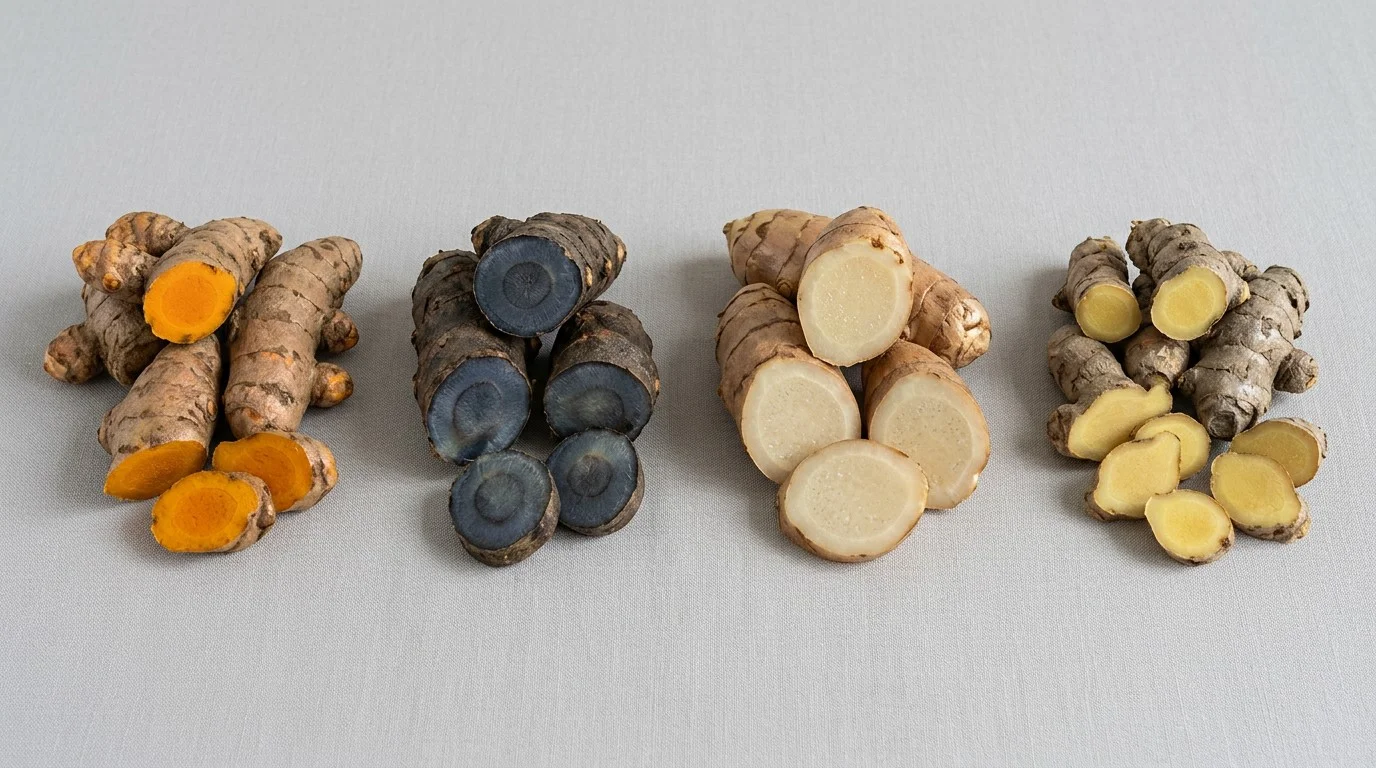
Different turmeric species can vary in colour, aroma and traditional uses, although appearance alone cannot reliably identify a species.
Although ordinary yellow turmeric is usually Curcuma longa, other plants within the Curcuma genus have different colours, aromas and traditional uses.
They are related to culinary turmeric, but they are not necessarily the same ingredient.
For example, black turmeric is known for its unusual blue-black rhizome, while wild turmeric is associated with traditional cosmetic preparations.
There are also regional varieties of ordinary yellow turmeric, including Lakadong.
The distinction matters because different species may have different chemical compositions, and research on ordinary turmeric cannot automatically be applied to every related plant.
A turmeric plant produces underground rhizomes with different shapes.
The larger central rhizome is often called the mother rhizome, while the narrower branches growing from it are known as finger rhizomes.
Both are parts of the same plant, rather than separate turmeric varieties.
These terms are mainly useful when discussing how turmeric grows, is harvested or is sold as whole rhizomes.
Turmeric leaves are also used in some regional food traditions, including wrapping or flavouring foods during cooking.
Black turmeric, commonly identified as Curcuma caesia, is a plant related to ordinary yellow turmeric.
It is known for the unusual bluish, purple or dark colouring inside its rhizome.
Black turmeric is also called Kali Haldi in parts of India, where it has a history of traditional and cultural uses.
Unlike the familiar golden culinary spice, black turmeric has a distinctive aroma often described as camphor-like.
The main differences are the plant species, rhizome colour, aroma and traditional uses.
Black turmeric is not simply ordinary yellow turmeric that has been dried or processed differently.
Its relative rarity and limited cultivation can also make it more difficult to obtain than ordinary turmeric.
Although traditional medicinal uses are widely discussed, these should not be confused with proven clinical benefits.
Research into Curcuma caesia includes laboratory and early-stage studies, but there is insufficient reliable human evidence to establish its effectiveness for treating specific health conditions.
White turmeric is a common name often used for Curcuma zedoaria, also known as zedoary.
It is related to ordinary yellow turmeric but differs in aroma, appearance and traditional uses.
Descriptions of white turmeric often refer to bitter, earthy or aromatic characteristics distinct from familiar culinary turmeric.
No. White turmeric and ordinary yellow turmeric generally refer to different plant species.
There is also an important naming complication.
Some sellers use terms such as white turmeric, Amba Haldi and mango ginger interchangeably. However, mango ginger is commonly identified as Curcuma amada, a different species from Curcuma zedoaria.
For this reason, the scientific plant name is more reliable than the common name alone.
White turmeric has a history of traditional culinary and medicinal use in parts of Asia, but claims about specific health benefits need careful scientific assessment.
Wild turmeric commonly refers to Curcuma aromatica, an aromatic plant related to ordinary culinary turmeric.
It is also known in some traditions as Kasturi Manjal or Kasturi Haldi.
Wild turmeric is particularly associated with traditional cosmetic preparations, including face and body pastes.
Ordinary yellow turmeric is mainly recognised as a culinary spice, whereas wild turmeric is more commonly discussed in connection with traditional skin preparations.
Their botanical identities and chemical compositions differ.
Some sellers describe wild turmeric as less likely to stain skin than culinary turmeric. However, staining can vary, and claims that it improves acne, pigmentation or skin ageing should not be accepted without suitable human evidence.
Natural ingredients can also irritate the skin or cause allergic reactions.
Wild turmeric should not automatically be substituted for culinary turmeric, particularly where the plant’s identity and suitability for consumption are uncertain.
Lakadong turmeric is a regional variety of ordinary yellow turmeric, Curcuma longa, associated with Meghalaya in north-east India.
It is particularly known for its deep colour and reputation for relatively high curcumin content.
Unlike black, white or wild turmeric, Lakadong is not usually described as a separate species.
Its growing origin and reported chemical composition are the main points of interest.
Some Lakadong turmeric is marketed as having higher curcumin levels than many conventional turmeric powders. However, curcumin content can vary between harvests, growing conditions and individual batches.
A higher percentage of curcumin does not, by itself, establish greater health benefits.
For someone choosing turmeric as a cooking ingredient, flavour, quality, authenticity and intended use may be more relevant than a headline curcumin percentage.
Lakadong is a regional variety of ordinary yellow turmeric, known for its origin in Meghalaya, India.
Yes. Turmeric is part of a much larger botanical group, and several regional varieties and related plants are recognised.
Examples include:
These examples show why the word turmeric can describe more than one thing.
For everyday readers, it is more useful to understand the main differences than to memorise every agricultural variety.
The ordinary turmeric used in most UK kitchens remains Curcuma longa.
Fresh turmeric and turmeric powder usually come from the same plant, but they behave differently in the kitchen.
Neither is automatically better.
Fresh turmeric is useful when you want its fresh aroma and are happy to wash, slice or grate it.
Ground powder is convenient when you want a readily available spice that mixes easily into everyday dishes.

Fresh turmeric offers a distinctive aroma, while ground turmeric is convenient for everyday cooking.
Often, yes, particularly in cooked recipes.
However, there is no exact universal conversion because fresh turmeric contains substantial water, and the flavour and strength of different powders vary.
As a rough culinary starting point, some recipes use approximately one teaspoon of ground turmeric in place of one tablespoon of grated fresh turmeric. Adjust according to taste and the recipe.
This is a cooking substitution, not a medical dosage conversion.
Dried turmeric often contains more curcumin per gram than fresh turmeric because much of the water has been removed.
However, the actual amount depends on the variety, growing conditions and processing.
More curcumin per gram does not automatically mean better absorption or better health outcomes.
For regular home cooking, ground powder is usually easier to store and measure.
Fresh root may be preferable when its taste, flavour and texture are important to the dish.
Both can be useful ingredients in a varied diet.
Two other terms are worth understanding because they are often confused with turmeric types.
Organic turmeric is not a separate botanical species.
It refers to turmeric produced according to applicable organic farming and certification standards.
It may be sold as fresh root, dried turmeric or ground powder.
Organic certification does not automatically establish a higher curcumin content or greater health benefits.
Turmeric extract is different from ordinary ground turmeric.
Extracts are preparations made to concentrate particular compounds from the plant. Some are standardised to specified curcuminoid levels.
Their composition and intended use may differ substantially from culinary turmeric.
Concentrated preparations also require more attention to safety, particularly where medicines or existing health conditions are involved.
Storage depends mainly on whether turmeric is fresh, dried or prepared.
Fresh turmeric root: Keep refrigerated in suitable packaging, protect it from excess moisture and inspect it for spoilage.
Dried turmeric root: Store in a cool, dry place away from moisture.
Ground turmeric powder: Keep in a tightly closed container, away from heat, direct sunlight and damp conditions.
Turmeric paste: Follow the recipe or manufacturer’s storage instructions, particularly where fresh ingredients are included.
Proper storage helps preserve flavour and quality and reduces the risk of spoilage.
| Advantages | Disadvantages |
| Fresh root provides a distinctive fresh aroma. | It requires preparation and has a shorter storage life. |
| Dried turmeric stores well. | Whole pieces may need grinding or other preparation. |
| Ground powder is convenient and easy to measure. | Aroma and flavour can deteriorate during storage. |
| Paste can be convenient for particular recipes. | Ingredients and storage requirements vary. |
| Different botanical varieties offer different flavours and traditional uses. | Some are difficult to identify, source or assess for safety. |
There is no single form that is best for every purpose.
No. Fresh root, dried root and ground powder commonly come from Curcuma longa. However, black, white and wild turmeric can refer to other species within the Curcuma genus.
Yes. Haldi is a Hindi word commonly used for turmeric.
The word does not describe a separate botanical species or a different form of turmeric.
You may also encounter names such as Kali Haldi for black turmeric and Kasturi Haldi for wild turmeric.
Ordinary yellow turmeric, Curcuma longa, is the familiar culinary turmeric used in many spice blends and everyday recipes.
There is no good basis for saying black turmeric is generally better.
They are different plants with different traditional uses. Evidence about ordinary turmeric or curcumin should not automatically be applied to black turmeric.
Not necessarily.
White turmeric often refers to Curcuma zedoaria, while mango ginger is Curcuma amada. Common names are sometimes used inconsistently, so check the botanical name.
Wild turmeric is more commonly associated with traditional cosmetic uses than everyday cooking.
It should not be substituted for culinary turmeric without reliable identification and appropriate food-safety information.
Lakadong turmeric is known for its reputation for relatively high curcumin content, but this does not prove that it provides greater health benefits.
Curcumin concentration is only one characteristic of the plant.
Both have practical advantages.
Fresh root offers a distinctive fresh flavour, while powder is convenient and keeps longer. There is insufficient evidence to say that one is universally healthier than the other when used as a normal food ingredient.
Ordinary culinary turmeric is generally used in food amounts by many people.
However, not every related Curcuma species has the same history of food use or safety evidence. Concentrated turmeric preparations are also different from ordinary culinary quantities.
Plant identification, intended use and individual circumstances matter.
Turmeric and related preparations may cause unwanted effects, including digestive discomfort or allergic reactions in some people.
Topical preparations can also irritate the skin.
Safety information for one species or preparation should not automatically be assumed to apply to another.
Concentrated turmeric or curcumin preparations may interact with certain medicines, and some formulations can present additional safety concerns.
If you take regular medication, have an existing medical condition or are considering a concentrated preparation, speak to a qualified healthcare professional before use.
Turmeric comes in several natural forms, from fresh root and dried rhizomes to ground powder and paste.
Most everyday culinary turmeric comes from Curcuma longa, but black, white and wild turmeric are names associated with related species that differ in appearance, aroma and traditional uses.
Lakadong turmeric is a regional variety of ordinary yellow turmeric, rather than a separate species.
Understanding these distinctions helps you choose the right ingredient, recognise unfamiliar names and avoid assuming that all turmeric plants or preparations are interchangeable.
For most everyday cooking, fresh turmeric root and ground turmeric powder remain practical choices.
Royal Botanic Gardens, Kew — Plants of the World Online. Botanical names and accepted plant classifications.
National Center for Complementary and Integrative Health — Turmeric. Information on turmeric research, potential benefits and safety considerations.
National Institutes of Health — PubMed. Scientific literature covering Curcuma longa, related species and their constituents.
Meghalaya Tourism — Lakadong Turmeric. Regional background on Lakadong turmeric and its cultivation.
These resources provide botanical, scientific and regional background. They should not be interpreted as evidence that every traditional use or health claim has been clinically established.
This article is for general educational purposes and is not medical advice. Turmeric and related plants should not be used to diagnose, treat or prevent disease without appropriate medical guidance. Consult a qualified healthcare professional before using concentrated turmeric preparations, particularly if you take medication, are pregnant or breastfeeding, or have an existing health condition.
Written by J. Henderson
Health & Wellness Research Writer
J. Henderson writes evidence-based articles on nutrition, botanical supplements and everyday wellbeing. His work focuses on translating scientific research into clear, practical guidance that helps readers make informed decisions about natural health products.