Turmeric Gummies
Turmeric gummies are chewable food supplements containing turmeric, curcumin or turmeric extract. They are a convenient alternative to capsules, tablets and powders.
Curcumin is the main compound in turmeric studied in scientific research. Some studies suggest it may help with joint pain and function, particularly in people with osteoarthritis, but evidence for many other claimed benefits remains limited or uncertain.
Turmeric gummies can also vary considerably in their curcumin content, ingredients and formulation. Some contain piperine or black pepper extract to increase curcumin absorption.
In short: turmeric gummies can be a convenient way to take turmeric or curcumin, but the gummy format does not automatically make them more effective. The ingredients, dose, formulation and safety are more important when comparing products.
Quick answer: are turmeric gummies worth considering?
Turmeric gummies are a convenient form of curcumin or turmeric supplement, but the evidence for their health benefits remains mixed.
- Convenient: Easy to chew and take.
- Contains: Turmeric, curcumin or both.
- Potential benefit: Some evidence supports joint-health benefits.
- Evidence: Research is still limited for many claimed benefits.
- Check the label: Curcumin content can vary between products.
- Black pepper: Piperine may increase curcumin absorption.
- Safety: Some concentrated products have been linked to rare liver injury.
- Medical advice: Check with a doctor or pharmacist if you take medicines.
The evidence does not show that turmeric gummies are inherently more effective than capsules, tablets or other turmeric supplements. Product formulation and ingredients are more important than the gummy format itself.
Turmeric Gummies and Turmeric Root

Turmeric gummies alongside fresh turmeric root, illustrating the relationship between the supplement format and the turmeric plant.
Table of Contents
- What are turmeric gummies?
- What ingredients are in turmeric gummies?
- Potential benefits of turmeric gummies
- Turmeric gummies compared with other turmeric supplements
- What to look for on a label
- Safety, side effects and interactions
- Frequently asked questions
- Summary
- Sources and further information
- Medical Disclaimer
What are turmeric gummies?
Turmeric gummies are chewable supplements designed to provide turmeric or curcumin in a format that does not require swallowing a tablet or capsule. Turmeric comes from the rhizome of Curcuma longa, a plant traditionally used as a culinary spice and in Ayurvedic medicine.
Turmeric contains several naturally occurring compounds known as curcuminoids. Curcumin is the best-known of these and is the compound most frequently investigated in modern clinical research. However, turmeric and curcumin are not interchangeable terms. A product labelled simply as turmeric may contain considerably different amounts of curcuminoids from a product specifically standardised for curcumin.
This distinction matters when comparing turmeric gummies because the amount of turmeric extract stated on the front of a pack does not necessarily tell you how much curcumin or total curcuminoids the product provides. Commercial preparations can vary substantially in their composition.
Close-Up of Turmeric Gummies

A close-up view of turmeric gummies.
What ingredients are in turmeric gummies?
The precise formulation varies between products, but turmeric gummies may contain:
- Turmeric root or turmeric extract
- Curcumin or standardised curcuminoids
- Black pepper or piperine
- Sweeteners or sugars
- Pectin or other gelling agents
- Natural or artificial flavours
- Acids and preservatives
- Vitamins, minerals or other botanical ingredients
One important consideration is bioavailability. Curcumin has relatively low oral bioavailability, meaning that only a limited amount is absorbed and reaches the circulation after ingestion. Researchers have investigated several approaches to increasing absorption, including piperine and specialised delivery systems.
However, higher absorption is not automatically evidence of greater health benefit. It can also change exposure to the active compounds and potentially affect safety. This is particularly relevant because turmeric products with enhanced bioavailability have been associated with rare cases of liver injury.
Turmeric Gummies Ingredients
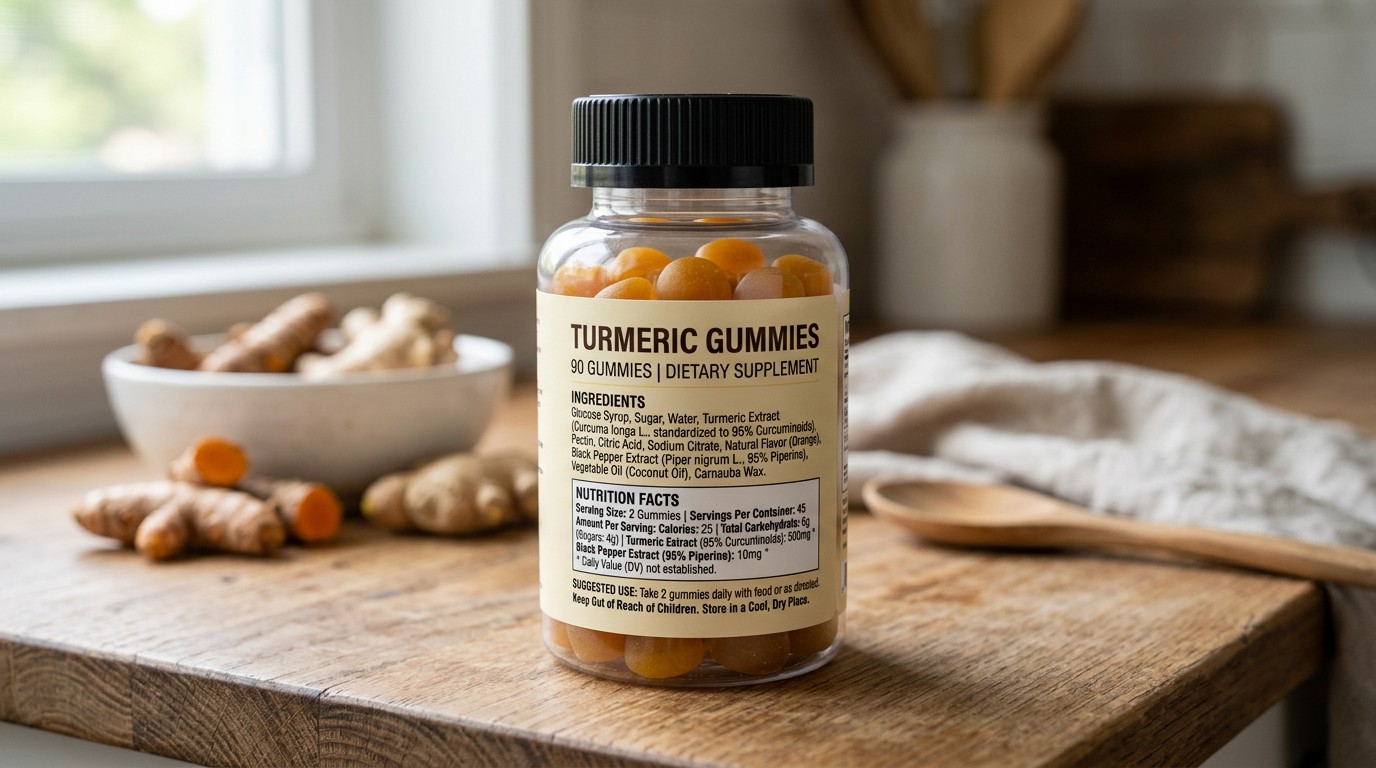
Turmeric gummies ingredients vary by manufacturer.
Potential benefits of turmeric gummies
1. Joint health and osteoarthritis
Joint health is one of the areas where turmeric and curcumin have been studied most extensively.
A 2024 meta-analysis of previous meta-analyses found that curcumin supplementation was associated with reductions in several measures of osteoarthritis pain, stiffness and functional limitations. However, studies differed in their formulations and methods, so the findings should not be interpreted as proof that every turmeric gummy will provide the same effect.
The National Center for Complementary and Integrative Health also notes that a 2021 systematic review found potentially beneficial effects of turmeric on knee osteoarthritis pain and function, while highlighting uncertainty around optimal dose, frequency and formulation.
2. Inflammation and antioxidant activity
Curcumin has biological properties that have attracted considerable scientific interest, including anti-inflammatory and antioxidant activity. Clinical research has examined markers such as C-reactive protein and inflammatory cytokines.
A 2025 systematic review and meta-analysis reported reductions in several inflammatory and oxidative-stress markers in studies of curcumin combined with piperine. However, the researchers also noted variation between studies, and these biochemical changes should not automatically be interpreted as preventing or treating a particular disease.
The distinction between biological effects measured in research and proven clinical benefits is important. Laboratory findings do not by themselves demonstrate that a supplement improves long-term health outcomes.
3. Other proposed benefits
Curcumin has also been investigated for digestive, metabolic, cardiovascular, neurological and other health outcomes. Research is ongoing, but evidence varies considerably by condition.
For example, the NCCIH concludes that there is currently insufficient evidence to support turmeric supplementation for inflammatory disorders generally.
Turmeric gummies therefore should not be viewed as a treatment for a medical condition, and claims that a product can prevent or cure disease should be treated cautiously.
Turmeric gummies compared with other turmeric supplements
| Supplement form | Main consideration | Typical advantage |
| Turmeric gummies | Ingredients and curcumin content can vary | Easy to chew and convenient |
| Turmeric capsules | Usually easier to provide a defined dose | Convenient and generally compact |
| Turmeric tablets | May contain standardised extracts | Straightforward dosage format |
| Turmeric powder | Composition depends on the raw turmeric | Versatile for food and drinks |
| Liquid turmeric products | Formulation and concentration vary | Easy to mix or consume |
There is no good evidence that the gummy format itself makes turmeric more effective. For comparison purposes, the actual active ingredients, amounts, formulation and quality of the product are more relevant than whether the supplement is a gummy, capsule or tablet.
Read our related guide on how to choose a turmeric supplement.
Turmeric Gummies with other Turmeric Supplements Forms
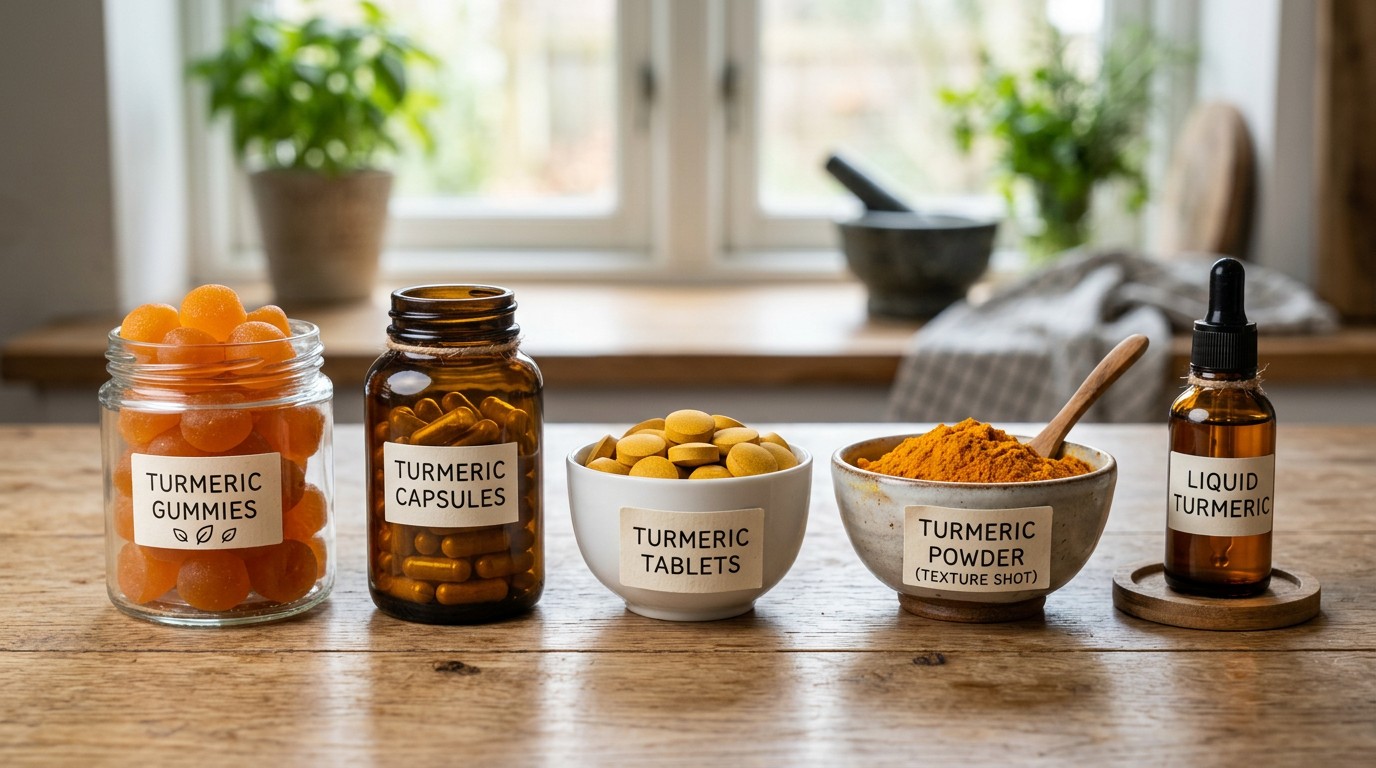
Turmeric gummies with other turmeric forms.
What to look for on a turmeric gummy label
A useful label should make it possible to identify the principal ingredients and their amounts.
Consider checking:
- The amount of turmeric or curcumin per serving – do not rely solely on a large number printed on the front of the package.
- Standardisation – where relevant, check whether the product specifies its curcuminoid content.
- Piperine or black pepper extract – identify whether an absorption-enhancing ingredient is included.
- Added sugars and sweeteners – gummies may contain ingredients that are less prominent than the turmeric itself.
- Full ingredient list – check for allergens and additional botanical ingredients.
- Recommended serving size – avoid assuming that more gummies mean greater benefit.
- Quality and manufacturing information – transparent labelling and appropriate quality controls are preferable.
Because food supplements can differ substantially in composition, comparing products by the amount of turmeric alone can be misleading.
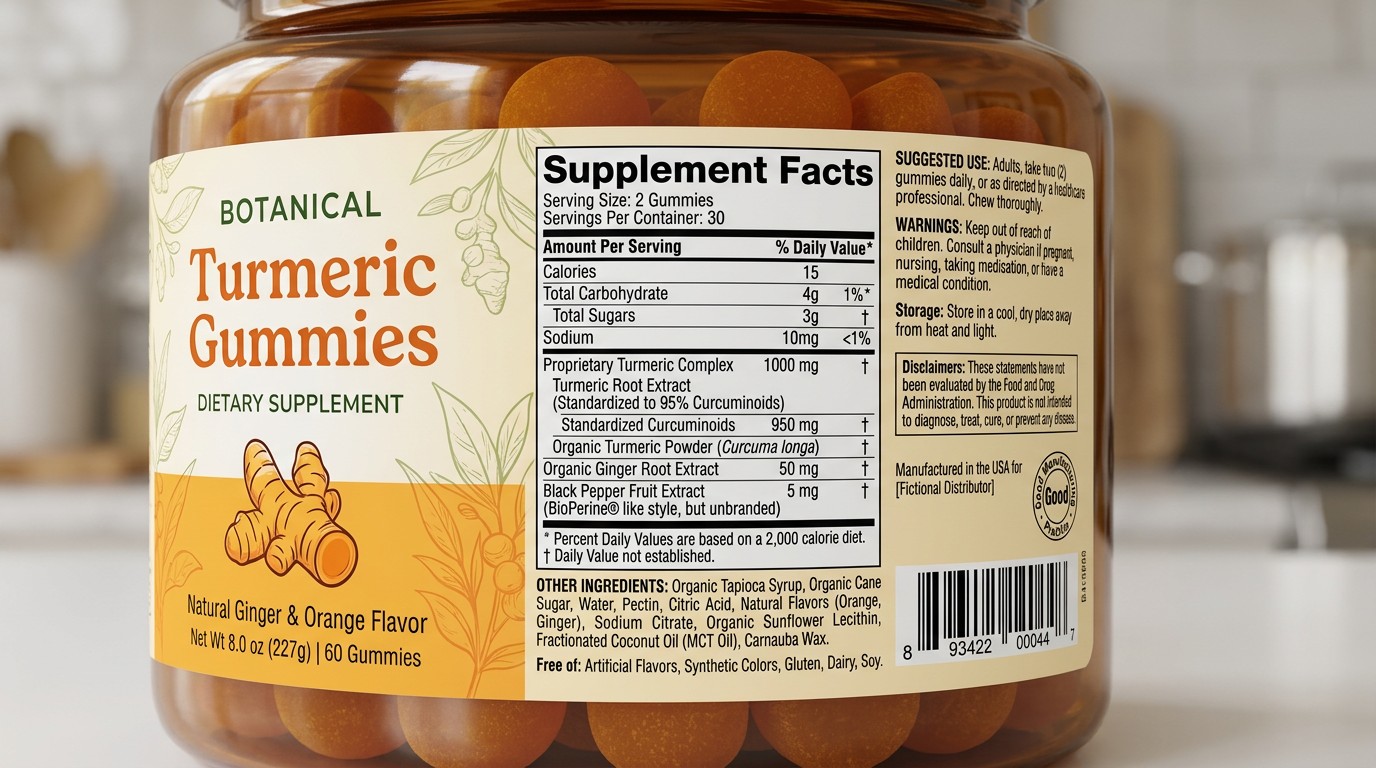
Illustrative example supplement label showing ingredients and serving information
Safety, side effects and interactions
Turmeric is generally well tolerated by many adults when used appropriately, but concentrated supplements are different from the amounts normally consumed as a culinary spice.
Possible side effects can include digestive symptoms such as indigestion, nausea or diarrhoea.
More importantly, rare cases of clinically apparent liver injury have been reported in people taking turmeric supplements. LiverTox reports that cases have particularly involved products designed to increase curcumin bioavailability, although liver injury has also been reported with other turmeric preparations.
Seek medical attention if symptoms such as unusual tiredness, loss of appetite, dark urine or yellowing of the skin or eyes develop after starting a turmeric supplement.
Turmeric and curcumin may also interact with medicines or other supplements. The NHS Specialist Pharmacy Service notes that turmeric and curcumin have the potential to interact with conventional medicines and other herbal products.
People should therefore speak to a doctor or pharmacist before using turmeric gummies if they take prescription or regular medicines, have a medical condition, are pregnant or breastfeeding, or are preparing for a medical procedure.
Frequently asked questions
What are turmeric gummies used for?
Turmeric gummies are generally taken as food supplements for general wellbeing, with products often marketed around joint health, inflammation and antioxidant support. Evidence is strongest for some measures associated with osteoarthritis, but evidence is not sufficient to regard turmeric gummies as a treatment for inflammatory diseases generally.
Do turmeric gummies contain curcumin?
They may. Some gummies contain turmeric extract, some contain specifically stated curcumin or curcuminoids, and others contain a combination. The label should be checked carefully because the amount of turmeric does not necessarily indicate the amount of curcumin.
Are turmeric gummies better than turmeric capsules?
Not necessarily. There is no reason to assume that a gummy is inherently more effective than a capsule. The more useful comparison is the amount and type of turmeric or curcumin, the formulation, additional ingredients and product quality.
Do turmeric gummies with black pepper work better?
Piperine from black pepper has been investigated as a way of increasing curcumin absorption. However, increased absorption does not automatically demonstrate better clinical outcomes, and high-bioavailability turmeric products have been associated with rare liver injuries.
Can turmeric gummies cause side effects?
Yes. Digestive symptoms can occur, and rare cases of liver injury have been reported with turmeric supplements. Anyone developing possible symptoms of liver injury, such as dark urine or jaundice, should seek medical advice promptly.
Should you take turmeric gummies every day?
There is no single evidence-based daily dose that applies to every turmeric gummy because products and formulations differ. Follow the product’s directions and speak with a doctor or pharmacist if you have any medical conditions or take medicines.
Summary – Turmeric Gummies
Turmeric gummies provide turmeric or curcumin in a convenient chewable format, but the gummy form itself has not been shown to provide greater health benefits than other supplement formats and turmeric forms. The most important factors are the ingredients, curcuminoid content, formulation and quality of the product.
Research suggests that curcumin may have modest benefits for some measures of knee osteoarthritis pain and function, although studies use different formulations and doses. Evidence for many other proposed health benefits remains limited or uncertain.
Safety also deserves attention. Turmeric supplements can cause digestive side effects and, rarely, liver injury. Products containing absorption-enhancing ingredients such as piperine deserve particular consideration because increasing bioavailability can alter exposure to curcumin.
For these reasons, turmeric gummies are best considered a food supplement rather than a replacement for medical treatment. Anyone taking medicines or managing a health condition should discuss their use with an appropriate healthcare professional.
Sources and further information
1. Should You Take Turmeric Every Day? Here’s What Doctors Say
2. The best foods to fight inflammation this spring | Prof. Tim Spector and Dr. Federica Amati
3. National Center for Complementary and Integrative Health (NCCIH) – Nutritional Approaches for Musculoskeletal Pain: What the Science Says.
Useful overview of the evidence for turmeric and curcumin, including osteoarthritis research and safety considerations. NCCIH turmeric and musculoskeletal pain evidence
4. National Center for Complementary and Integrative Health – Osteoarthritis: In Depth.
Provides broader context about complementary approaches to osteoarthritis and the limitations of evidence for dietary supplements. NCCIH Osteoarthritis: In Depth
5. PubMed – The efficacy of curcumin in relieving osteoarthritis: A meta-analysis of meta-analyses (2024).
Reviews evidence from multiple meta-analyses of randomised controlled trials. PubMed: Curcumin and osteoarthritis meta-analysis
6. PubMed – The Effects of Curcumin Plus Piperine Co-administration on Inflammation and Oxidative Stress (2025).
Reviews randomised controlled trials examining curcumin and piperine. PubMed: Curcumin plus piperine systematic review and meta-analysis
7. PubMed – Curcumin-piperine supplementation and human health (2023).
Reviews clinical and preclinical research concerning curcumin, piperine and bioavailability. PubMed: Curcumin and piperine review
8. NCBI LiverTox – Turmeric.
Detailed medical reference covering turmeric, curcumin, adverse effects and reported liver injury. NCBI LiverTox: Turmeric
Research into Turmeric and Curcumin Supplements

Scientific research into turmeric and curcumin supplements
Medical disclaimer
This page is provided for general educational and informational purposes only. It is not medical advice and should not be used to diagnose, treat, cure or prevent any disease or medical condition.
Food supplements can affect people differently and may interact with medicines or other treatments. Always consult a qualified medical doctor, pharmacist or other appropriate healthcare professional before starting turmeric gummies or another concentrated turmeric or curcumin supplement, particularly if you take medication, have an existing medical condition, are pregnant or breastfeeding, or are preparing for surgery.
Do not stop prescribed medication or replace medical treatment with a food supplement based on information on this page.
Author
Written by J. Henderson
Health & Wellness Research Writer
J. Henderson writes evidence-based articles on nutrition, botanical supplements and everyday wellbeing. His work focuses on translating scientific research into clear, practical guidance that helps readers make informed decisions about natural health products.