Turmeric Capsules
Quick Answer
Turmeric capsules contain turmeric powder, extracts, curcuminoids or curcumin inside a capsule shell. They provide a convenient, pre-measured way to take a turmeric supplement, but formulations can vary considerably. Potential benefits depend on what the capsule contains and the scientific evidence for the particular use.
Key Points
- Turmeric capsules contain different formulations.
- Turmeric and curcumin are not the same.
- Capsules provide convenient, pre-measured amounts.
- Some contain black pepper or piperine.
- Potential benefits vary by formulation and purpose.
- Higher milligrams do not necessarily mean better.
- Side effects and interactions are possible.
Related Guides
Explore more about turmeric and your options:
- Turmeric Tablets — how tablets compare with other formats.
- How to Choose Turmeric Supplements — what to consider when comparing products.
- Taking Turmeric Supplements with Food — practical questions about taking supplements with food.
- What Is Curcumin? — understanding the compound found in turmeric.
- Turmeric with Black Pepper — why black pepper is paired with turmeric.
What Are Turmeric Capsules?
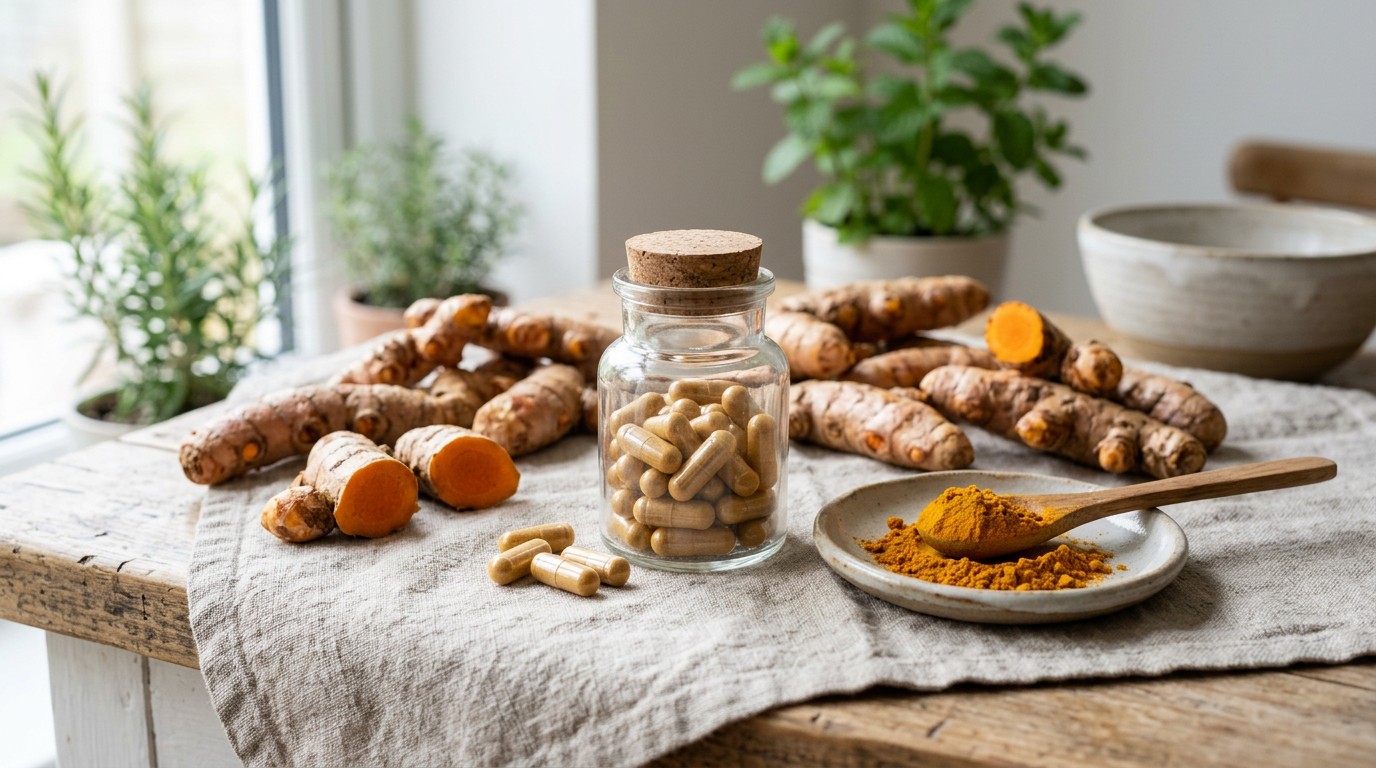
Turmeric capsules alongside fresh turmeric root and turmeric powder.
About Turmeric Capsules
Who Might Consider Turmeric Capsules?
People may consider turmeric capsules if they want a convenient, pre-measured supplement without the distinctive taste of turmeric powder. Some people are particularly interested in potential joint-health effects, although the evidence depends on the formulation being studied.
What Do Turmeric Capsules Contain?
Capsules can contain ground turmeric, curcuminoids, turmeric extracts, concentrated curcumin or combinations of these ingredients. Some also contain black pepper extract or other ingredients intended to increase curcumin bioavailability.
Where Can You Buy Turmeric Capsules?
Turmeric capsules are widely available from online retailers, pharmacies and health shops. Look for products from reputable manufacturers that clearly state their ingredients, amounts, directions and relevant safety information.
When Should You Take Turmeric Capsules?
There is no universally established best time for every turmeric capsule. Follow the instructions provided with the particular product and seek professional advice if you take medicines or have relevant health conditions.
Why Choose Capsules Instead of Other Turmeric Supplements?
Capsules are convenient, portable and provide a pre-measured amount without much turmeric taste. However, capsules are not automatically more effective than tablets, powders or other forms. What the supplement contains is generally more important than the capsule itself.
How Can You Compare Turmeric Capsules?
Check whether the capsule contains turmeric powder, an extract or curcumin, together with the amount provided, curcuminoid content where stated, additional ingredients and safety information. Compare the actual formulation rather than simply choosing the largest milligram number.
Comparing Turmeric Capsules

Comparing turmeric capsules can help you understand the differences between supplement types and formulations.
Table of Contents
- What are turmeric capsules?
- Turmeric powder vs turmeric extract vs curcumin
- Common turmeric capsule ingredients
- Why some capsules contain black pepper or piperine
- What does the research say about turmeric capsules?
- How to compare turmeric capsules
- Advantages and disadvantages of turmeric capsules
- Safety, side effects and possible interactions
- Who should seek medical advice before using them?
- Frequently asked questions
- Summary
- Sources and further information
- Medical disclaimer
What are Turmeric capsules? an overview
Turmeric is a plant in the ginger family (Zingiberaceae). Its underground stem, known as a rhizome, is widely used as a culinary spice and has also been used traditionally in several systems of medicine. Curcumin is a major component responsible for turmeric’s characteristic yellow colour and is one of the most extensively studied turmeric compounds.
A turmeric capsule may therefore mean quite different things depending on the formulation. A simple product may contain powdered turmeric root, whereas another may contain a concentrated extract with a specified percentage of curcuminoids.
This distinction is important when comparing products. The number of milligrams stated on the front of a packet does not necessarily tell you how much curcumin it contains.
Turmeric capsules compared
| Type | What it contains | Main point |
| Turmeric powder | Ground turmeric rhizome | Closest to the whole spice |
| Turmeric extract | Concentrated turmeric compounds | Can contain a higher proportion of curcuminoids |
| Curcumin extract | Concentrated curcuminoids | More specifically focused on curcumin |
| Curcumin + piperine | Curcumin plus black-pepper-derived piperine | Designed to increase absorption |
| Enhanced-bioavailability curcumin | Curcumin using a specialised delivery system | Formulation may substantially alter absorption |
The evidence does not establish that one type is universally best. Different formulations can produce different levels of absorption and may not have identical effects in clinical studies.
Comparison of Turmeric Capsule Types
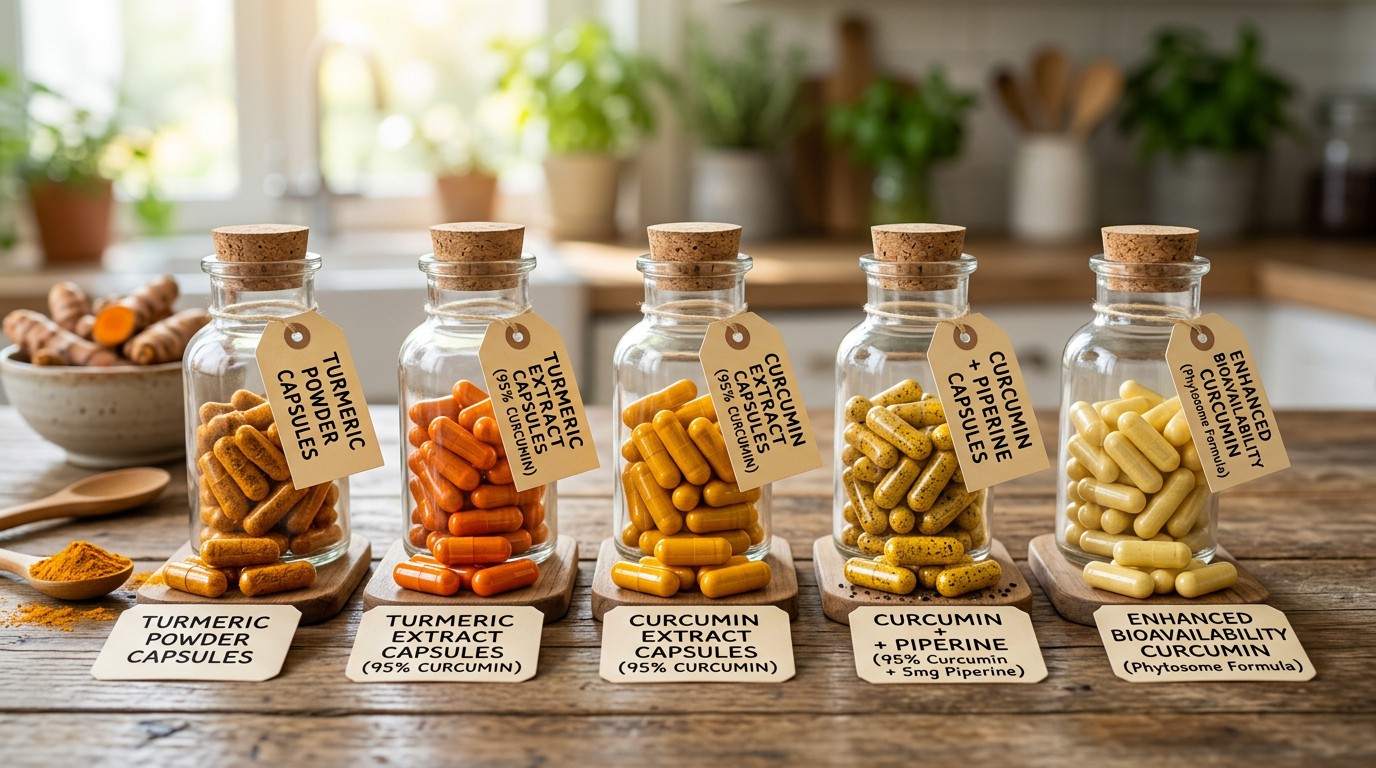
Turmeric capsules are available in different forms.
Turmeric powder, turmeric extract and curcumin
The terms turmeric, turmeric extract, curcuminoids and curcumin are sometimes used interchangeably in supplement marketing, but they describe different things.
Turmeric powder is made from the dried rhizome. It contains a mixture of naturally occurring substances, including curcuminoids and volatile oils.
Turmeric extract is produced by extracting selected compounds from turmeric. Its composition depends on the extraction and standardisation process.
Curcuminoids are a family of compounds found in turmeric. Curcumin is the best-known member and has been the focus of much laboratory and human research.
Consequently, two turmeric capsules can contain very different amounts and types of active compounds even when both are labelled as turmeric supplements.
For consumers, the most useful information is usually found in the ingredients panel rather than simply the product name. Look for the form of turmeric used, the amount per serving and whether the manufacturer specifies curcuminoid or curcumin content.
Turmeric Powder, Turmeric Extract and Curcumin
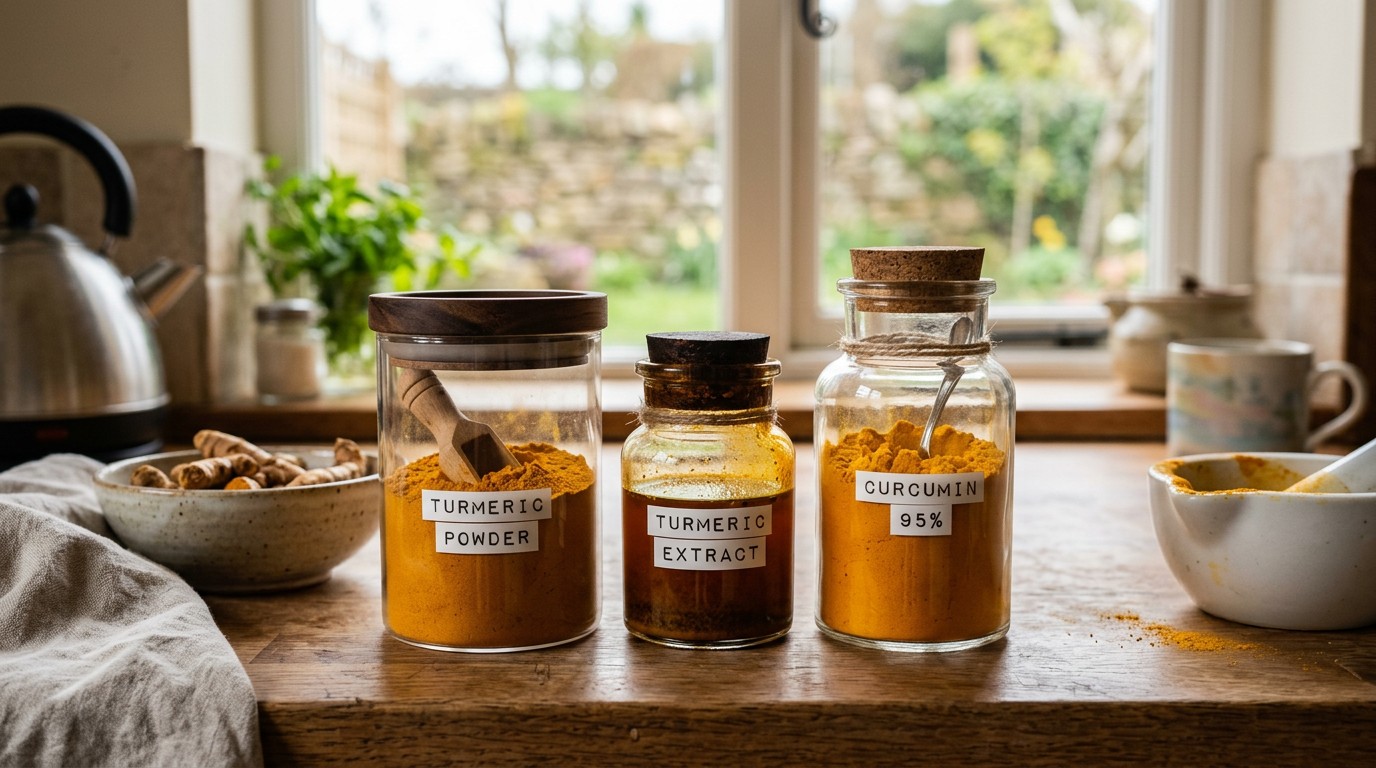
Turmeric powder, turmeric extract, curcuminoids and curcumin are different terms, although supplement marketing often uses them interchangeably.
Common ingredients in turmeric capsules
Turmeric capsules can contain additional ingredients intended to improve absorption, stability, manufacturing or formulation.
One of the most familiar is piperine, a compound found in black pepper. Curcumin has relatively poor oral bioavailability, meaning that only a limited amount is absorbed into the bloodstream. Piperine can increase curcumin absorption and exposure, which is why the combination is common in supplements.
Other products use different approaches to improve bioavailability. These may alter how the curcumin is dispersed, absorbed or delivered.
Higher bioavailability can be scientifically useful when studying curcumin, but it should not automatically be interpreted as meaning a supplement is safer or more effective. The National Center for Complementary and Integrative Health notes that some highly bioavailable turmeric or curcumin products have been associated with liver damage.
What Is Inside Turmeric Capsules?
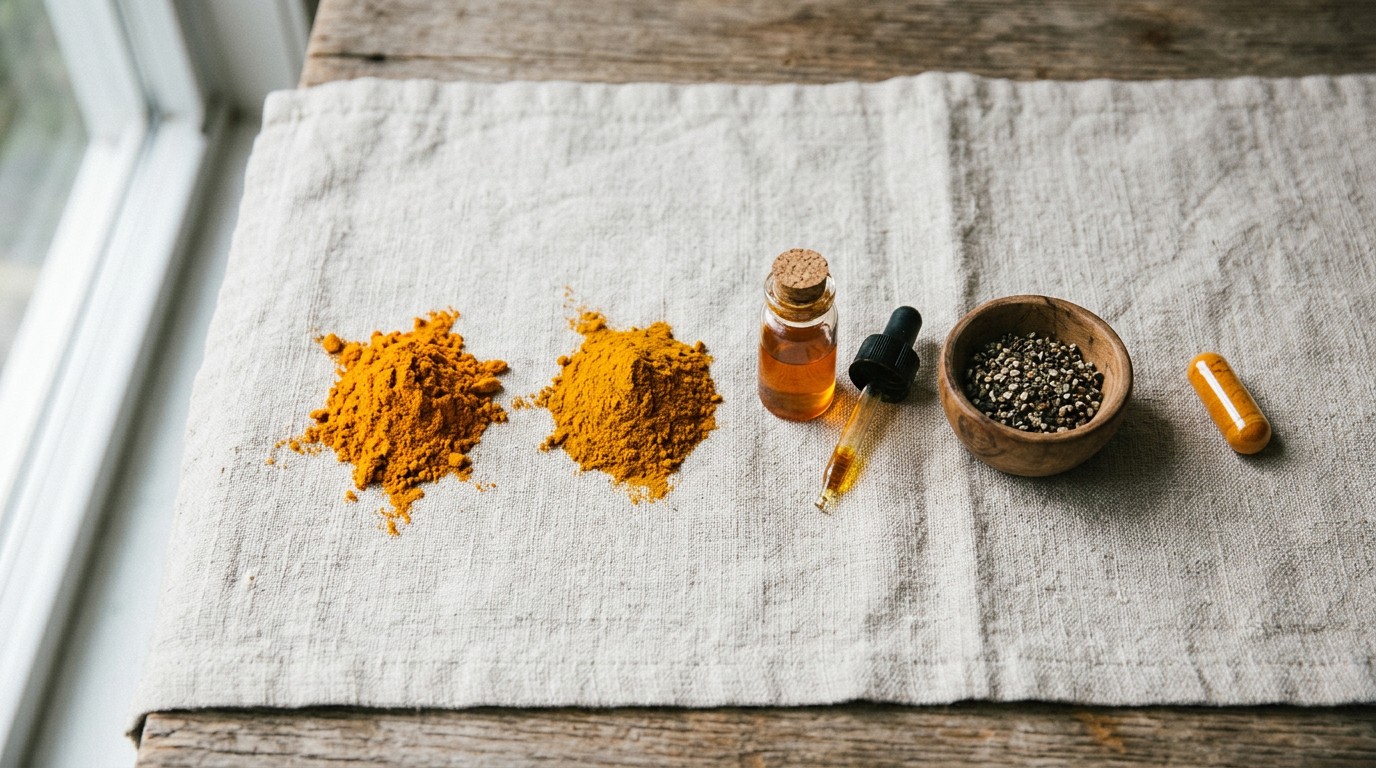
Common ingredients found in turmeric capsule formulations.
What does the research say about turmeric capsules?
Research into turmeric and curcumin is extensive, but the quality and results of studies vary.
1. Joint health and osteoarthritis
One of the better-studied uses is osteoarthritis, particularly knee osteoarthritis. Several systematic reviews and meta-analyses have reported improvements in measures such as pain, stiffness and physical function among people taking turmeric or curcumin preparations.
A 2025 systematic review and network meta-analysis comparing different turmeric preparations also found reductions in knee osteoarthritis pain compared with placebo. However, differences between formulations and studies mean that these results should not be interpreted as proof that every turmeric capsule will produce the same effect.
The NCCIH describes the evidence for osteoarthritis as initially positive while noting that higher-quality evidence is still needed.
2. Inflammation and oxidative stress
Curcumin has biological properties associated with antioxidant and anti-inflammatory activity, and clinical trials have measured changes in inflammatory and oxidative-stress markers.
A recent systematic review of randomised controlled trials examining curcumin with piperine reported improvements in several laboratory markers. However, changes in biomarkers do not necessarily mean that a supplement prevents disease or produces a meaningful long-term health benefit. Larger and longer studies are still needed.
3. Other potential uses
Turmeric and curcumin have also been investigated for areas including metabolic health, liver health and other inflammatory conditions. The evidence is not sufficiently consistent to say that turmeric capsules prevent or treat these conditions.
For this reason, claims that turmeric capsules are a general-purpose treatment for inflammation, cancer, heart disease or other medical conditions should be treated cautiously. The NCCIH states that there is currently insufficient evidence to definitively conclude that oral turmeric or curcumin provides benefits for many health conditions.
Turmeric Capsules and Joint Health

Turmeric and curcumin have been studied in relation to knee osteoarthritis and joint symptoms.
How to compare turmeric capsules
A useful comparison should go beyond price or the amount of powder shown on the front of the packet.
Check:
- Form: Is it turmeric powder, turmeric extract or a concentrated curcumin product?
- Active compounds: Does the label state the curcuminoid or curcumin content?
- Serving size: How many capsules provide the stated amount?
- Bioavailability ingredients: Does it contain piperine or another absorption-enhancing formulation?
- Other ingredients: Check for unnecessary additives or ingredients you may need to avoid.
- Manufacturer information: Look for clear labelling and appropriate quality-control information.
- Intended use: A product studied for a specific purpose should not automatically be assumed to have the same evidence for another purpose.
There is no single universally recommended turmeric capsule formulation because clinical research has used a range of preparations. Read our related guide on how to choose a turmeric supplement.
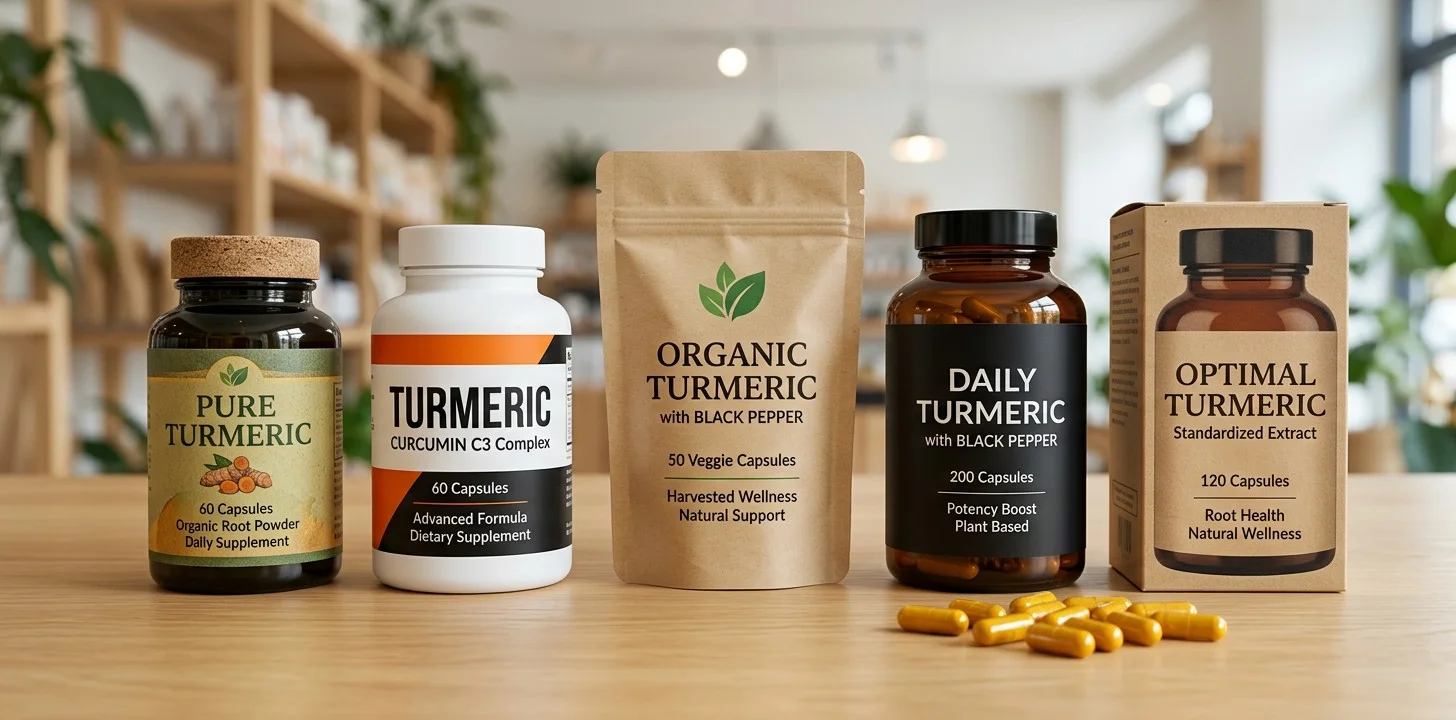
How to Choose Turmeric Capsules

Check the ingredients, formulation and serving information when comparing turmeric capsules.
Advantages and disadvantages of turmeric capsules
Turmeric capsules may offer some potential benefits, but the evidence is not equally strong for every use. Research on turmeric and curcumin has produced promising results for some joint symptoms, while safety and differences between formulations are important considerations.
Advantages
- Convenient: Easy to take as a daily supplement.
- May support joint health: Research suggests potential benefits for knee osteoarthritis symptoms.
- Concentrated formula: Some capsules provide more curcumin than turmeric used as a food.
- Different formulations: Some products are designed to improve curcumin absorption.
Disadvantages
- Evidence varies: Benefits are not proven for every health condition.
- May cause side effects: Digestive problems such as nausea, reflux or diarrhoea can occur.
- Can interact with medicines: Turmeric supplements may not be suitable with some medicines.
- Liver problems are possible: Some high-bioavailability curcumin products have been linked to liver injury.
Turmeric capsules: safety and side effects
Turmeric used as a culinary ingredient is generally different from taking a concentrated supplement. Supplements can provide substantially greater amounts of particular compounds.
Reported oral side effects can include nausea, vomiting, acid reflux, stomach upset, diarrhoea and constipation.
A particularly important safety issue is liver injury. The US National Library of Medicine’s LiverTox database reports cases of clinically apparent acute liver injury associated with some turmeric products. Increased-bioavailability products have featured prominently in reports, although liver injury has also been reported with other formulations.
Anyone taking a turmeric or curcumin supplement who develops symptoms such as unusual tiredness, loss of appetite, dark urine or yellowing of the skin or eyes should stop the supplement and seek medical advice promptly.
Turmeric Capsules and Safety
Safety and medicine interactions are important considerations before taking turmeric supplements.
Medicines and turmeric capsules
Turmeric supplements may interact with medicines. This is particularly relevant to people taking medicines that affect blood clotting.
People taking anticoagulants should speak to their GP, anticoagulant clinic or pharmacist before starting a herbal supplement. NHS guidance recommends discussing medicines, remedies and supplements with a healthcare professional because some combinations can alter anticoagulant effects.
Turmeric may also interact with certain medicines through effects on drug metabolism. Memorial Sloan Kettering Cancer Center highlights potential interactions involving anticoagulants, some chemotherapy medicines and other drugs. The clinical importance can vary depending on the medicine and formulation.
Anyone receiving cancer treatment should discuss turmeric capsules with their oncology team before using them, rather than assuming that a natural product is automatically compatible with treatment.
Who should speak to a doctor before taking turmeric capsules?
Medical advice is particularly important if you:
- take prescription medicines or anticoagulants;
- are pregnant or breastfeeding;
- have liver or gallbladder problems;
- have a history or increased risk of kidney stones;
- are preparing for surgery;
- are receiving cancer treatment;
- have an existing medical condition;
- are considering a high-dose or high-bioavailability curcumin product.
The NCCIH advises caution during pregnancy because the safety of turmeric supplements at amounts above those commonly found in food is not established.
Frequently asked questions
What are turmeric capsules used for?
Turmeric capsules are commonly used as dietary supplements for general wellbeing and are particularly studied in relation to joint health, inflammation and osteoarthritis. Evidence varies by condition, and they should not be considered a proven treatment for disease.
Are turmeric capsules the same as curcumin capsules?
No. Turmeric contains many naturally occurring compounds, including curcuminoids. Curcumin is one of the principal compounds studied in turmeric research. A curcumin capsule may therefore contain a much more concentrated preparation than a capsule containing turmeric powder.
Is turmeric with black pepper better?
Piperine from black pepper can substantially increase the absorption of curcumin, which is why it is used in some formulations. However, increased absorption does not automatically mean greater clinical benefit or better safety.
Do turmeric capsules help with joint pain?
There is encouraging evidence that some turmeric and curcumin preparations may reduce pain and improve symptoms associated with knee osteoarthritis. However, studies have used different formulations and doses, so the findings should not be applied automatically to every turmeric capsule.
Can turmeric capsules cause side effects?
Yes. Possible side effects include digestive symptoms such as stomach upset, nausea, reflux, diarrhoea and constipation. Some turmeric products have also been associated with liver injury.
Can you take turmeric capsules with medicines?
Not necessarily. Turmeric can interact with some medicines, including medicines affecting blood clotting, and caution is particularly important during cancer treatment. Ask a doctor or pharmacist before starting a turmeric supplement if you take medication.
How do I choose a turmeric capsule?
Start by checking whether it contains turmeric powder, turmeric extract or curcumin, then look at the stated curcuminoid content, serving size and any ingredients intended to improve absorption. Also consider your medicines and health circumstances before choosing a supplement. Read our related guide on how to choose a turmeric supplement.
Summary – Turmeric Gummies
Turmeric capsules provide turmeric powder, turmeric extract, curcuminoids or concentrated curcumin in a convenient oral form. The products can differ substantially, so the term “turmeric capsule” does not describe one standard formulation.
The strongest current human evidence is around some aspects of joint health, particularly knee osteoarthritis, although research quality and formulations vary. Evidence for many other proposed benefits remains insufficient or preliminary.
Piperine and other technologies can increase curcumin absorption, but higher bioavailability is not automatically better. Some highly bioavailable turmeric products have been associated with liver injury, and turmeric supplements can interact with medicines.
For these reasons, turmeric capsules are best considered as supplements rather than replacements for prescribed treatment or a balanced diet. Anyone with a medical condition, taking medication, pregnant or breastfeeding should seek professional advice before using concentrated turmeric or curcumin supplements.
Sources and further information
1. Should You Take Turmeric Every Day? Here’s What Doctors Say
2. 10 anti-inflammatory foods for more energy, less pain and better health – The Doctor’s Kitchen
3. What TURMERIC Really Does to Your BODY – Dr. Suneel Dhand
4. National Center for Complementary and Integrative Health (NCCIH) — Turmeric: Usefulness and Safety.
Evidence, potential uses, side effects, bioavailability and safety information. Read the NCCIH turmeric information
5. National Library of Medicine — LiverTox: Turmeric.
Clinical information concerning turmeric-associated liver injury. Read LiverTox: Turmeric
6. European Medicines Agency — European Union herbal monograph on Curcuma longa rhizoma.
Regulatory and traditional-use information concerning turmeric preparations. Read the EMA turmeric monograph
7. Bideshki et al., 2024 — The efficacy of curcumin in relieving osteoarthritis: A meta-analysis of meta-analyses.
Evidence from multiple meta-analyses concerning osteoarthritis outcomes. Read the PubMed study
8. 2025 — Effect of turmeric products on knee osteoarthritis: a systematic review and network meta-analysis.
Comparison of turmeric preparations in randomised controlled trials. Read the PubMed study
9. Hosseini et al., 2025 — Curcumin plus piperine systematic review and meta-analysis.
Research examining inflammatory and oxidative-stress outcomes. Read the PubMed study
10. Pan et al., 2026 — Curcumin-piperine supplementation systematic review of randomised controlled trials.
Recent evidence concerning curcumin and piperine combinations. Read the PubMed study
11. NHS — Anticoagulant medicines: considerations.
Guidance on discussing supplements and herbal remedies with healthcare professionals when taking anticoagulants. Read the NHS guidance
12. Memorial Sloan Kettering Cancer Center — Turmeric.
Evidence-based information on potential uses, adverse effects and herb–drug interactions. Read the MSK turmeric information
Medical disclaimer
This page is provided for general educational and informational purposes only. It is not medical advice, diagnosis or treatment, and it should not be used as a substitute for advice from a qualified doctor or other healthcare professional. Always speak to your doctor or pharmacist before starting turmeric capsules or another dietary supplement, particularly if you take medicines or have an existing health condition. Do not stop or change prescribed treatment based on information on this page.
Author
Written by J. Henderson
Health & Wellness Research Writer
J. Henderson writes evidence-based articles on nutrition, botanical supplements and everyday wellbeing. His work focuses on translating scientific research into clear, practical guidance that helps readers make informed decisions about natural health products.
- Written by J. Henderson
- Reviewed by Fiona Finlay
- Reviewed on the 28 August 2026