High Strength Turmeric Supplements
Quick Answer
High strength turmeric supplements come in several forms, including tablets, capsules, concentrated extracts and high-absorption formulas. Some products contain turmeric, while others focus on curcumin or combine turmeric with ingredients such as black pepper.
The term “high strength” does not have one standard meaning. Products may use large milligram amounts, concentrated extracts, curcuminoid percentages or absorption claims to describe their strength.
This means the biggest number on the packet does not necessarily identify the strongest or most suitable product.
Key Points
- High strength turmeric comes in tablets, capsules, gummies and other formulations.
- Products may contain turmeric, curcumin or both.
- Black pepper is commonly added to turmeric supplements.
- Some products focus on higher absorption.
- “High strength” has no single standard meaning.
- Bigger milligram numbers do not always mean stronger.
- Check the extract, curcuminoids and serving size when comparing products.
Related Guides
Explore more about turmeric and your options:
- How to Choose Turmeric Supplements — what to consider when comparing products.
- Turmeric Extract — how extracts differ from culinary turmeric.
- Turmeric Capsules — understanding turmeric capsule formulations.
- Taking Turmeric Supplements with Food — practical questions about taking supplements with food.
Types of High Strength Turmeric Supplements
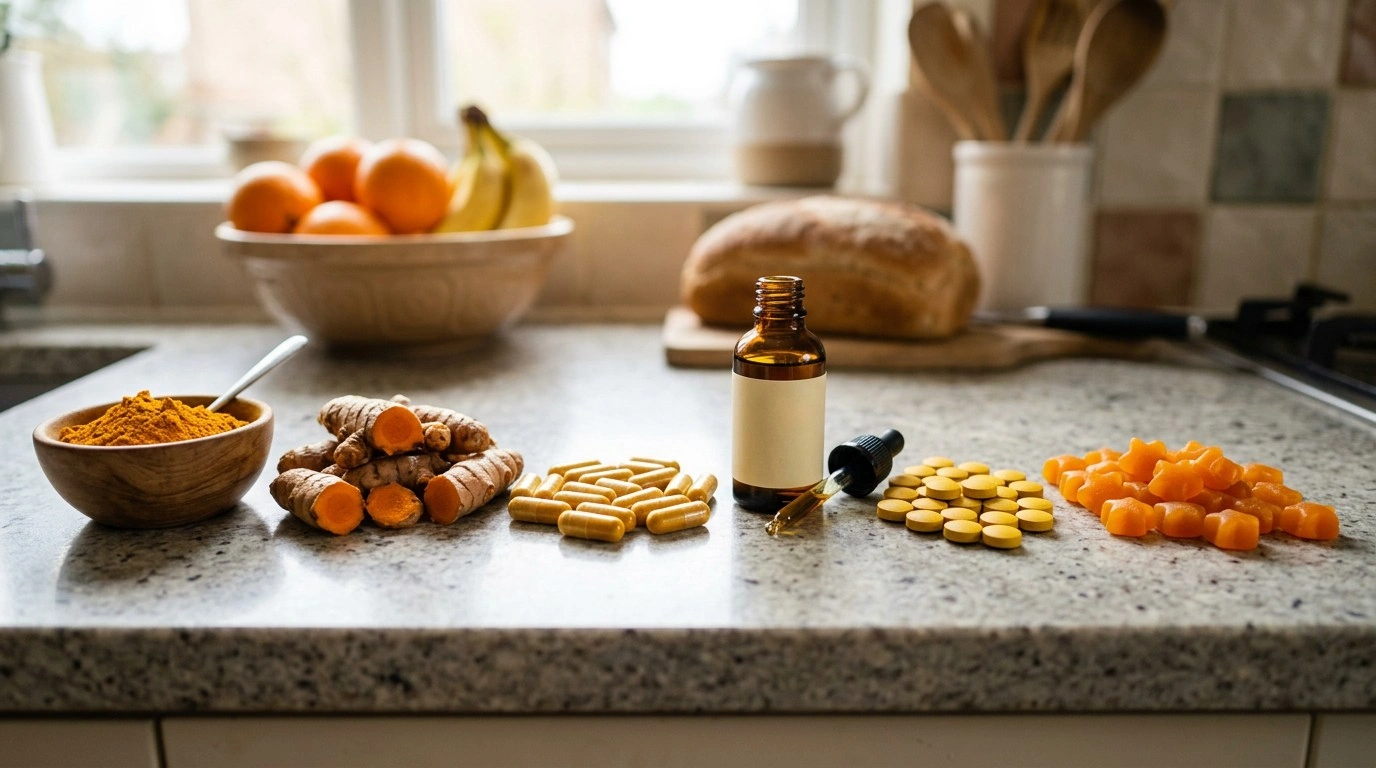
High strength turmeric is available in different forms, including tablets, capsules, extracts, liquids and gummies.
About High Strength Turmeric Supplements
Who? High strength turmeric supplements are generally considered by people looking for a more concentrated turmeric or curcumin product or comparing different supplement strengths.
What? They include tablets, capsules, extracts and other formulations containing turmeric, curcumin or curcuminoids, sometimes combined with ingredients such as black pepper.
When? People commonly encounter them when comparing turmeric supplements and trying to understand terms such as high strength, maximum strength, high potency or 95% curcuminoids.
Where? They are widely sold by supplement retailers, pharmacies and online stores in several different formats.
Why? People may choose them because they want a concentrated formulation, although higher strength does not automatically mean greater benefit.
How? Products can describe strength using milligrams, extract ratios, turmeric-equivalent amounts, curcuminoid percentages or formulations designed to affect absorption.
Table of Contents
- What Are the Main Types of High Strength Turmeric?
- What Is High Strength Turmeric?
- Who Chooses High Strength Turmeric?
- Why Does “High Strength” Get Confusing?
- How Do You Compare High Strength Turmeric Supplements?
- Does a Higher Milligram Number Mean Stronger Turmeric?
- What Is Turmeric Extract?
- What Does 95% Curcuminoids Mean?
- High Strength Turmeric vs High Strength Curcumin
- Does Absorption Matter?
- Is the Strongest Turmeric Supplement Always the Best?
- What Should You Look for on the Label?
- High Strength Turmeric Tablets vs Capsules
- Does Black Pepper Make Turmeric Stronger?
- What Is the Best Strength of Turmeric to Take?
- Frequently Asked Questions
- Safety and Side Effects
- Summary
- Further Information and Reading
What Are the Main Types of High Strength Turmeric?
High strength turmeric is available in several different types. The names used on products and in searches can vary, but common examples include:
High Strength Turmeric Tablets
Tablets are one of the most familiar formats and may contain turmeric powder, concentrated turmeric extract or a combination of ingredients.
Some are marketed using terms such as high strength or maximum strength turmeric tablets and may display large turmeric-equivalent amounts on the front of the packet.
High Strength Turmeric Capsules
Capsules can also contain turmeric powder or concentrated extracts.
The amount inside a capsule does not by itself tell you how strong the product is. Check whether the label refers to the actual extract, turmeric-root equivalent or curcuminoid content.
High Strength Curcumin Supplements
Some products focus primarily on curcumin or curcuminoid-rich extracts rather than turmeric as a whole.
These may be described as high strength or high potency curcumin supplements. Some extracts state the percentage of curcuminoids they contain, such as 95%.
Turmeric Extract Supplements
Concentrated turmeric extracts provide a different composition from ordinary turmeric root powder.
Labels may show an extract ratio, turmeric-equivalent amount or standardised curcuminoid percentage. This is why an extract displaying a smaller physical amount can still be marketed as high strength.
High Strength Turmeric with Black Pepper
Turmeric and black pepper is a common supplement combination and also appears prominently in consumer searches.
Black pepper contains piperine, which has been studied for its effect on curcumin bioavailability. It is therefore better understood as an absorption ingredient rather than a measure of turmeric strength.
High-Absorption Turmeric and Curcumin
Some supplements focus less on a very large milligram figure and more on how the curcumin is formulated.
Consumers may encounter descriptions such as high absorption turmeric, highly absorbable curcumin, enhanced bioavailability, liposomal, phytosome or micellar formulations.
These products should not automatically be considered “stronger”. They use different approaches intended to affect bioavailability, which needs to be considered separately from the amount of turmeric or curcumin in the product.
What About Gummies, Liquids and Other Formats?
High strength turmeric and curcumin can also be sold in other formats, including gummies and liquid products.
However, the physical format does not determine the strength. A gummy, liquid, capsule or tablet still needs to be judged by what it contains, the serving size and how the ingredients are formulated.
Our guide to turmeric supplements explains the wider range of supplement formats.
High Strength Turmeric Formulations
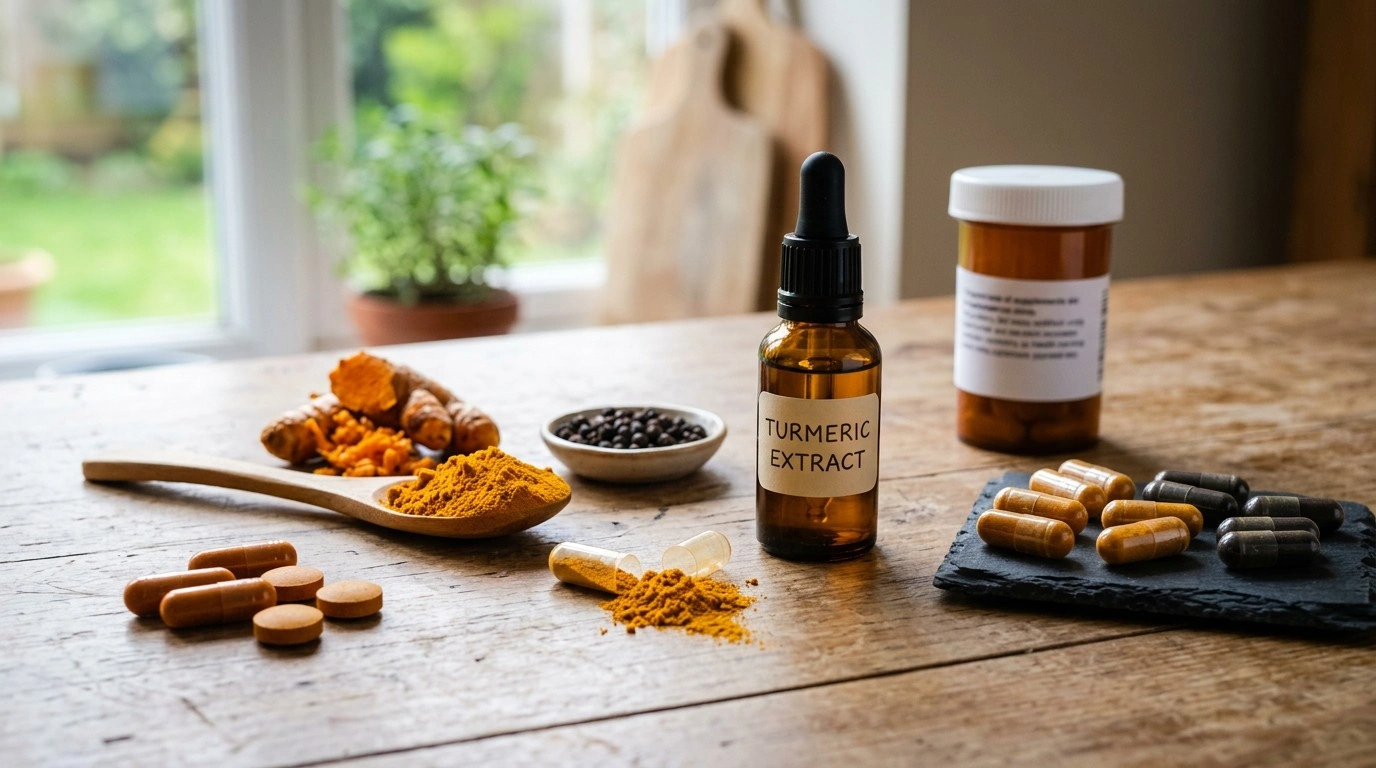
High strength turmeric products can differ by format, extract, curcuminoid content and ingredients used to influence absorption.
What Is High Strength Turmeric?
High strength turmeric is a term commonly used for turmeric supplements intended to provide a concentrated amount of turmeric, curcumin or curcuminoids, or which use a formulation designed to improve absorption.
However, there is no single definition of high strength.
One product might use a concentrated turmeric extract. Another might highlight a large turmeric-equivalent figure such as 10,000 mg or 20,000 mg. Another may focus on 95% curcuminoids, while another emphasises enhanced absorption.
This means two products both described as high strength turmeric can be very different.
Understanding what is actually inside the product is therefore more useful than simply choosing the largest number on the packet.
Who Chooses High Strength Turmeric?
People searching for high strength turmeric may be looking for a more concentrated alternative to ordinary turmeric supplements, comparing different products or trying to understand which formulation provides what they want.
Some people search specifically for turmeric tablets or capsules, while others look for curcumin, extracts, turmeric, ginger and black-pepper combinations or products marketed around higher absorption. The search research shows this mixture of terminology rather than one single product type.
People also commonly encounter turmeric while researching areas such as joint health and inflammation. However, choosing a higher-strength product does not establish that it will provide a greater health benefit.
Why Does “High Strength” Get Confusing?
Because manufacturers can describe strength in different ways.
A packet might emphasise:
- a large milligram number
- turmeric-root equivalent
- an extract ratio
- curcuminoid percentage
- actual curcuminoid content
- “high potency”
- “maximum strength”
- enhanced absorption
- black pepper or piperine
- a specialist bioavailability formulation
These aren’t all measurements of the same thing.
That’s why 10,000 mg on one product cannot necessarily be compared directly with 500 mg or 95% on another.
For a broader look at labels, ingredients and formulations, read our guide on how to choose a turmeric supplement.
Comparing High Strength Turmeric Supplements
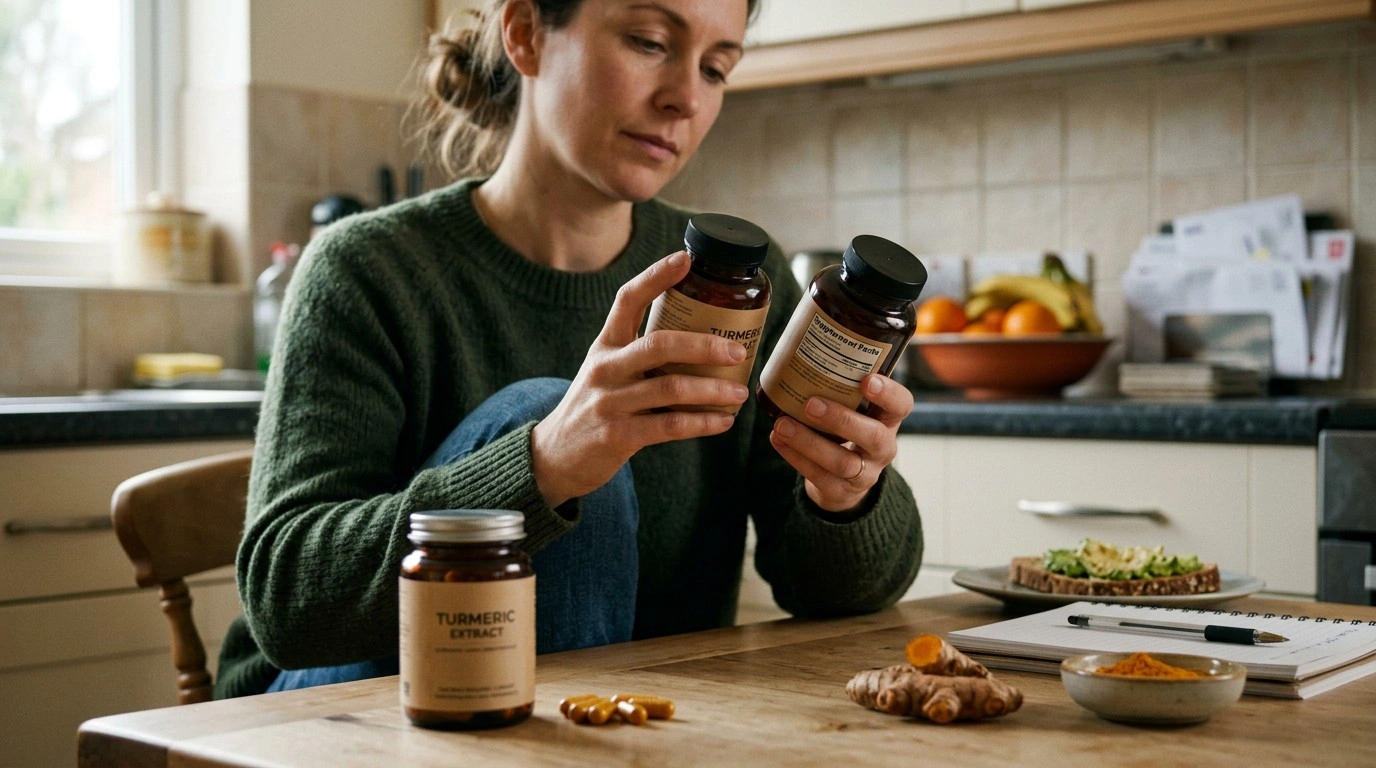
Look beyond the largest number on the front and compare the extract, curcuminoids, serving size and formulation.
How Do You Compare High Strength Turmeric Supplements?
Rather than asking only “Which has the biggest number?”, look at what that number describes.
Check:
- What type of turmeric product is it?
- Is it turmeric powder or an extract?
- What does the milligram amount refer to?
- Is a turmeric-equivalent amount being displayed?
- Is the extract standardised for curcuminoids?
- How much curcuminoid material does a serving provide?
- What is the recommended serving size?
- Does it contain black pepper or piperine?
- Does it use another formulation intended to affect absorption?
- What other ingredients does it contain?
That gives you a much better basis for comparing two products.
Does a Higher Milligram Number Mean Stronger Turmeric?
Not necessarily.
This is one of the most important things to understand when comparing high strength turmeric supplements.
For example, a product may display a very large number such as 10,000 mg on its packaging. That figure may represent the amount of turmeric root that the concentrated extract is said to be equivalent to rather than the physical amount of extract contained in the supplement.
A smaller quantity of concentrated extract can therefore be described using a much larger turmeric-equivalent figure.
Another supplement may display a lower milligram number but tell you exactly how much standardised extract or curcuminoids it contains.
The two numbers are measuring different things, so comparing them directly can be misleading.
What Does “Equivalent to” Mean?
An “equivalent to” figure usually relates a concentrated extract back to the amount of original plant material used to produce it.
For example, if a label gives an extract ratio, the amount of extract in the capsule or tablet may represent a larger amount of turmeric root.
This can explain why some turmeric supplements display figures of many thousands of milligrams even though a tablet or capsule could not physically contain that much turmeric powder.
The important question is therefore not simply:
How many milligrams does it say on the front?
It is:
What do those milligrams actually represent?
Turmeric Milligrams vs Extract Strength
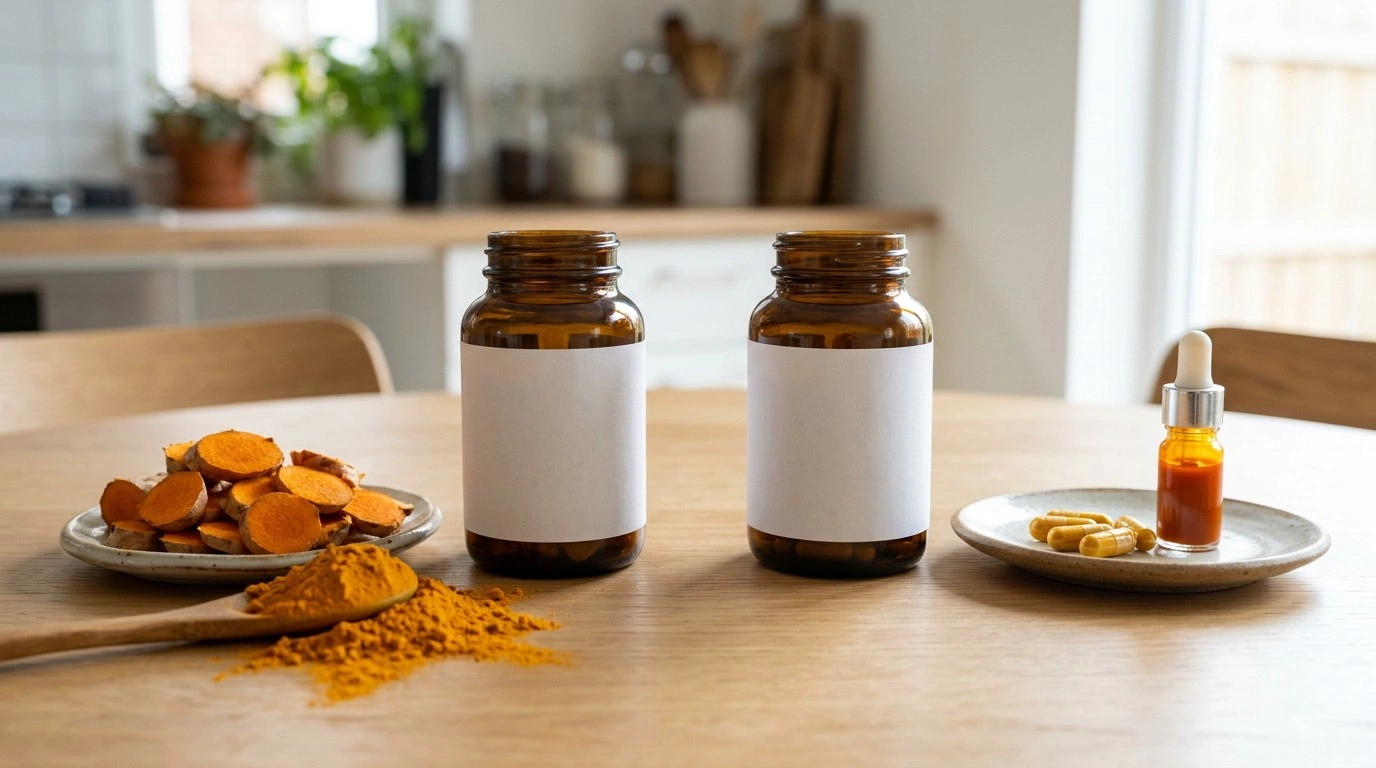
A larger milligram figure may describe turmeric-root equivalent rather than the actual amount of extract in the supplement.
What Is Turmeric Extract?
Turmeric extract is produced by concentrating selected compounds from turmeric rather than simply grinding the dried root into powder.
Extracts can therefore have a different composition from ordinary turmeric powder.
Some manufacturers state an extract ratio, while others standardise their extract to contain a particular proportion of curcuminoids.
This is one reason why 500 mg of one turmeric ingredient cannot automatically be compared with 500 mg of another.
What Does 95% Curcuminoids Mean?
Some high strength turmeric and curcumin supplements are described as being standardised to 95% curcuminoids.
Curcuminoids are a group of naturally occurring compounds found in turmeric. Curcumin is the best known of them.
A standardised extract is manufactured to provide a specified proportion of particular compounds. Therefore, a label stating 95% curcuminoids is giving you different information from one that simply states the total amount of turmeric.
Knowing the amount of extract and its standardisation can help you understand approximately how much curcuminoid material a serving provides.
However, 95% does not automatically mean that a supplement is the best choice. Strength is only one characteristic of a formulation. Bioavailability, dose, other ingredients, safety and the evidence for the particular formulation may also matter.
Turmeric Extract, Curcuminoids and Black Pepper
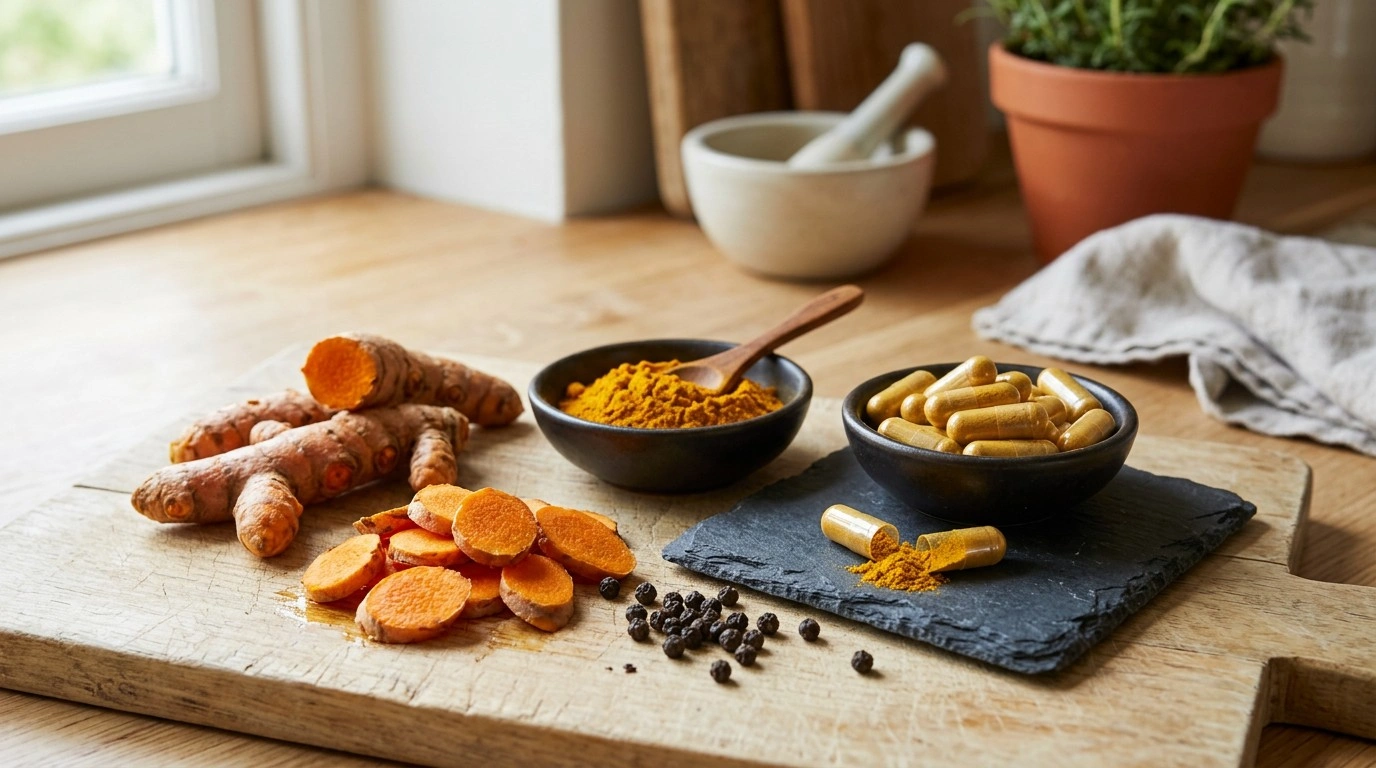
High strength products may use concentrated turmeric extracts, standardised curcuminoids and ingredients such as black pepper.
Is High Strength Turmeric the Same as High Strength Curcumin?
Not necessarily.
Turmeric and curcumin are related, but they are not interchangeable terms.
Turmeric comes from the plant Curcuma longa and contains numerous naturally occurring compounds, including a group called curcuminoids.
Curcumin is one of those curcuminoids.
A high strength turmeric product might contain turmeric powder, turmeric extract, curcuminoids or a combination of ingredients.
A high strength curcumin supplement is more specifically focused on curcumin or a curcuminoid-rich extract.
This distinction matters when comparing labels because a large amount of turmeric is not the same thing as the same amount of curcumin.
Our guide to turmeric vs curcumin explains the difference in more detail.
Does Absorption Affect How You Compare Turmeric Supplements?
Yes, but absorption and strength are not exactly the same thing.
Curcumin naturally has relatively low oral bioavailability. Researchers and supplement manufacturers have therefore investigated different ways of increasing its absorption.
These include formulations containing piperine, a compound found in black pepper, as well as specialised delivery systems.
Some products therefore use terms such as:
- high absorption
- enhanced bioavailability
- with black pepper
- with piperine
- liposomal
- phytosome
- micellar
These terms describe aspects of the formulation rather than simply how many milligrams it contains.
A product formulated to improve curcumin bioavailability cannot therefore be compared with another product solely by looking at the milligram number on the front of the packet.
Learn more about how black pepper helps turmeric absorption.
Is the Strongest Turmeric Supplement Always the Best?
No.
“Strongest” sounds straightforward, but turmeric supplements can differ in too many ways for the largest number on the packaging to provide a reliable answer by itself.
A very concentrated supplement is not automatically more suitable, more effective or safer.
Instead, consider what the product actually contains, how much is provided per serving, whether the extract is standardised, how it is formulated and whether the claims on the label are clearly explained.
Quality and transparency can be more useful when comparing products than simply looking for words such as maximum, strong, extra strength or high strength.
For a broader checklist, see our guide on how to choose a turmeric supplement.
What Should You Look for on a High Strength Turmeric Label?
When comparing products, start with the ingredients panel rather than the largest number printed on the front.
Look for:
- Turmeric amount: Is it powder or an extract?
- Extract amount: How much extract is actually provided?
- Equivalent amount: Does a large milligram figure refer to turmeric-root equivalent?
- Curcuminoids: Does the label state their amount or percentage?
- Serving size: Is the stated amount per capsule, tablet or daily serving?
- Absorption ingredients: Does it contain black pepper or piperine?
- Formulation: Does the product use another bioavailability system?
- Other ingredients: Is turmeric combined with ginger, vitamins or other substances?
The clearer the label, the easier it is to make a meaningful comparison.
High Strength Turmeric Tablets vs Capsules
Both tablets and capsules can contain high strength turmeric extracts, curcumin or combinations of turmeric with other ingredients.
The physical format does not determine the strength.
A tablet isn’t automatically stronger than a capsule, and a capsule isn’t automatically better absorbed than a tablet.
What matters is what is inside it and how the formulation is designed.
Someone who prefers one format over another can compare the ingredient amounts and formulation rather than assuming the delivery format determines potency.
Does Black Pepper Make Turmeric Stronger?
Black pepper does not increase the amount of turmeric or curcumin contained in a supplement.
Instead, the interest in black pepper comes from piperine, one of its naturally occurring compounds.
Piperine has been studied for its ability to increase the bioavailability of curcumin under particular experimental conditions.
That means it is more accurate to think about black pepper in terms of absorption rather than strength.
This distinction is useful because a product advertised as “high strength turmeric with black pepper” is communicating two separate characteristics: the amount or concentration of its turmeric ingredient and an ingredient intended to influence curcumin bioavailability.
What Is the Best Strength of Turmeric to Take?
There is no single turmeric strength that is best for everyone.
Research has used different turmeric and curcumin preparations at different doses, making simple milligram comparisons difficult. A dose used in a study of one formulation cannot automatically be transferred to another product.
Individual circumstances also matter, including medicines, health conditions and the reason someone is considering a supplement.
Rather than assuming that more is better, check what the supplement actually contains and follow the manufacturer’s directions. Speak to a GP, pharmacist or another appropriately qualified healthcare professional if you are unsure whether a turmeric or curcumin supplement is suitable for you.
Frequently asked questions
What is high strength turmeric good for?
High strength turmeric supplements provide concentrated forms of turmeric or curcumin. They are marketed for various health purposes, but potential benefits depend on the formulation and condition being studied.
“High strength” itself does not prove that a product will be effective.
What is the strongest turmeric supplement?
There is no single meaningful measure of the “strongest” turmeric supplement.
Products can differ in extract concentration, curcuminoid content, equivalent turmeric amounts and bioavailability, so the biggest milligram number does not necessarily identify the strongest formulation.
Is 1,000 mg of turmeric a high dose?
It depends on what the 1,000 mg represents.
Turmeric powder, concentrated extract and turmeric-equivalent amounts are not directly interchangeable. Check the full ingredient and serving information rather than relying on the milligram figure alone.
Is 95% curcumin strong?
A product described as standardised to 95% usually refers to the proportion of curcuminoids in an extract rather than simply the total amount of turmeric.
The percentage is useful information, but it does not by itself establish the effectiveness, absorption or suitability of the supplement.
Is high strength turmeric better than normal turmeric?
Not necessarily.
A concentrated supplement provides a different amount and composition of turmeric compounds from ordinary turmeric powder, but “stronger” does not automatically mean “better”.
The appropriate choice depends on why the product is being used, its formulation and individual circumstances.
Can you take high strength turmeric every day?
Some turmeric and curcumin supplements are designed for daily use, but suitability depends on the product, dose, medicines and individual health circumstances.
Follow the product directions and seek professional advice if you take medication or have a medical condition.
Are High Strength Turmeric Supplements Safe?
Turmeric used in normal food amounts is different from taking a concentrated turmeric or curcumin supplement.
High strength products may contain concentrated extracts, substantial amounts of curcuminoids or formulations designed to increase absorption. The words “high strength” do not mean that a supplement is more suitable or safer.
Safety can depend on the particular product, dose, formulation, duration of use and individual circumstances.
People with existing health conditions, those taking medicines, anyone preparing for surgery, and people who are pregnant or breastfeeding should seek appropriate professional advice before using turmeric or curcumin supplements.
What Are the Possible Side Effects of High Strength Turmeric?
Turmeric and curcumin supplements can cause side effects in some people.
Reported effects can include digestive symptoms such as:
- stomach discomfort
- nausea
- diarrhoea
- acid reflux or digestive irritation
The likelihood and severity of side effects can vary according to the supplement, dose and individual.
Concentrated turmeric or curcumin supplements should not be treated as equivalent to the amounts of turmeric normally used as a spice in food.
Stop using a supplement and seek appropriate medical advice if you experience a concerning or unexpected reaction.
Can High Strength Turmeric Interact with Medicines?
Turmeric and curcumin supplements can interact with medicines and may not be suitable for everyone.
This becomes particularly important when considering a concentrated or enhanced-bioavailability formulation because the amount and absorption of curcumin may differ considerably between products.
Speak to a GP, pharmacist or other appropriately qualified healthcare professional before using a high strength turmeric or curcumin supplement if you:
- take prescription medicines
- have an existing medical condition
- are taking other supplements
- are pregnant or breastfeeding
- are preparing for surgery
- are considering turmeric or curcumin for a particular health condition
Do not stop taking or alter prescribed medicines because of information about turmeric or curcumin online.
Summary
High strength turmeric does not have one simple definition.
It can be sold as tablets, capsules, extracts, curcumin supplements, black-pepper combinations and higher-absorption formulations, as well as gummies and liquids.
Manufacturers may describe strength using concentrated extracts, large turmeric-equivalent amounts, curcuminoid concentrations or formulations designed to improve absorption.
When comparing products:
- identify what type of supplement it is
- don’t rely on the biggest milligram number
- check whether the figure refers to powder, extract or turmeric equivalent
- look for the amount or percentage of curcuminoids
- check the serving size
- consider absorption separately from strength
- compare the complete formulation rather than one front-label claim
The simplest question to ask when a turmeric supplement displays an impressive strength figure is:
What does that number actually represent?
Once you know that, comparing different types of high strength turmeric becomes considerably easier.
Further Information and Reading
For additional perspectives on turmeric, curcumin and choosing supplements, the following videos and independent resources provide useful further information.
1. Should You Take Turmeric Every Day? Here’s What Doctors Say
A doctor-led discussion covering daily turmeric use, potential benefits and important considerations.
2. What Happens to Your Body If You Eat Turmeric For 30 Days? — Dr. Sten Ekberg
Dr Sten Ekberg discusses turmeric, curcumin and what regular consumption may mean for the body.
3. Which Turmeric Supplement Actually Works — Dr. Micah Yu
Dr Micah Yu discusses different turmeric supplements and some of the factors to consider when comparing formulations.
Further Reading
For more detailed scientific and independent information, the following resources provide useful background on turmeric, curcumin, safety and bioavailability.
1. NCCIH — Turmeric: Usefulness and Safety
The US National Center for Complementary and Integrative Health provides an independent overview of turmeric and curcumin research, potential uses and safety considerations.
2. UK Committee on Toxicity — Turmeric and Curcumin Supplements
The UK Committee on Toxicity provides information about the safety of turmeric and curcumin supplements and the scientific evidence considered in its assessment.
3. PubMed — Influence of Piperine on the Pharmacokinetics of Curcumin
Published research available through PubMed examines curcumin bioavailability when curcumin is combined with piperine, helping explain why black pepper appears in many turmeric formulations.
4. PubMed — Bioavailable Curcumin Formulations
This scientific review examines different approaches used to increase curcumin bioavailability, providing useful background when comparing absorption claims between formulations.
Medical Disclaimer
The information on this page is provided for general educational and informational purposes only and is not intended as medical advice, diagnosis or treatment.
Research into turmeric and curcumin continues to develop, and evidence can vary depending on the health condition, dose and formulation studied.
Turmeric and curcumin supplements may cause side effects or interact with medicines and may not be suitable for everyone.
If you have a medical condition, take prescription medicines, are pregnant or breastfeeding, are preparing for surgery or are considering a high strength turmeric or curcumin supplement for a specific health concern, speak to a GP, pharmacist or other appropriately qualified healthcare professional.
Author
Written by J. Henderson
Health & Wellness Research Writer
J. Henderson writes evidence-based articles on nutrition, botanical supplements and everyday wellbeing. His work focuses on translating scientific research into clear, practical guidance that helps readers make informed decisions about natural health products.
- Written by J. Henderson
- Reviewed by Fiona Finlay
- Reviewed on the 07 September 2026