Turmeric Benefits
Quick Answer
Turmeric is best known for curcumin, one of its naturally occurring curcuminoids.
Research has investigated turmeric and curcumin for a wide range of potential health benefits. Joint pain and osteoarthritis are among the better-studied areas, while research has also explored their effects on inflammation, oxidative stress, metabolic health, cardiovascular health and other conditions.
However, the evidence is not equally strong for every claimed benefit.
There is also an important difference between using turmeric as a food or spice and taking a concentrated turmeric or curcumin supplement. The amount consumed, formulation and how well curcumin is absorbed can all influence the results.
Key Points
- Turmeric contains compounds called curcuminoids, including curcumin.
- Joint health is one of the better-researched potential benefits.
- Curcumin has anti-inflammatory and antioxidant properties.
- Evidence for many other health benefits remains mixed or developing.
- Turmeric food and concentrated supplements are not the same.
- Curcumin is naturally poorly absorbed by the body.
- More turmeric does not automatically mean greater benefit.
- Supplements can cause side effects and interact with medicines.
Turmeric and a Healthy Lifestyle
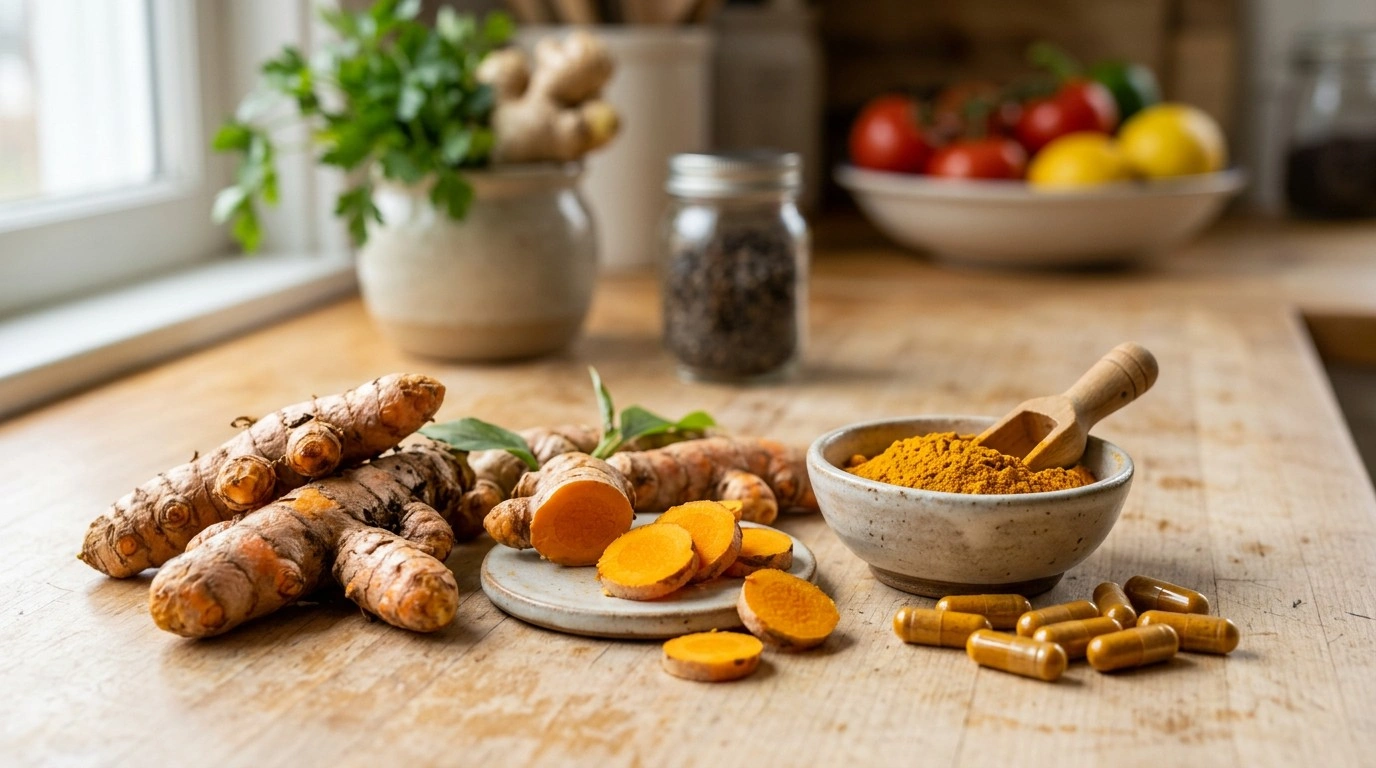
Turmeric is commonly used as part of a healthy diet and is also available in concentrated supplement forms.
What Is Turmeric Good For?
Turmeric (Curcuma longa) is a yellow-orange spice obtained from the rhizome of a plant belonging to the ginger family.
People have used turmeric for centuries as a food, spice and ingredient in traditional medicine. Today, much of the scientific interest in turmeric centres on its naturally occurring curcuminoids, particularly curcumin.
So, what is turmeric actually good for?
The most realistic answer is that it depends on what form of turmeric you mean and what health outcome you are considering.
Modern research has investigated turmeric and curcumin in areas including:
- joint health and osteoarthritis
- inflammatory processes
- oxidative stress
- metabolic health
- cardiovascular health
- digestive health
- brain and mood health
But being investigated is not the same as being proven to treat a condition.
Some areas have considerably more human research than others, and studies frequently use concentrated turmeric extracts or curcumin formulations rather than the amount of turmeric normally added to food.
Understanding that difference makes many of the claims surrounding turmeric much easier to put into perspective.
Where Do Turmeric’s Potential Benefits Come From?
Turmeric contains many naturally occurring plant compounds.
The best known are curcuminoids, a group of compounds that includes curcumin.
Curcumin has attracted considerable scientific interest because of its biological activity, particularly its interactions with pathways associated with inflammation and oxidative stress.
This is why turmeric and curcumin are often discussed together.
However, turmeric and curcumin are not interchangeable terms.
Turmeric is the whole plant material or spice. Curcumin is one component found naturally within turmeric.
This distinction becomes particularly important when looking at scientific studies because researchers may use concentrated curcumin or standardised turmeric extracts rather than ordinary culinary turmeric.
Turmeric, Curcumin and Potential Benefits
Turmeric contains naturally occurring curcuminoids, including curcumin, which has been widely investigated in scientific research.
What Are the Main Potential Benefits of Turmeric?
People search for turmeric for many different reasons, but the scientific evidence behind each proposed benefit varies considerably.
Rather than treating every possible effect as equally established, it is more useful to look at where the research is strongest and where it remains uncertain.
Turmeric and Joint Health
Joint health, particularly osteoarthritis, is one of the most extensively studied uses of turmeric and curcumin.
Clinical trials and systematic reviews have investigated whether turmeric extracts and curcumin formulations can help reduce pain and improve physical function in people with osteoarthritis.
Results from a number of studies are encouraging.
However, different trials have used different extracts, curcumin concentrations, doses and formulations. This makes it difficult to assume that the results from one clinical trial apply to every turmeric powder, capsule, tablet or drink.
For somebody considering turmeric primarily because of joint discomfort, this distinction is particularly important.
Evidence outlook: Promising, with substantial human research, but product formulation matters.
Turmeric and Joint Health
Joint health and osteoarthritis are among the better-studied areas of turmeric and curcumin research.
Turmeric and Inflammation
Inflammation is another major reason people become interested in turmeric.
Curcumin has been extensively studied for its effects on biological pathways involved in inflammatory processes.
Research has also examined whether curcumin supplementation can affect various inflammatory markers in humans.
However, the popular description of turmeric as simply a “natural anti-inflammatory” can make the evidence sound more straightforward than it really is.
Inflammation is part of the body’s normal immune response and is involved in many different health conditions.
Evidence that curcumin influences inflammatory pathways does not mean that eating turmeric or taking a supplement has been proven to treat every condition involving inflammation.
Evidence outlook: Strong biological rationale and substantial research, but clinical benefits depend on the condition and formulation being studied.
Turmeric and Antioxidant Activity
Curcumin also has antioxidant properties.
Antioxidants interact with unstable molecules known as free radicals, while oxidative stress occurs when there is an imbalance between reactive molecules and the body’s ability to manage them.
Laboratory and human research has investigated how curcumin may influence oxidative-stress markers and the body’s own antioxidant systems.
This is scientifically interesting, but phrases such as “protects your cells” or “detoxifies the body” can oversimplify a complicated biological process.
Eating turmeric should therefore not be viewed as a guarantee against diseases associated with oxidative stress.
Evidence outlook: Well-established biological activity, but this should not be translated into broad disease-prevention claims.
Can Turmeric Benefit Heart Health?
Turmeric and curcumin have been investigated for several factors associated with cardiovascular health.
Studies have examined possible effects on areas including:
- blood lipids
- blood pressure
- endothelial function
- inflammatory markers
- oxidative stress
Some results are encouraging, but the evidence does not justify describing turmeric as a treatment or preventative for heart disease.
Diet, physical activity, smoking, body weight, blood pressure, cholesterol and other established factors remain considerably more important to cardiovascular health.
Evidence outlook: Interesting and developing, but not established as a treatment for cardiovascular disease.
Can Turmeric Help with Blood Sugar?
Curcumin has also been studied in relation to blood glucose, insulin sensitivity and metabolic health.
Some clinical trials and reviews have reported improvements in certain metabolic markers.
However, study populations, formulations and doses vary, and turmeric should not be presented as a treatment or preventative for diabetes.
Anyone with diabetes or taking medicines that affect blood glucose should discuss concentrated turmeric or curcumin supplements with an appropriate healthcare professional.
Evidence outlook: Promising research, but insufficient reason to replace established diabetes prevention or treatment strategies.
Does Turmeric Benefit the Brain or Mood?
Curcumin has attracted research interest in areas including cognition, brain health, depression and anxiety.
Researchers have proposed several possible mechanisms, including effects involving inflammation, oxidative stress and signalling within the nervous system.
Some human studies have produced encouraging findings, but this research is considerably less settled than many online descriptions suggest.
Turmeric or curcumin should not be considered a replacement for appropriate treatment for depression, anxiety, dementia or other neurological or mental-health conditions.
Evidence outlook: Emerging and scientifically interesting, but not established for treating neurological or mental-health conditions.
Are There Other Potential Turmeric Benefits?
Turmeric and curcumin have been investigated across a remarkably wide range of health areas.
These include:
- digestive health
- exercise recovery
- skin health
- liver health
- metabolic health
- inflammatory conditions
- cognitive health
There is also laboratory and early-stage research involving many diseases.
This is where it becomes particularly important to distinguish scientific investigation from demonstrated human benefit.
A compound producing an interesting result in cells or animals does not automatically mean eating turmeric or taking curcumin supplements will produce the same result in people.
This is also why lists promising “20 benefits of turmeric” should be treated cautiously. The number of possible benefits is much less important than the quality of evidence supporting each one.
Turmeric vs Curcumin: Does the Difference Matter?
Yes.
Turmeric is the plant and spice. Curcumin is one of the principal curcuminoids naturally present within turmeric.
Ordinary turmeric powder contains substantially less curcumin than the concentrated extracts commonly used in research.
This means a study involving a particular curcumin extract cannot automatically be used as evidence that adding a teaspoon of turmeric to dinner will produce an equivalent effect.
Likewise, two turmeric supplements displaying similar-looking labels may provide very different amounts and forms of curcuminoids.
Our guide to turmeric vs curcumin explains the difference in more detail.
Turmeric can be consumed as food, powder, drinks or supplements, but these forms do not necessarily provide equivalent amounts of curcumin.
Does Black Pepper Increase Turmeric Absorption?
Black pepper contains piperine, which has been investigated for its ability to increase curcumin bioavailability.
A frequently cited human study found that combining 20 mg of piperine with 2 g of curcumin increased curcumin bioavailability by 2,000% under the specific conditions of that study.
That figure needs to be interpreted carefully.
It does not mean black pepper makes turmeric 2,000% more effective or produces 2,000% greater health benefits.
Bioavailability describes how much of a substance becomes available to the body. Bioavailability and clinical effectiveness are not the same thing.
There are also other approaches used to improve curcumin absorption.
Read our explanation of black pepper and turmeric absorption.
Is Turmeric Good for You Every Day?
Turmeric is commonly eaten as part of the diet and has a long history of culinary use.
However, eating turmeric in food and taking a concentrated turmeric or curcumin supplement every day are different things.
Whether daily supplementation is appropriate can depend on:
- the formulation
- amount consumed
- duration of use
- medicines
- existing health conditions
- individual tolerance
More is not necessarily better.
If you are considering regular supplementation, follow the manufacturer’s directions and seek professional advice where appropriate.
Considering a Turmeric Supplement
Concentrated turmeric and curcumin supplements should be considered differently from turmeric used in normal foods.
What Are the Risks and Side Effects of Turmeric?
Turmeric used in normal food amounts is generally different from taking concentrated supplements.
Turmeric and curcumin supplements can cause side effects, particularly at higher amounts.
Possible problems can include:
- nausea
- diarrhoea
- stomach discomfort
- other digestive symptoms
Turmeric or curcumin supplements may also be unsuitable for some people and may interact with certain medicines.
Particular caution may be appropriate for people taking medication or living with existing medical conditions.
If you are pregnant, breastfeeding, taking prescription medicines, preparing for surgery or have an existing health condition, speak to a GP, pharmacist or other appropriately qualified healthcare professional before taking concentrated turmeric or curcumin supplements.
Frequently Asked Questions
Summary
Turmeric has been used as a food, spice and traditional remedy for centuries, while modern research has focused particularly on curcumin and other curcuminoids.
The strongest reason for scientific interest is not that turmeric has been proven to provide dozens of health benefits. It is that its compounds have biological properties that have justified substantial research.
Joint health and osteoarthritis are among the better-studied areas, while research into inflammation, oxidative stress, cardiovascular health, metabolic health, brain health and other areas continues.
The most important distinction is between interesting scientific evidence and proven clinical benefit.
Turmeric can be part of a healthy diet, but no single spice or supplement replaces the wider foundations of health, including a balanced diet, regular physical activity, adequate sleep and appropriate medical care.
For a broader introduction to the plant, its history, uses, nutrition and safety, visit our complete guide to turmeric.
Related Guides
Turmeric Supplements: Learn about the different types of turmeric supplements, their ingredients, formulations and what to consider when choosing one.
Turmeric Powder Supplements – Compare whole turmeric powder with more concentrated supplement formulations.
Turmeric Capsules – Learn what turmeric capsules can contain and how to compare them.
Turmeric Tablets – Understand tablet formulations, ingredients and potential benefits.
Turmeric and Black Pepper – Discover why turmeric and black pepper are commonly combined and what research says about curcumin absorption.
2. The Pros and Cons of Turmeric — NutritionFacts.org
Dr Michael Greger explores research surrounding turmeric and curcumin, considering potential health benefits alongside some of the limitations and concerns associated with their use.
3. The Major Reason I Changed My Mind About Curcumin — Dr Boz
Dr Annette Bosworth discusses curcumin and explains how research influenced her perspective on its potential health effects and use.
Medical Disclaimer
The information on this page is provided for general educational and informational purposes only and is not intended as medical advice, diagnosis or treatment.
Research into turmeric and curcumin continues to develop, and evidence can vary depending on the health condition, dose and formulation studied.
Turmeric and curcumin supplements may cause side effects or interact with medicines and may not be suitable for everyone.
If you have a medical condition, take prescription medicines, are pregnant or breastfeeding, are preparing for surgery or are considering turmeric or curcumin supplements for a specific health concern, speak to a GP, pharmacist or other appropriately qualified healthcare professional.
Author
Written by J. Henderson
Health & Wellness Research Writer
J. Henderson writes evidence-based articles on nutrition, botanical supplements and everyday wellbeing. His work focuses on translating scientific research into clear, practical guidance that helps readers make informed decisions about natural health products.