Turmeric and Health
Simple Guide to Turmeric, Curcumin and Health
Published: 7 October 2026
Quick Answer
How Can Turmeric Affect Your Health?
Turmeric has been used as a food, spice and in traditional medicine and practices for centuries. Today, researchers are studying turmeric and its compounds, particularly curcumin, to understand their possible effects on different areas of health.
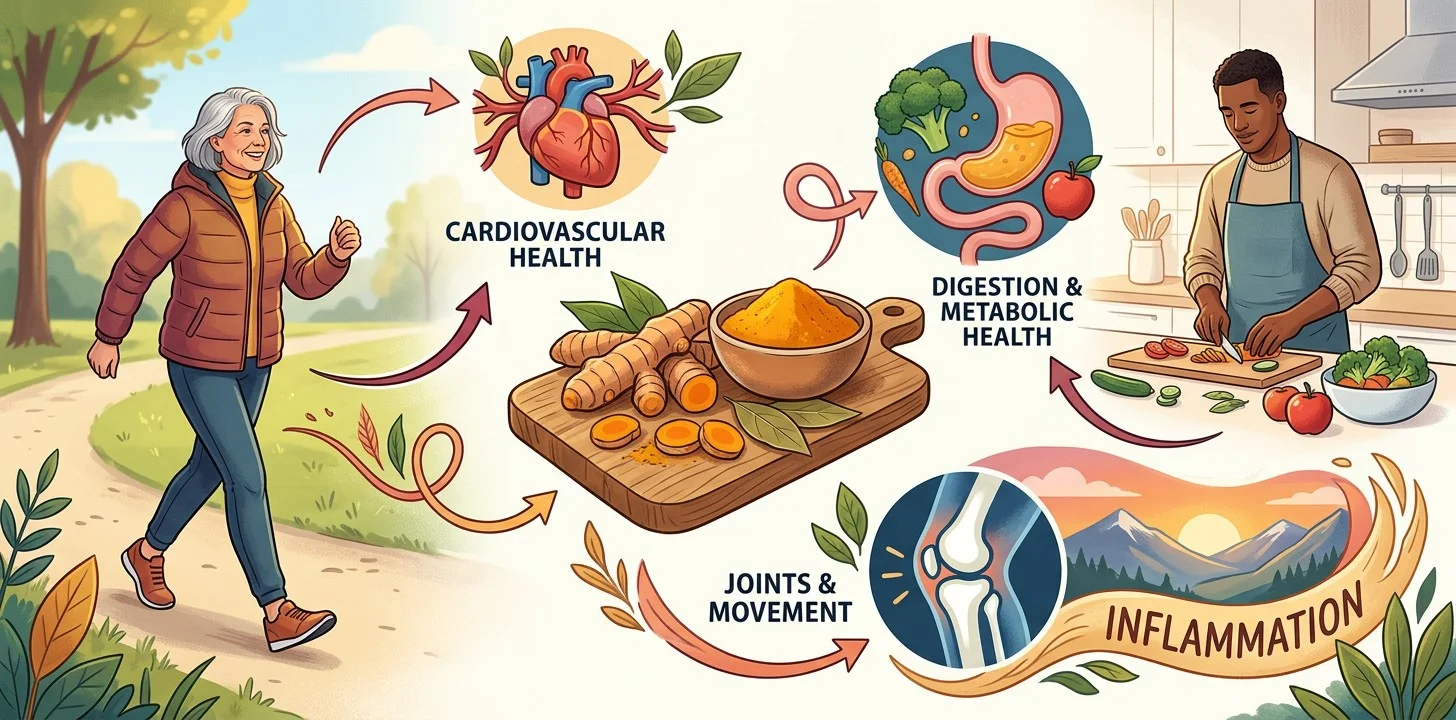
Research has looked at areas including inflammation, joint health, heart health, digestion, blood pressure, cholesterol and blood sugar.
However, the evidence is not equally strong in every area. Many studies also use concentrated turmeric extracts or curcumin supplements rather than the turmeric normally used in food.
Key Points
- Turmeric and curcumin have been studied across several areas of health.
- Research includes inflammation, joints, heart health, digestion and metabolic health.
- The strength of the evidence varies depending on the health question.
- Many clinical studies use curcumin or concentrated turmeric extracts.
- Turmeric supplements are different from using turmeric as a normal food or spice.
- Turmeric can interact with some medicines and may not be suitable for everyone.
Related Guides
Explore the different areas of turmeric and health:
- Turmeric and Heart Health — research into turmeric and cardiovascular health.
- Turmeric and Blood Pressure — what the evidence says about blood pressure.
- Turmeric and Cholesterol — research into turmeric and cholesterol levels.
- Turmeric for Digestion — turmeric and digestive health.
- Turmeric and Antioxidants — understanding turmeric and oxidative stress.
About Turmeric and Health
What? Turmeric is a plant and spice containing naturally occurring compounds called curcuminoids, including curcumin.
Who? People may be interested in turmeric because of its use in food, traditional practices or as a dietary supplement.
Where? Turmeric is used around the world in cooking and is also widely available in supplements such as capsules, tablets, powders and extracts.
When? Turmeric has a long history of traditional use, while modern scientific research continues to investigate its possible effects on health.
Why? Researchers are interested in turmeric because compounds including curcumin may interact with biological processes involved in inflammation, oxidative stress and other areas of health.
How? Turmeric can be consumed as part of food or taken in supplement form, although the formulations and quantities used in research can be very different from culinary turmeric.
| Health area | What is being studied |
| Inflammation | How curcumin may interact with inflammatory processes |
| Joint health | Joint discomfort, stiffness, movement and physical function |
| Heart health | Turmeric and curcumin in relation to cardiovascular health |
| Blood pressure | Possible effects on blood pressure and cardiovascular markers |
| Cholesterol | Cholesterol, blood lipids and related cardiovascular markers |
| Digestion | Turmeric, curcumin and digestive health |
| Blood sugar | Blood glucose and wider metabolic health |
| Antioxidants | Curcumin, antioxidant activity and oxidative stress |
| Blood thinners | Possible interactions and blood-clotting considerations |
Turmeric Health Research Areas
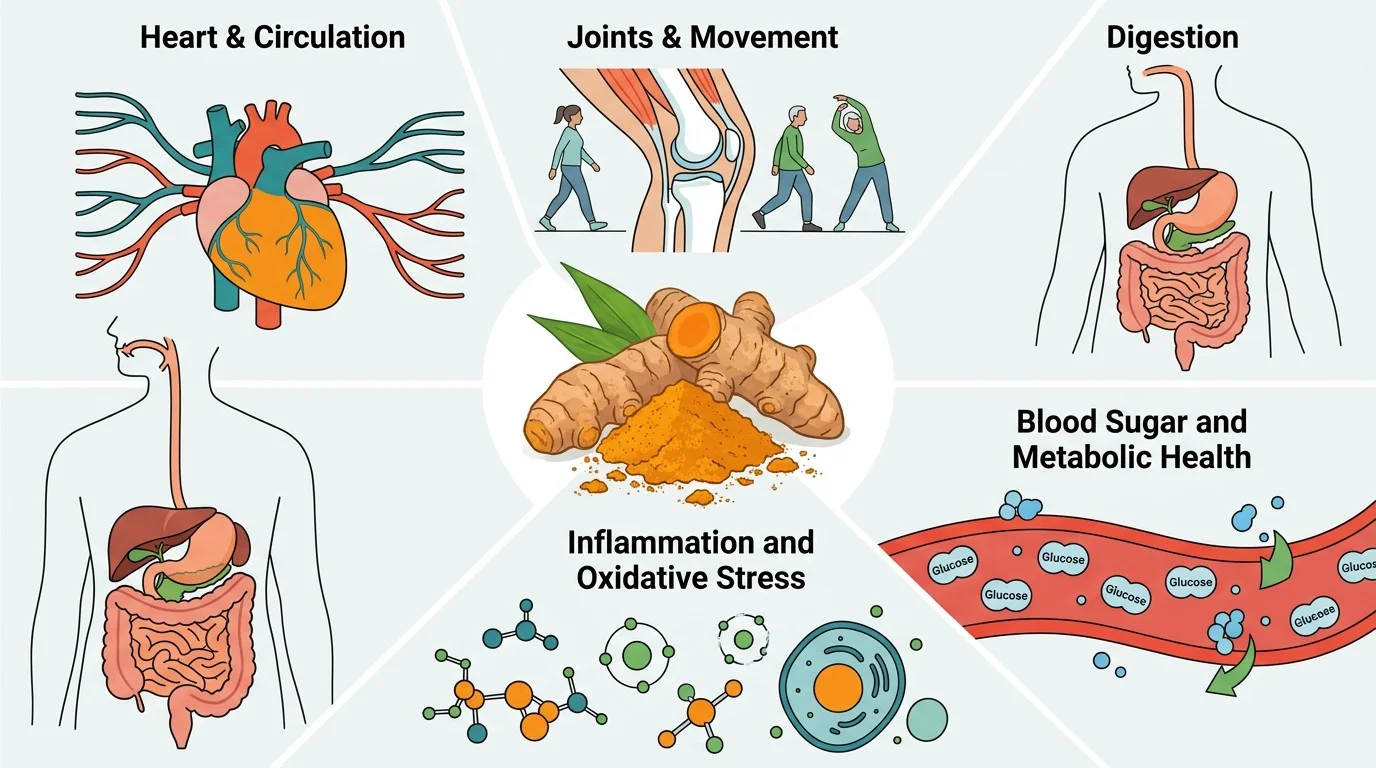
Research into turmeric and curcumin covers several areas of health, with different amounts and quality of evidence for each.
Contents
- Turmeric and Different Areas of Health
- Turmeric and Inflammation
- Turmeric and Heart Health
- Turmeric and Joint Health
- Turmeric and Digestion
- Turmeric and Blood Sugar
- Turmeric and Antioxidants
- Turmeric and Blood Thinners
- Is Turmeric the Same as Curcumin?
- How Strong Is the Evidence for Turmeric and Health?
- Turmeric in Food and Supplements
- Is Turmeric Safe?
- Frequently Asked Questions
- Summary
- Related Guides
- Further Information and Reading
- Medical disclaimer
Turmeric and Different Areas of Health
Different areas of turmeric research have different levels of evidence. The following guides explore some of the main health questions in more detail.
Turmeric and Inflammation
Inflammation is one of the main reasons researchers have become interested in curcumin. Research is investigating how curcumin may interact with processes involved in inflammation and what this could mean for human health.
Read our guide to Turmeric and Inflammation
Turmeric and Heart Health
Research into turmeric and cardiovascular health includes several different areas, including blood pressure, cholesterol and other factors associated with heart health.
Read our guide to Turmeric and Heart Health
You can also explore Turmeric and Blood Pressure and Turmeric and Cholesterol.
Turmeric and Joint Health
Turmeric and curcumin have been studied for their potential effects on joint discomfort, stiffness and physical function. Research has particularly investigated people with osteoarthritis.
Read our guide to Turmeric for Joint Pain
Turmeric and Digestion
Turmeric has a long history of use in food and traditional practices, while modern research has also investigated its relationship with digestive health.
Read our guide to Turmeric for Digestion
Turmeric and Blood Sugar
Researchers have investigated curcumin and turmeric extracts in relation to blood sugar and wider metabolic health. Research in this area should not be confused with established medical treatment.
Read our guide to Turmeric and Blood Sugar
Turmeric and Antioxidants
Curcumin is widely studied for its antioxidant properties and its relationship with oxidative stress. Our guide explains what these terms mean and what researchers are investigating.
Read our guide to Turmeric and Antioxidants
Turmeric and Blood Thinners
Turmeric isn’t only researched for potential health benefits. It is also important to understand possible interactions and safety considerations, particularly when using concentrated supplements alongside medicines.
Read our guide to Turmeric and Blood Thinners
Turmeric and Curcumin: What’s the Difference?
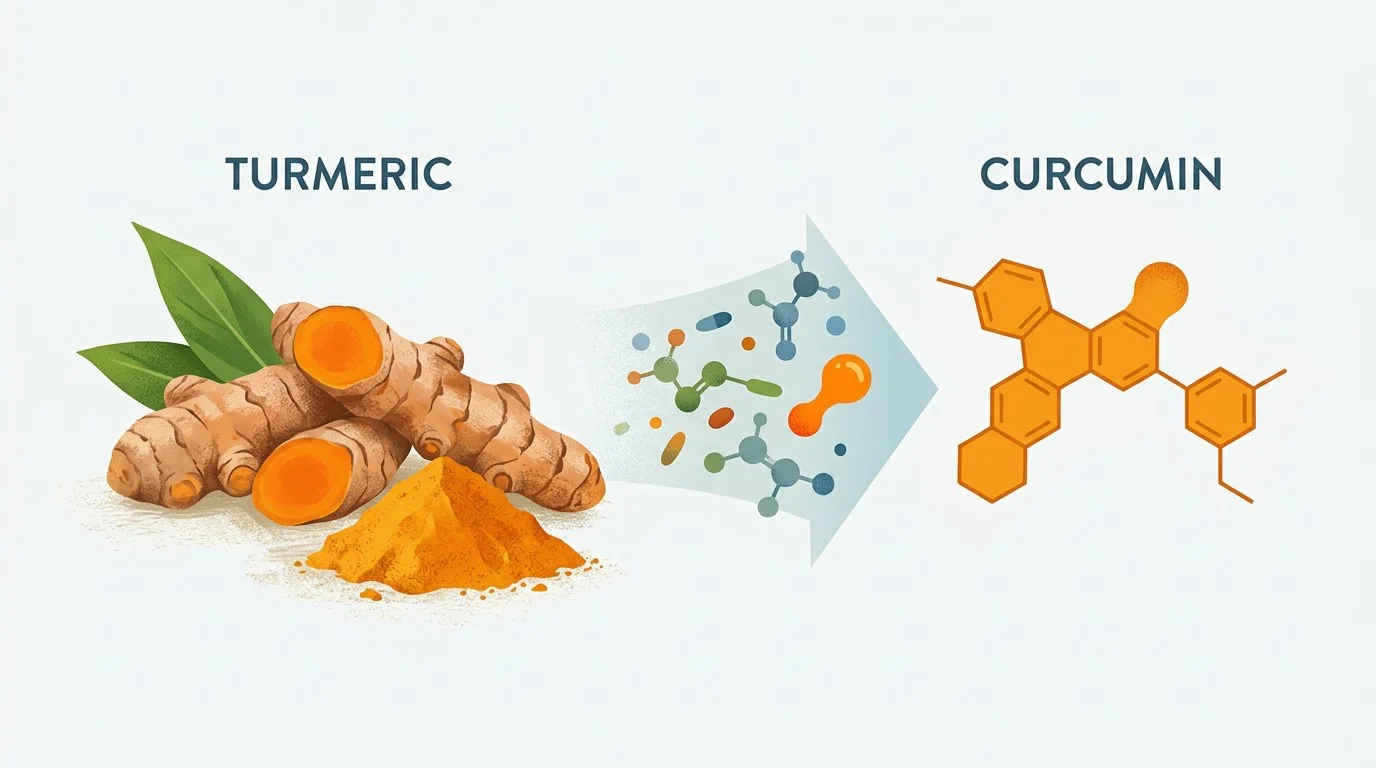
Turmeric is the whole plant and spice, while curcumin is one of several naturally occurring compounds found within turmeric.
Is Turmeric the Same as Curcumin?
No. Turmeric is the whole plant and spice, while curcumin is one of its naturally occurring compounds.
This distinction matters because much of the clinical research into turmeric and health uses curcumin or concentrated turmeric extracts, sometimes in formulations designed to increase absorption.
Research findings from these products therefore cannot automatically be applied to the turmeric used in everyday cooking.
How Strong Is the Evidence for Turmeric and Health?
There is no single answer.
Turmeric and curcumin have been investigated across many areas of health, but the amount and quality of research differs considerably between them.
Some areas have been examined in multiple clinical trials and systematic reviews. Others have much less human research available.
This is why our individual health guides look at each question separately rather than assuming that evidence for one potential effect proves another.
Turmeric in Food and Supplements
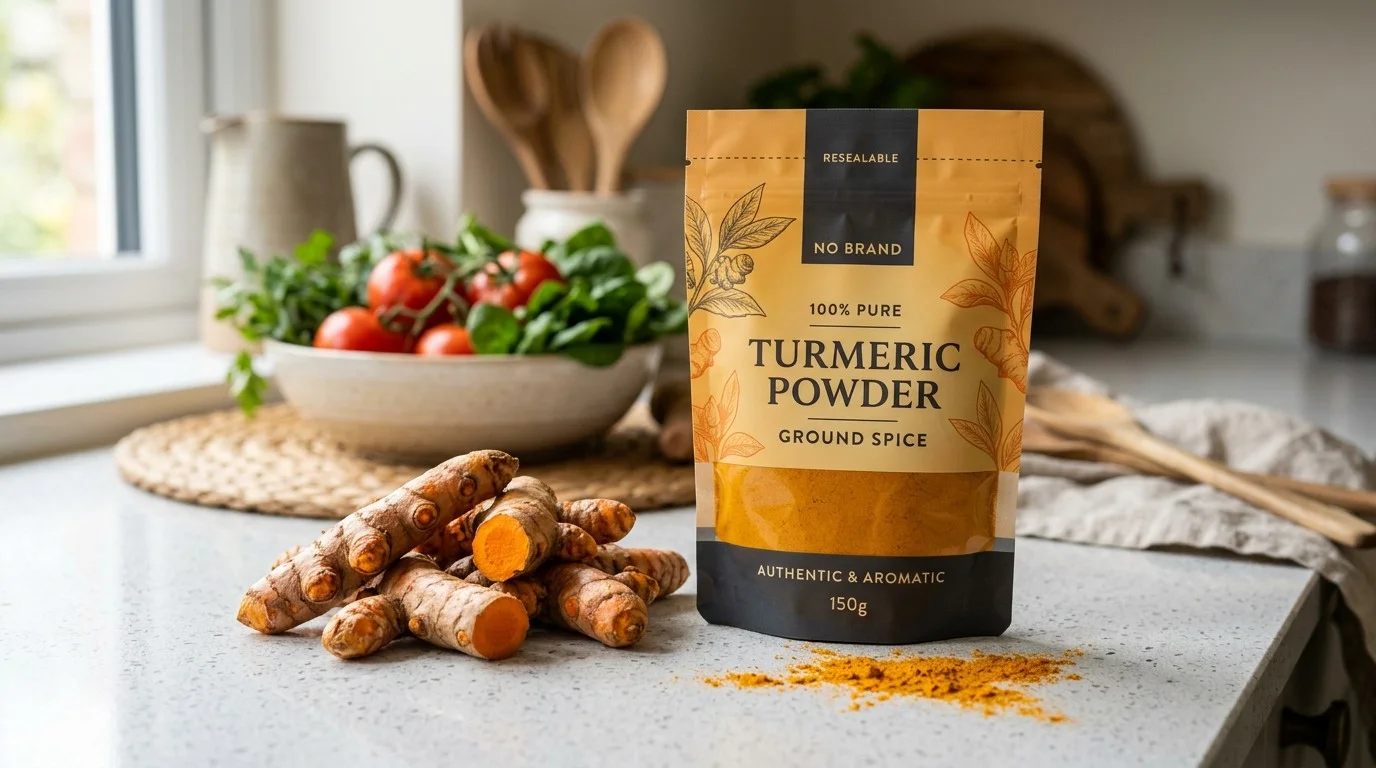
Turmeric can be used as a spice in normal food or taken in more concentrated forms such as capsules, tablets, powders and extracts.
These are not necessarily equivalent. Supplement formulations can contain very different amounts of turmeric or curcumin and may include ingredients intended to change absorption.
If you are considering supplements, our Turmeric Supplements guide explains the different forms and what to consider when comparing them.
Turmeric in Food and Supplements

Turmeric is commonly used as a food and spice and is also available in more concentrated supplement forms.
Is Turmeric Safe?
Turmeric used in normal amounts as food is different from taking concentrated turmeric or curcumin supplements.
Supplements can cause side effects in some people and may interact with medicines. Anyone with an existing health condition, taking medication, pregnant or breastfeeding should seek appropriate professional advice before using turmeric supplements for health purposes.
Frequently Asked Questions
Is Turmeric Good for Your Health?
Turmeric contains compounds that researchers are studying for a range of potential health effects. However, evidence varies considerably depending on the particular health question, and turmeric should not be viewed as a treatment for every condition.
What Is Curcumin?
Curcumin is one of the naturally occurring curcuminoids found in turmeric. It is responsible for much of turmeric’s yellow colour and is one of the compounds most extensively studied by researchers.
Is Turmeric Good for Inflammation?
Curcumin has been widely investigated for its potential effects on biological processes involved in inflammation. What this means for particular health conditions depends on the available clinical evidence.
Is Turmeric Better as Food or a Supplement?
They serve different purposes and should not be treated as interchangeable. Turmeric is commonly used as a food and spice, whereas supplements can provide much more concentrated turmeric extracts or curcumin.
Can Turmeric Interact with Medicines?
Yes, turmeric and particularly concentrated supplements may interact with some medicines. This is one reason anyone taking medication should seek professional advice before starting a turmeric or curcumin supplement.
Summary
Turmeric and curcumin are being studied across a wide range of health areas, including inflammation, joint health, cardiovascular health, digestion, blood sugar and oxidative stress.
The evidence is stronger in some areas than others, and much of the clinical research involves concentrated curcumin or turmeric extracts rather than culinary turmeric.
Use the individual health guides above to explore each topic and its available evidence in more detail.
Further Information and Reading
The following independent sources provide further information about turmeric, curcumin and health. They are included for informational purposes only and should not be considered medical advice.
1. NCCIH — Turmeric: Usefulness and Safety
The US National Center for Complementary and Integrative Health provides an independent overview of turmeric and curcumin research and safety, including what is currently known, areas where evidence remains uncertain and important considerations around supplement formulations and safety. NCCIH notes that despite substantial research, there is not currently enough evidence to reach definitive conclusions about turmeric or curcumin for health purposes.
2. PubMed — Curcumin on Human Health
This 2024 systematic review and meta-analysis brought together 103 randomised controlled trials covering 42 health outcomes and 7,216 participants. It provides a useful broad overview of research into curcumin and human health, while also showing why evidence needs to be considered separately for different outcomes and why further high-quality long-term research is still needed.
Medical Disclaimer
The information on this page is provided for general educational and informational purposes only and is not intended as medical advice, diagnosis or treatment. Speak to a qualified healthcare professional if you have questions about a medical condition, medicines or the use of turmeric or curcumin supplements.
Author
Written by J. Henderson
Health & Wellness Research Writer
J. Henderson writes evidence-based articles on nutrition, botanical supplements and everyday wellbeing. His work focuses on translating scientific research into clear, practical guidance that helps readers make informed decisions about natural health products.